MCQ
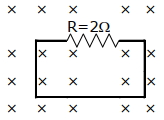
In the given figure the magnetic flux through the loop increases according to the relation $\phi_{B}(t)=10 t^{2}+20 t$, where $\phi_{B}$ is in milliwebers and $t$ is in seconds.

The magnitude of current through ${R}=2 \,\Omega$ resistor at ${t}=5\, {s}$ is $....\,{mA}$.
  • A
    $10$
  • $60$
  • C
    $180$
  • D
    $120$

Answer

Correct option: B.
$60$
b
As we know induce emf

$|\in|=\frac{{d} \phi}{{dt}}=20 {t}+20\, {mV}$

$|{i}|=\frac{|\in|}{{R}}=10 {t}+10\, {mA}$

$\text { at } {t}=5$

$\mid {i} \mid=60\, {mA}$

Need a full question paper?

Generate a complete, print-ready paper with questions like this in minutes — across 16+ boards, with answer keys.

Start Generating Free

Similar questions

The binding energy per nucleon is maximum in the case of
When a uranium isotope ${ }_{92}^{235} U$ is bombarded with a neutron, it generates ${ }_{36}^{89} Kr$, three neutrons and:
Huygen's theory of secondary waves can be used of find
Out of the following which one is a forward biased diode? 
Consider the following statements:

$I$. All isotopes of an element have the same number of neutrons.

$II$. Only one isotope of an element can be stable and non-radioactive.

$III$. All elements have isotopes.

$IV$. All isotopes of carbon can form chemical compounds with oxygen-$16$.

Choose the correct option regarding an isotope.

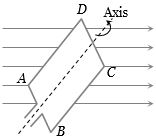
A rectangular coil $ABCD$ is rotated anticlockwise with a uniform angular velocity about the axis shown in diagram below. The axis of rotation of the coil as well as the magnetic field $B$ are horizontal. The induced $e.m.f$. in the coil would be maximum when
The first member of the Balmer series of hydrogen atom has a wavelength of $6561\; \mathring A$. The wavelength of the second member of the Balmer series (in $nm$) is
A bar magnet of magnetic moment $10^4\,J/T$ is free to rotate in a horizontal plane. The work done in rotating the magnet slowly from a direction parallel to a horizontal magnetic field of $4×10^{-5}\, T$ to a direction $ 60° $ from the field will be.....$ J$
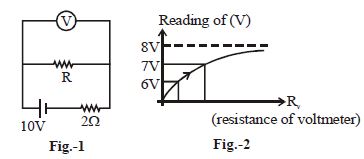
In the given figure $-1$, resistance of shown voltmeter is variable. Variation of whose reading with respect to its resistance is shown in figure $-2$. The value of $R$ is ............... $\Omega$
The work done in bringing a 20 coulomb charge from point A to point B for distance 0.2m is 2J. The potential difference between the two points will be (in volt).