Question
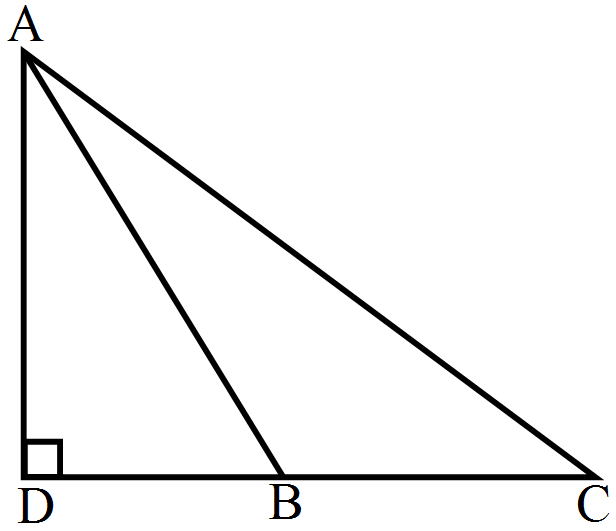
In the given figure, $\triangle\text{ABC}$ is an obtuse triangle, obtuse-angled at $B$. If $\text{AD}\perp\text{CB}$ (produced) prove that $AC^2 = AB^2+ BC^2 +2BC.BD.$
​​​​​​​

Answer


Applying Pythagoras theorem in right-angled triangle $ADC$, we get:
$AC^2= AD^2 + DC^2$
$\Rightarrow AC^2 - DC^2 = AD^2$
$\Rightarrow AD^2 = AC^2- DC^2 .....(1)$
Applying Oythagoras theorem in right-triangle $ADB,$ we get:
$AB^2 = AD^2 + DB^2$
$\Rightarrow AB^2 - DB^2= AD^2$
$\Rightarrow AD^2 = AB^2 - DB^2 .....(2)$
From equation $(1)$ and $(2)$, we have:
$AC^2 - DC^2 = AB^2 - DB^2$
$\Rightarrow AC^2 = AB^2 + DC^2 - DB^2$
$\Rightarrow AC^2 = AB^2 + (DB + BC)^2- DB^2$ $(\therefore\text{DB}+\text{BC}=\text{DC})$
$\Rightarrow AC^2 = AB^2 + DB^2 + BC^2 + 2DB.BC - DB^2$
$\Rightarrow AC^2 = AB^2 + BC^2 + 2BC.BD$
This completes the proof.

Need a full question paper?

Generate a complete, print-ready paper with questions like this in minutes — across 16+ boards, with answer keys.

Start Generating Free

Similar questions

State the SAS-similarity criterion.
If the roots of the equation $\left(a^2+b^2\right) x^2-2(a c+b d) x+\left(c^2+d^2\right)=0$ are equal, prove that $\frac{a}{b}=\frac{c}{d}$
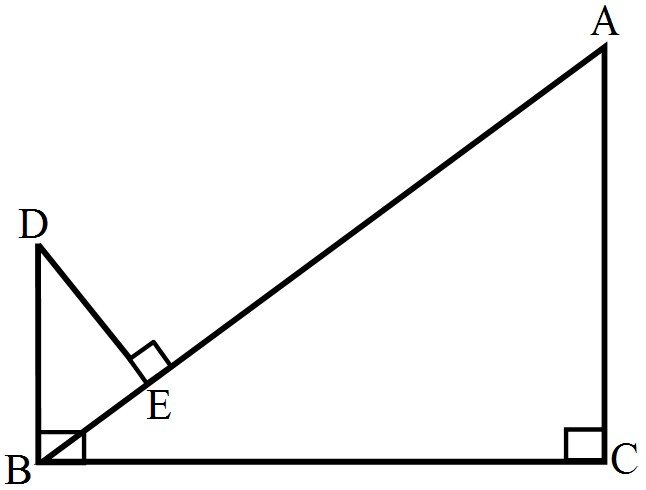
In the given figure, $\text{DB}\perp\text{BC},\text{DE}\perp\text{AB}$ and $\text{AC}\perp\text{BC}.$
Prove that $\frac{\text{BE}}{\text{DE}}=\frac{\text{AC}}{\text{BC}}.$
Given the linear equation $2x + 3y - 8 = 0$, write another linear equation in two variables such that the geometrical representation of the pair so formed is:
  1. Intersecting lines.
  2. Parallel lines.
  3. Coincident lines.
In the following table, the investment made by 210 families is shown. Present it in the form of a histogram.
Draw a right triangle ABC in which AC = AB = 4.5cm and $\angle\text{A} = 90^\circ.$ Draw a triangle similar to $\triangle\text{ABC}$ with its sides equal to $\Big(\frac{5}{4}\Big)^\text{th}$ of the corresponding sides of $\triangle\text{ABC}.$
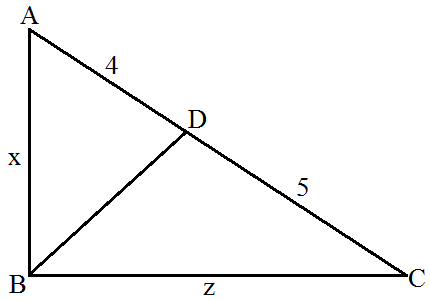
In the figures given below, an altitude is drawn to the hypotenuse by a right-angled triangle. The length of different line-segment are marked in figure. Determine $x, y, z$ in case.
Find the next five terms of the following sequences given:
$a_1 = 4, a_n = 4a_{n-1} + 3, n > 1.$
On an environment day, students in a school planted 120 trees under plantation project. The information regarding the project is shown in the following table. Show it by a pie diagram.
Prove the following identities:
$\frac{\tan\theta}{(1-\cot\theta)}+\frac{\cot\theta}{(1-\tan\theta)}=(1+\sec\theta\text{ cosec }\theta)$