Question
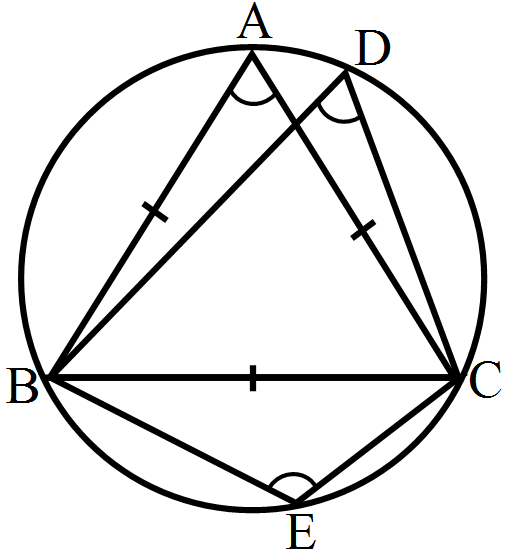
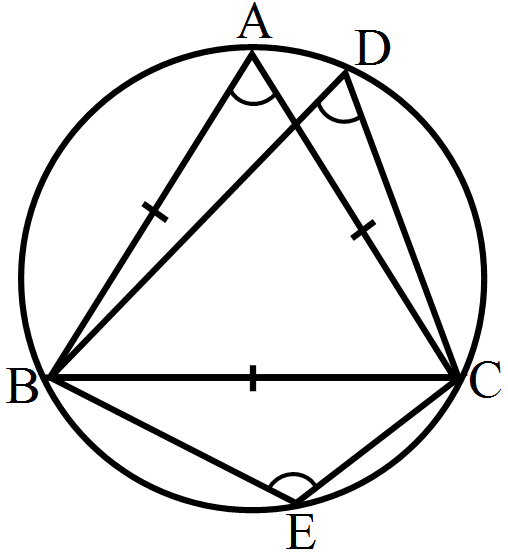
In the given figure, $\triangle\text{ABC}$ is equilateral. Find
  1. $\angle\text{BDC}$
  2. $\angle\text{BEC}$

Answer

  1. Given: $\triangle\text{ABC}$ is an equilateral triangle
i.e., each of its angle = 60°

$\Rightarrow\ \angle\text{BAC}=\angle\text{ABC}=\angle\text{ACB}=60^\circ$

Angles in the same segment of a circle are equal.

$\text{i.e.},\angle\text{BDC}=\angle\text{BAC}=60^\circ$

$\therefore\ \angle\text{BDC}=60^\circ$
  1. The opposite angles of a cyclic quadrilateral are supplementary.
Then in cyclic quadrilateral ABEC, we have:

$\angle\text{BAC}+\angle\text{BEC}=180^\circ$

$\Rightarrow\ 60^\circ+\angle\text{BEC}=180^\circ$

$\Rightarrow\ \angle\text{BEC}=(180^\circ-60^\circ)=120^\circ$

$\therefore\ \angle\text{BDC}=60^\circ$ and $\angle\text{BEC}=120^\circ$

Need a full question paper?

Generate a complete, print-ready paper with questions like this in minutes — across 16+ boards, with answer keys.

Start Generating Free

Similar questions

Ravish tells his doughter Aarushi, "Seven years ago, I was seven times as old as you were then. Also, three years from now, I shall be three times as old as you will be".. lf present ages of Aarushi and Ravish are x and y years respectively, represent this situation algebraically as well as graphically.
Prove the following two theorems for two congruent circles : Congruent chords in congruent circles are equidistant from their respective centres.
Mr. Sayyad kept ₹ 40,000 in a bank at 8% compound interest for 2 years. Mr. Fernandes invested ₹ 1,20,000 in a mutual fund for 2 years. After 2 years, Mr. Fernandes got ₹ 1,92,000. Whose investment turned out to be more profitable?
In the given figure, ABC is an equilateral triangle; PQ || AC and AC is produced to R such that CR = BP. Prove that QR bisects PC.
Aarushi was driving a car with uniform speed of 60km/ h. Draw distance-time graph. From the graph, find the distance travelled by Aarushi in:
  1. $2\frac{1}{2}\text{ Hours}$
  2. $\frac{1}{2}\text{ Hour}$
Draw the graphs of the linear equations 4x - 3y + 4 = 0 and 4x + 3y - 20 = 0. Find the area bounded by these lines and x-axis.
Nikhil spent 5% of his monthly income on his children’s education, invested 14% in shares, deposited 3% in a bank and used 40% for his daily expenses. He was left with a balance of ₹ 19,000. What was his income that month?
1. Divide $p(x) = 3x^2 + x + 7 by x + 2.$ Find the remainder.
2. Find the value of $p(x) = 3x^2 + x + 7 $ when $x = – 2.$
3. See whether remainder obtained by division is same as the value of $p(-2)$. Take one more example and verify.
If the co-ordinate of A is x and that of B is . y, find d(A, B).
i. x = 1, y = 7
ii. x = 6, y = -2
iii. x = -3, y = 7
iv. x = -4, y = -5
v. x = -3, y = -6
vi. x = 4, y = -8
If ABC and BDE are two equilateral triangles such that D is the mid-point of BC, then find $\text{ar}(\triangle\text{ABC}) : \text{ar}(\triangle\text{BDE}).$