Question 15 Marks
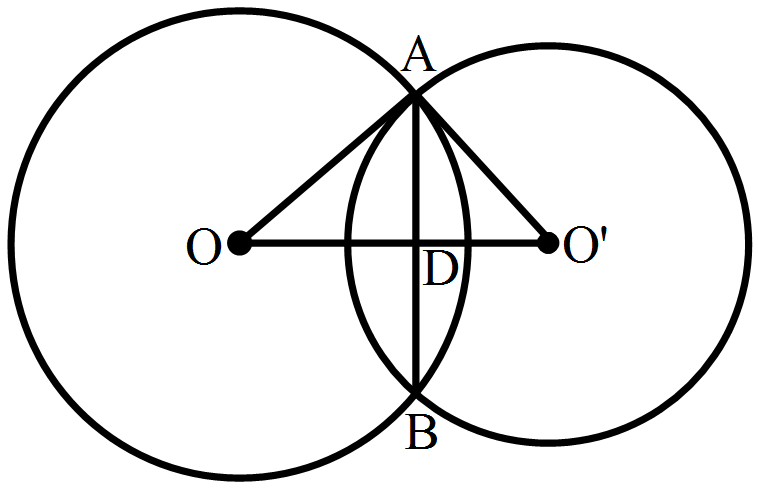
Two circles with centres O and O' intersect at two points A and B. A line PQ is drawn parallel to OO' through A or B, intersecting the circles at P and Q. Prove that PQ = 2OO'.
Answer
View full question & answer→Given: Two circles with centres O and O' intersect at two points A and B. 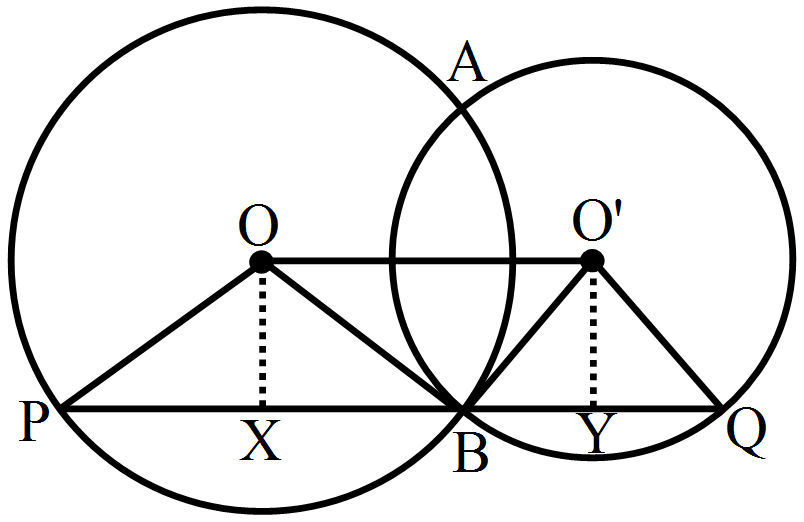 Draw a line PQ parallel to OO' through B, OX perpendicular to PQ, O'Y perpendicular to PQ, join all. We know that perpendicular drawn from the centre to the chord, bisects the chord.$\therefore$ PX = XB and YQ = BY
$\therefore$ PX + YQ = XB + BY
On adding XB + BY on both sides, we get PX + YQ + XB + BY = 2(XB + BY) ⇒ PQ = 2(XY) ⇒ PQ = 2(OO') Hence, PQ = 2OO'
Draw a line PQ parallel to OO' through B, OX perpendicular to PQ, O'Y perpendicular to PQ, join all. We know that perpendicular drawn from the centre to the chord, bisects the chord.$\therefore$ PX = XB and YQ = BY$\therefore$ PX + YQ = XB + BY
On adding XB + BY on both sides, we get PX + YQ + XB + BY = 2(XB + BY) ⇒ PQ = 2(XY) ⇒ PQ = 2(OO') Hence, PQ = 2OO'
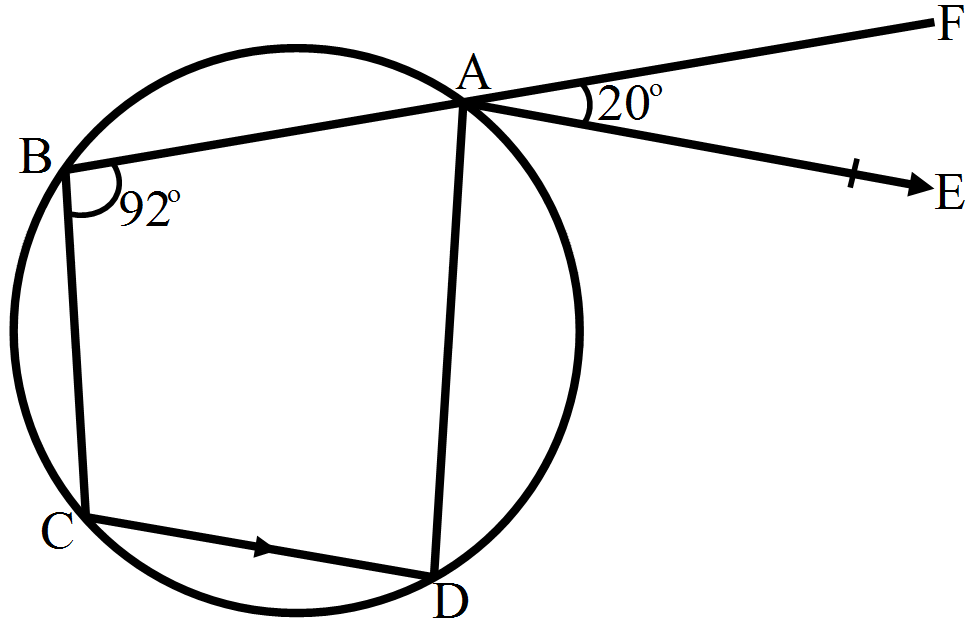
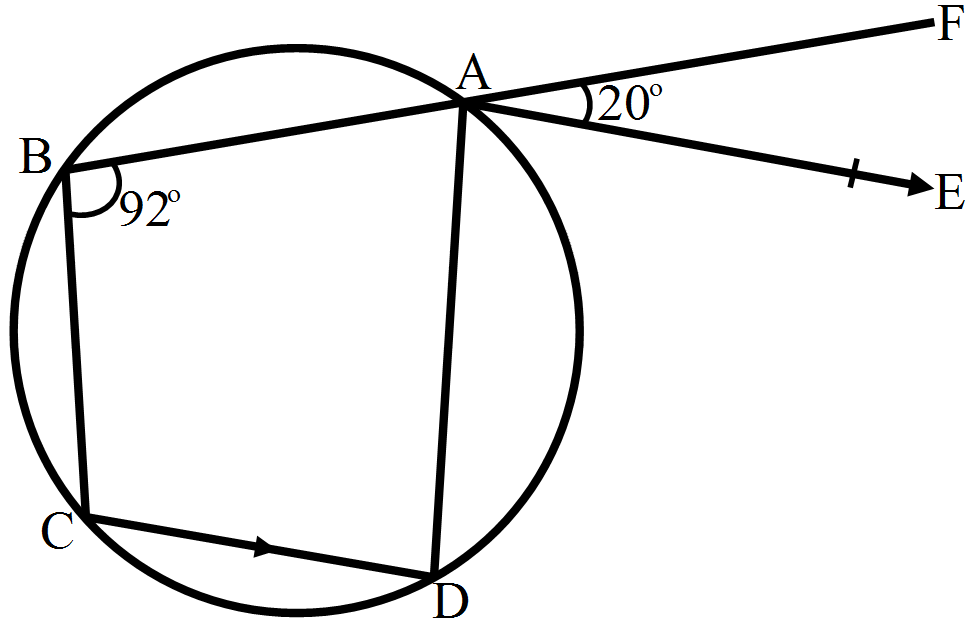 Given: ABCD is a cyclic quadrilateral. Then $\angle\text{ABC}+\angle\text{ADC}=180^\circ$$\Rightarrow\ 92^\circ+\angle\text{ADC}=180^\circ$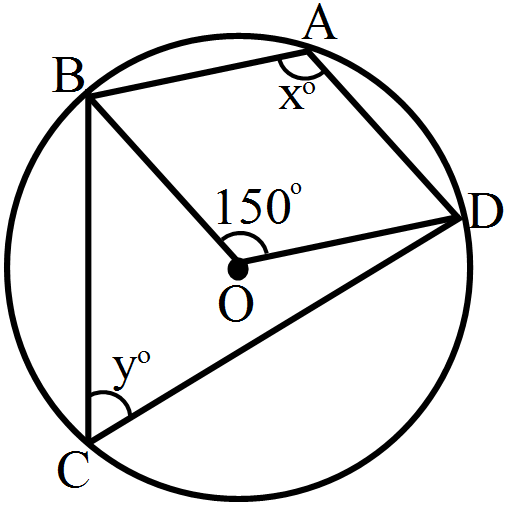
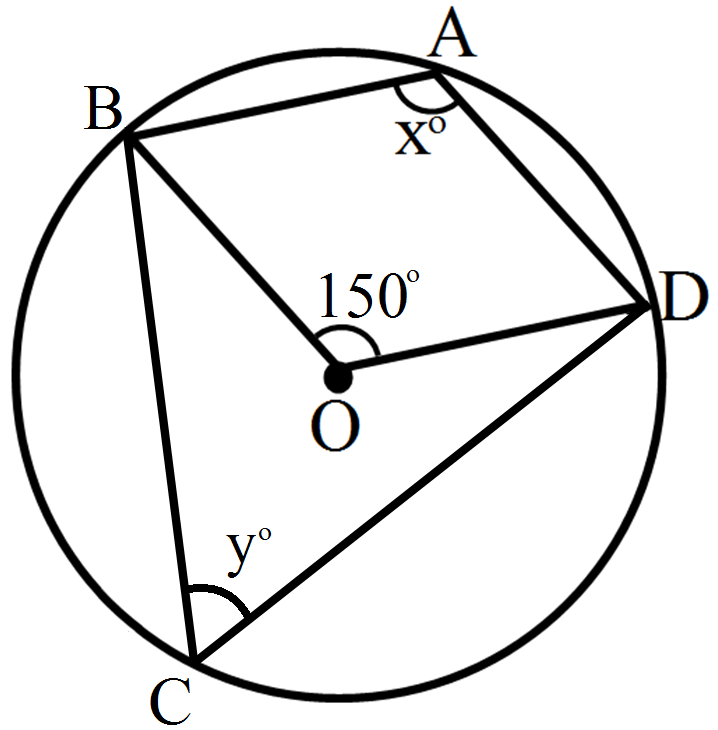 Now,$\text{x}=\frac{1}{2}(\text{reflex}\angle\text{BOD})$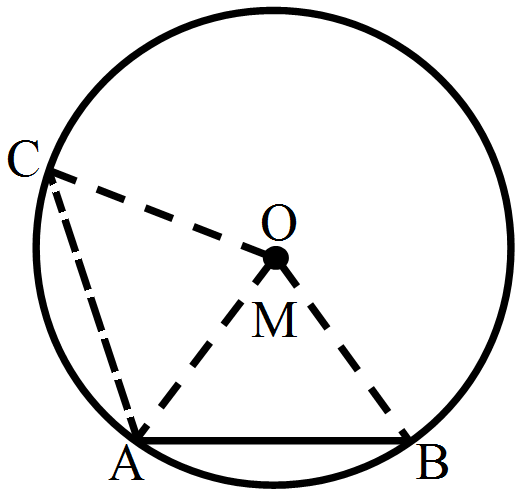
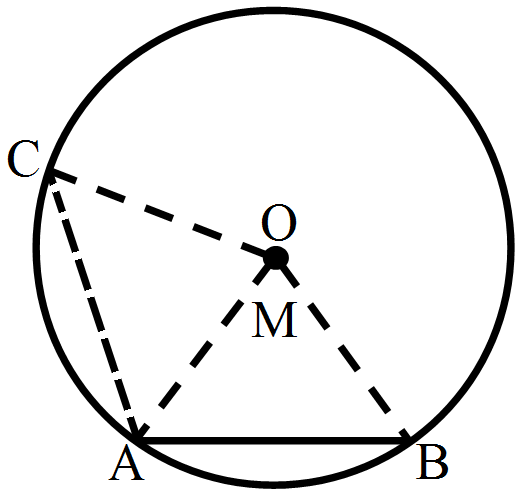 To prove: $\angle\text{OAB}=\angle\text{OAC}$ Construction: Join OA, OB and OC. Proof: In $\triangle\text{OAB}$ and $\triangle\text{OAC},$ we have: AB = AC (Given) OA = OA (Common) OB = OC (Radii of a circle)$\therefore\ \triangle\text{OAB}\cong\triangle\text{OAC}$ (By SSS congruency rule)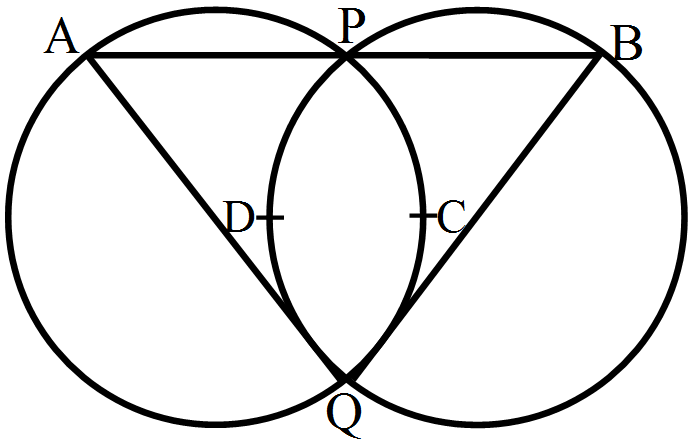
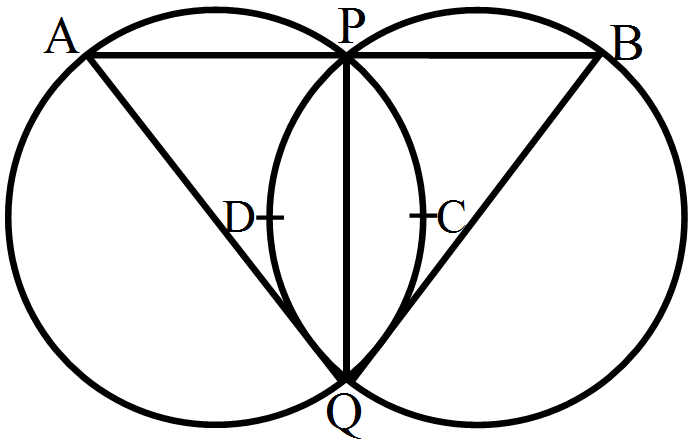 Proof: Two circles will be congruent if and only if they have equal radii. Here, PQ is the common chord to both the circles. Thus, their corresponding arcs are equal (if two chords of a circle are equal, then their corresponding arcs are congruent). So, arc PCQ = arc PDQ$\therefore\ \angle\text{QAP}=\angle\text{QBP}$ (Congruent arcs have the same degree in measure)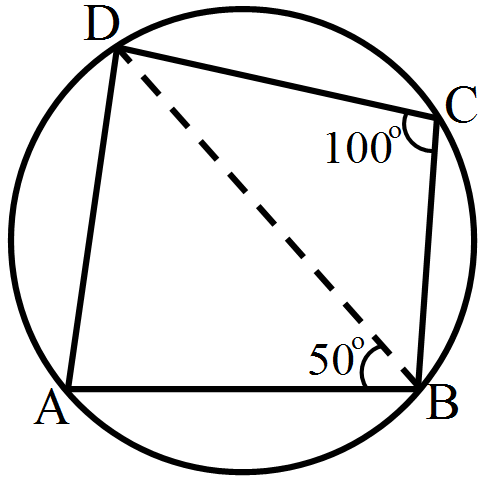
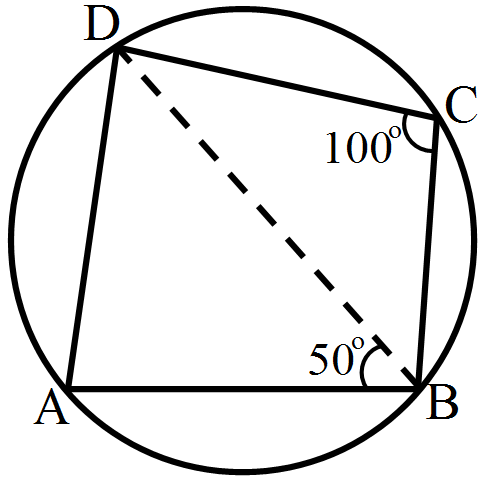 Now, in $\triangle\text{ABD},$ we have:$\angle\text{A}+\angle\text{ABD}+\angle\text{ADB}=180^\circ$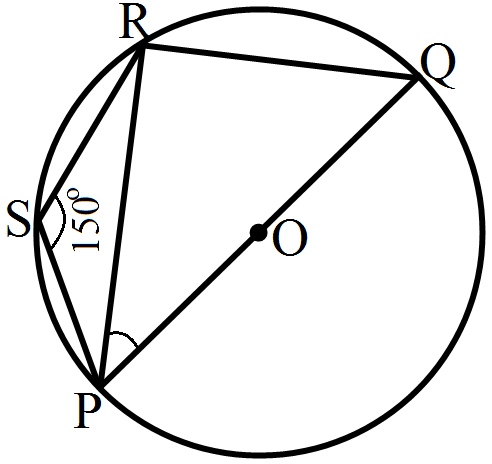
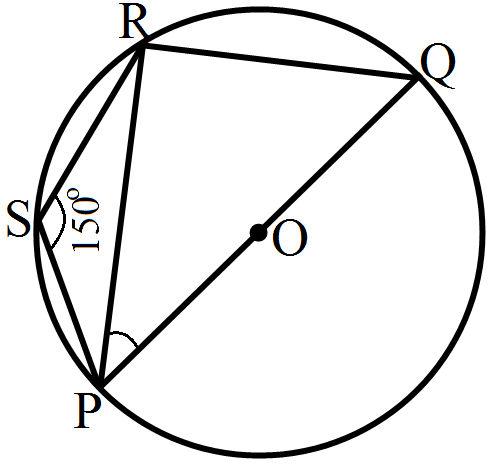 In cyclic quadrilateral PQRS, we have:$\angle\text{PSR}+\angle\text{PQR}=180^\circ$
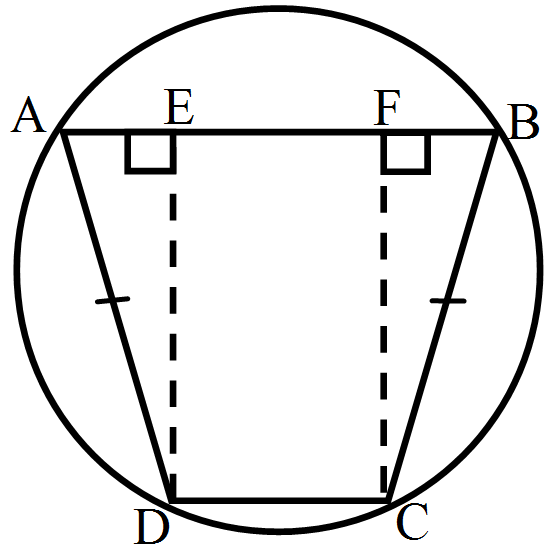
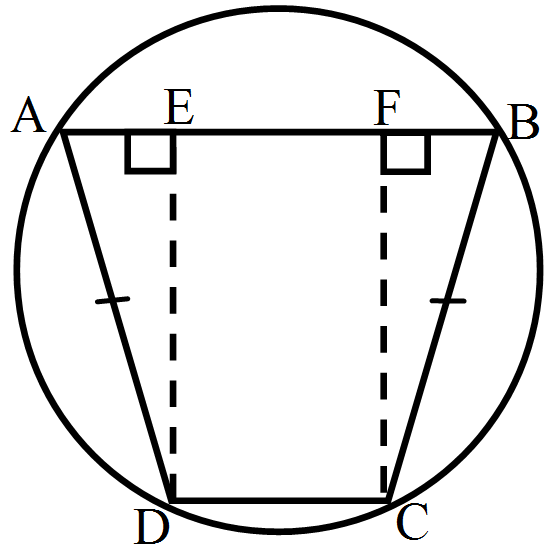 ABCD is a quadrilateral in which AD = BC and $\angle\text{ADC}=\angle\text{BCD}.$ Draw $\text{DE}\perp\text{AB}$ and $\text{CF}\perp\text{AB}.$ In $\triangle\text{ADE}$ and $\triangle\text{BCF},$ we have:$\angle\text{ADE}=\angle\text{ADC}-90^\circ=\angle\text{BCD}-90^\circ=\angle\text{BCF}$ $[$given: $\angle\text{ADC}=\angle\text{BCD}]$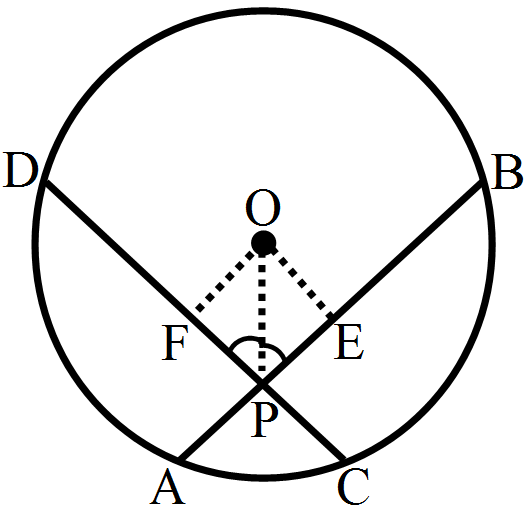
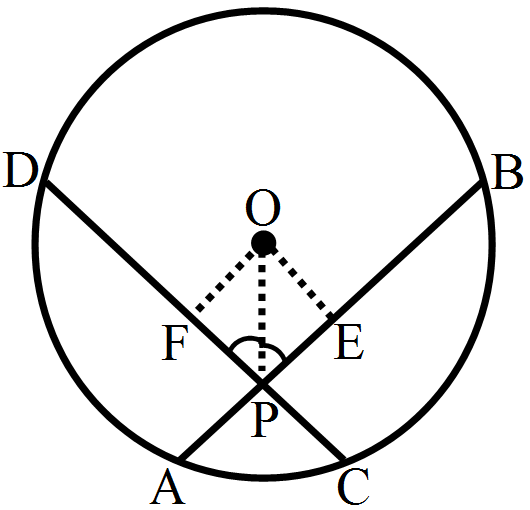 Given: O is the centre of a circle in which chords AB and CD intersect. at P such that PO bisects $\angle\text{BPD}.$ To prove: AB = CD Construction: Draw $\text{OE}\perp\text{AB}$ and $\text{OF}\perp\text{CD}.$ Proof: In $\triangle\text{OEP}$ and $\triangle\text{OFP},$ we have:$\angle\text{OEP}=\angle\text{OFP}$ [90° each]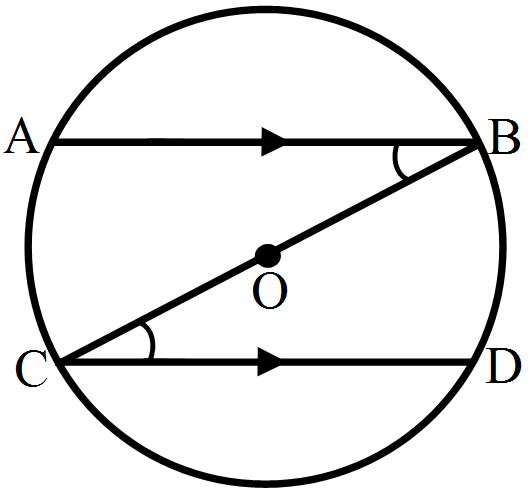
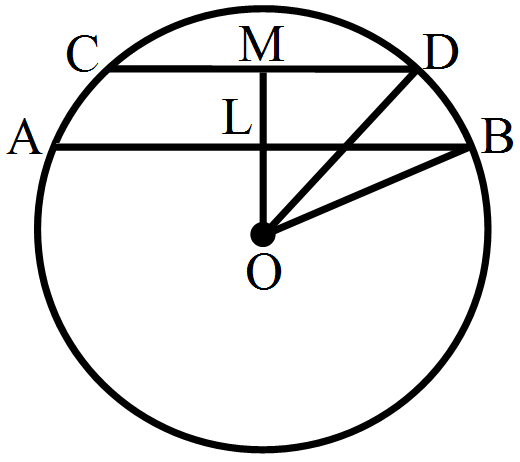
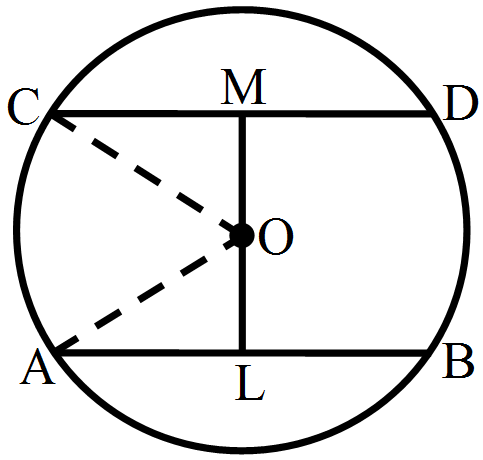
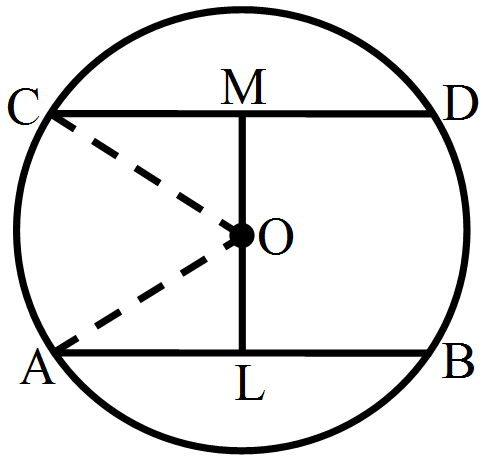
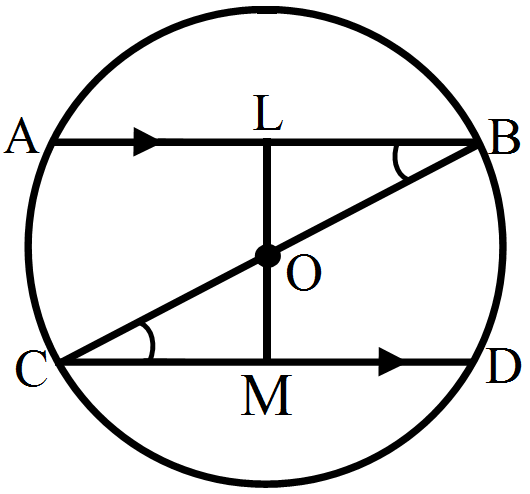 Proof: In $\triangle\text{OLB}$ and $\triangle\text{OMC},$ we have:$\angle\text{OLB}=\angle\text{OMC}$ [ 90° each]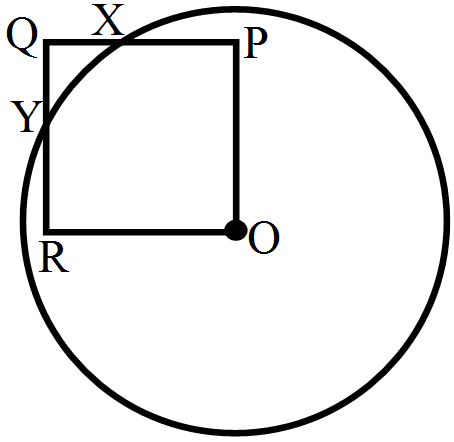
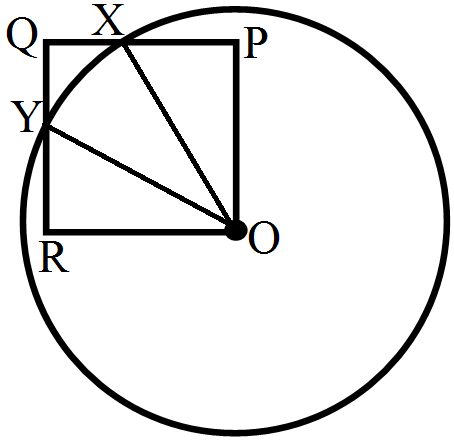 Proof: In $\triangle\text{OXP}$ and $\triangle\text{OYP},$ we have:$\angle\text{OPX}=\angle\text{ORY}$ (90° each)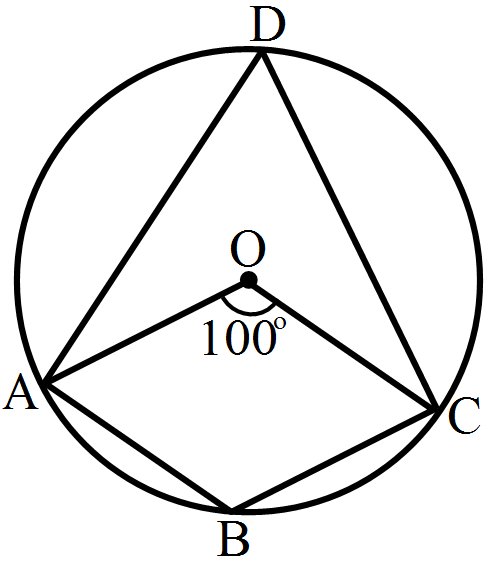
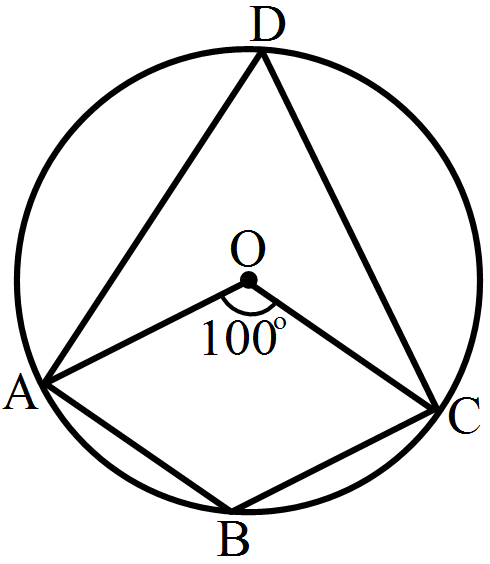 We know that the angle subtended by an arc is twice the angle subtended by it on the circumference in the alternate segment. Thus, $\angle\text{AOC}=2\angle\text{ADC}$$\Rightarrow\ 100^\circ=2\angle\text{ADC}$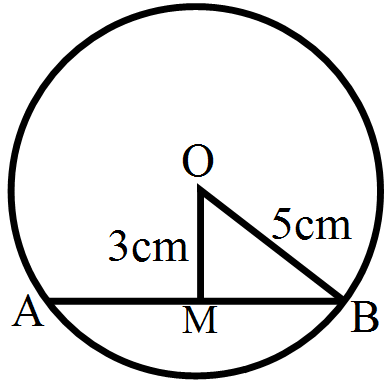
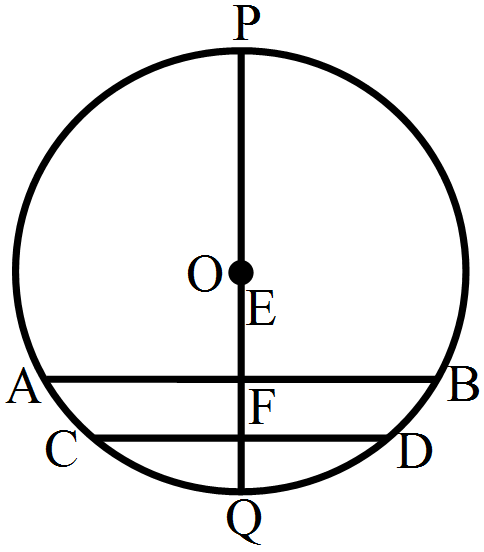 Given: AB and CD are two parallel chords of a circle with centre O. POQ is a diameter which is perpendicular to AB. To prove: $\text{PF}\perp\text{CD}$ and CF = FD Proof: AB || CD and POQ is a diameter.$\angle\text{PEB}=90^\circ$ [Given]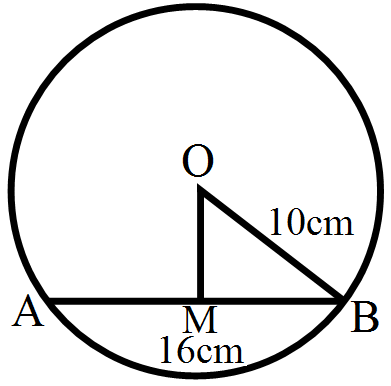
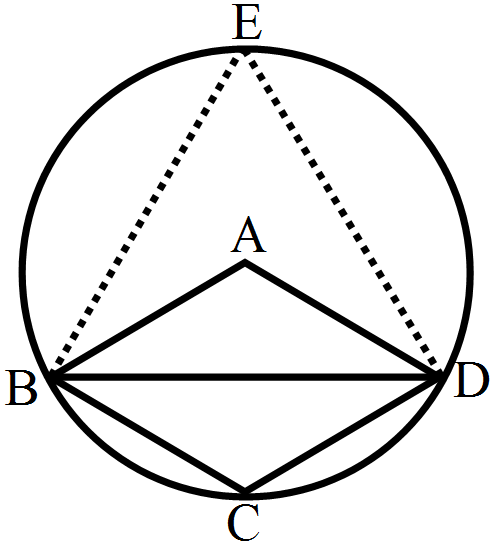 Construction: Take a point E on the circle. Join BE, DE and BD. We know that the angle subtended by an arc of a circle at its centre is twice the angle subtended by the same arc at a point on the circumference.$\Rightarrow\ \angle\text{BAD}=2\angle\text{BED}$
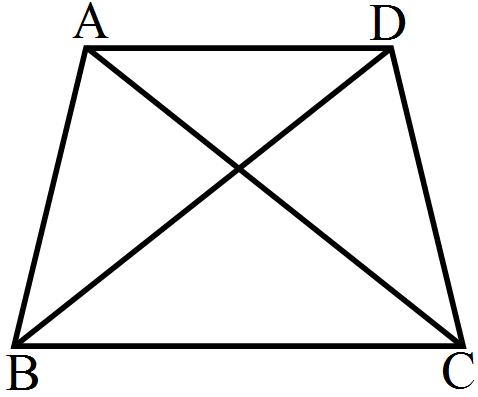 Then D is the required point BD and CD. In $\triangle\text{ABC}$ and $\triangle\text{DCB}$ AB = DC AC = DB BC = CB [Common]$\therefore\ \triangle\text{ABC}\cong\triangle\text{DCB}$ [By SSS]
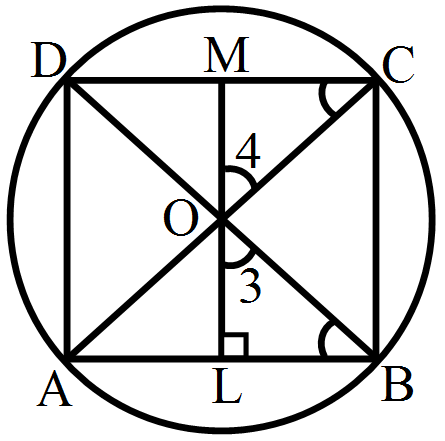 To prove: CM = MD Proof:$\angle\text{1}=\angle\text{2}$ [angles in the same segment]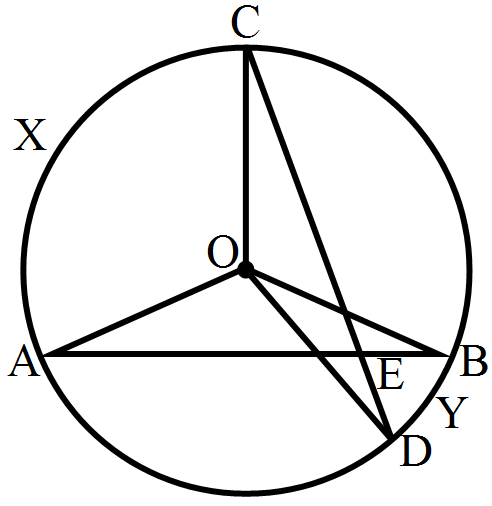
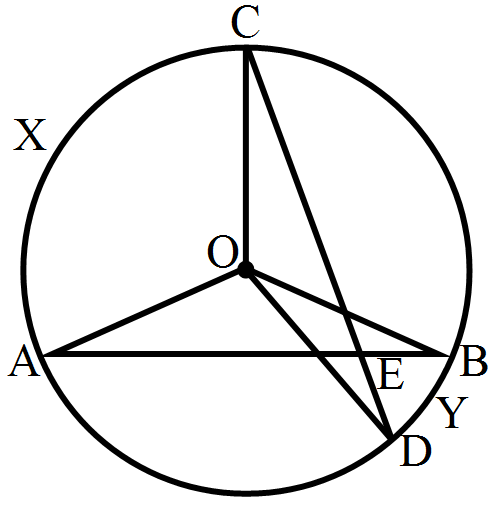 We know that the angle subtended by an arc of a circle at the centre is double the angle subtended by it on the remaining part of the circle. Here, arc AXC subtends $\angle\text{AOC}$ at the centre and $\angle\text{ADC}$ at D on the circle.$\therefore\ \angle\text{AOC}=2\angle\text{ADC}$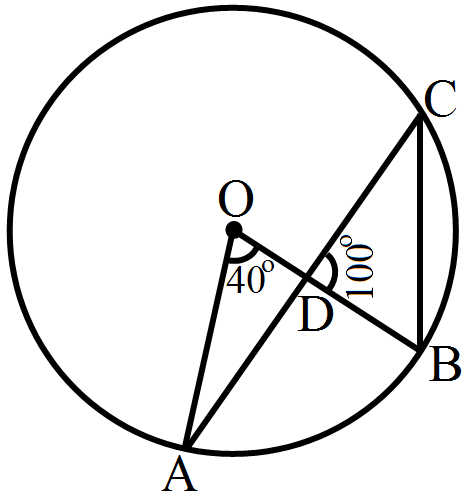
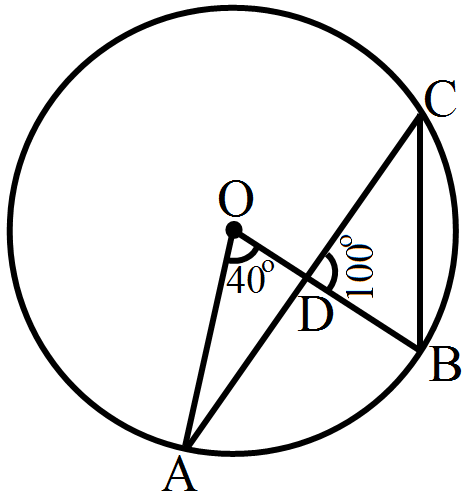 We know that the angle subtended by an arc of a circle at the centre is double the angle subtended by the arc at any point on the circumference.$\angle\text{AOB}=2\angle\text{ACB}$
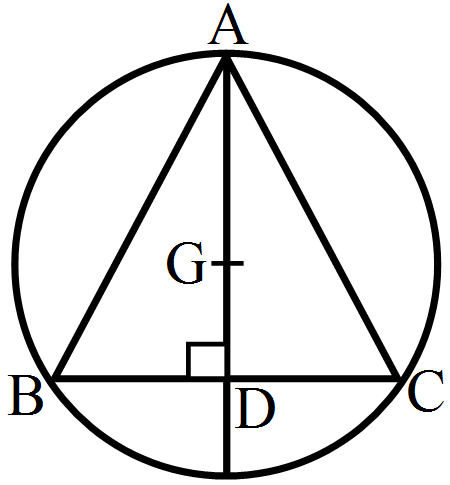 Then, $\text{AD}\perp\text{BC}$ $[\triangle\text{ABC}$ is an equilateral triangle$]$ Also,$\text{BD}=\Big(\frac{\text{BC}}{2}\Big)=\Big(\frac{9}{2}\Big)=4.5\text{cm}$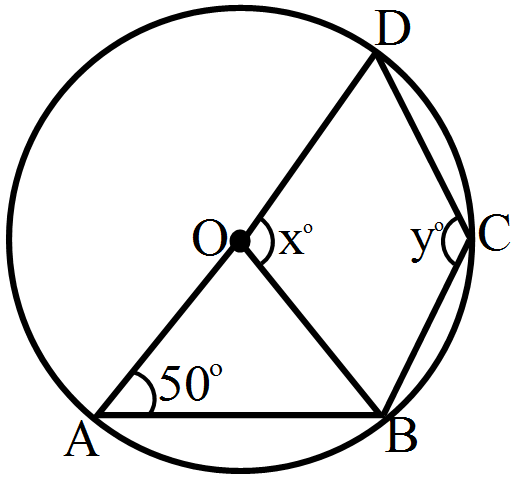
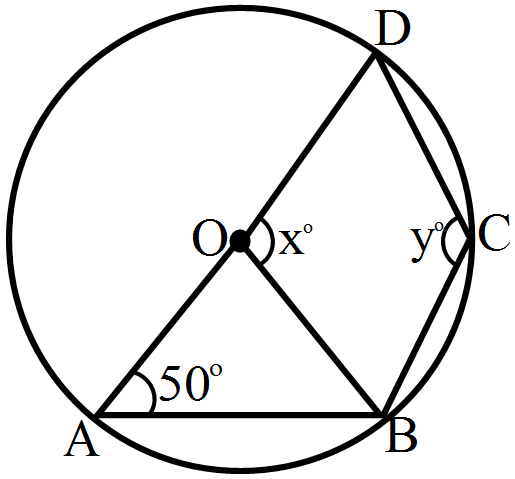 O is the centre of the circle and $\angle\text{DAB}=50^\circ.$ OA = OB [Radii of a circle]$\Rightarrow\ \angle\text{OBA}=\angle\text{OAB}=50^\circ$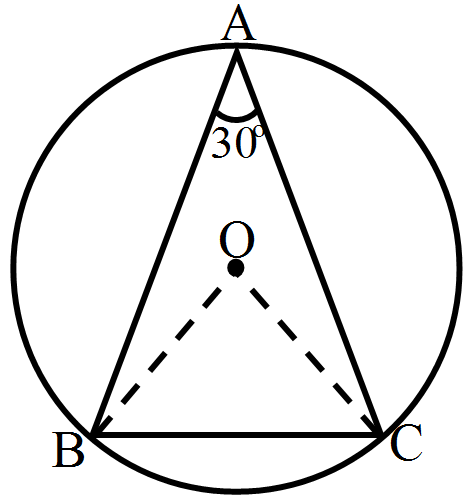
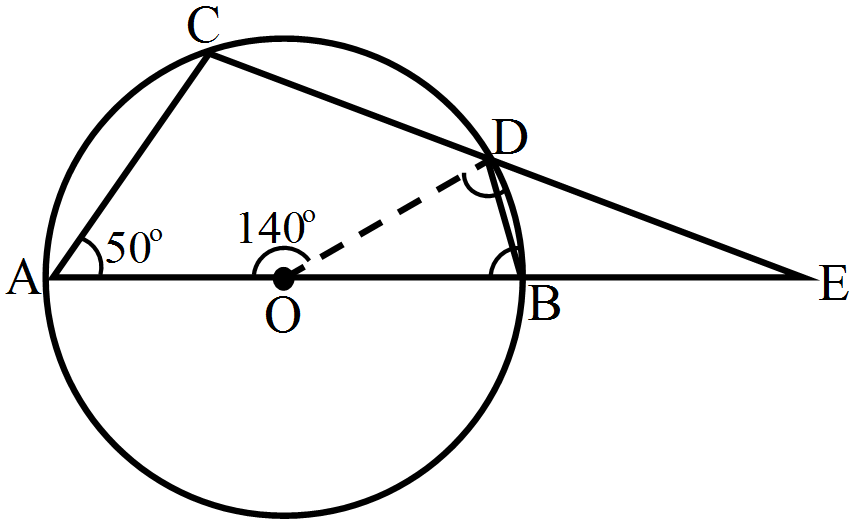
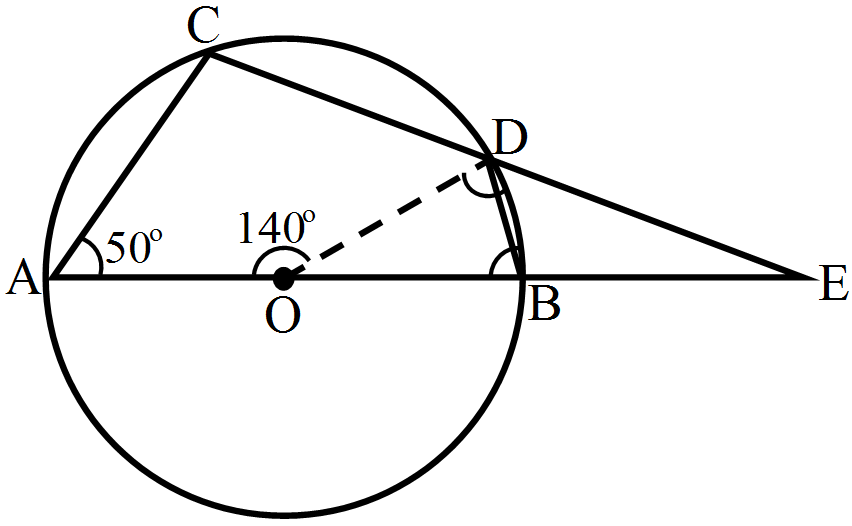
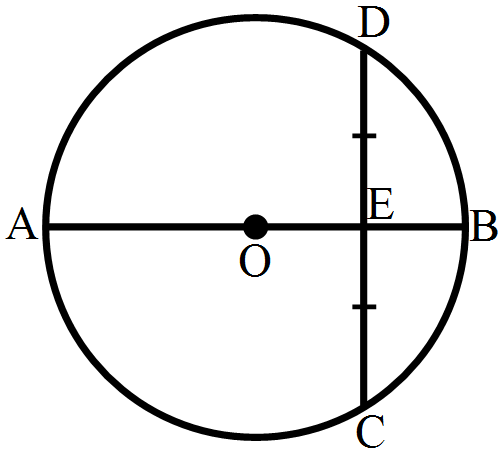
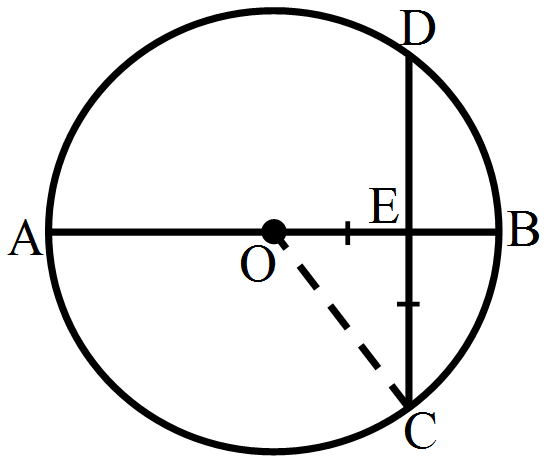
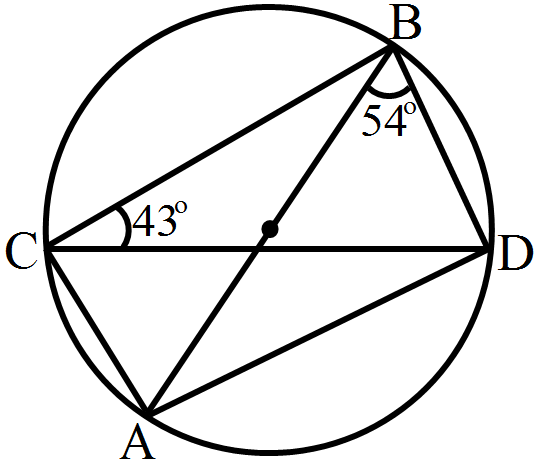
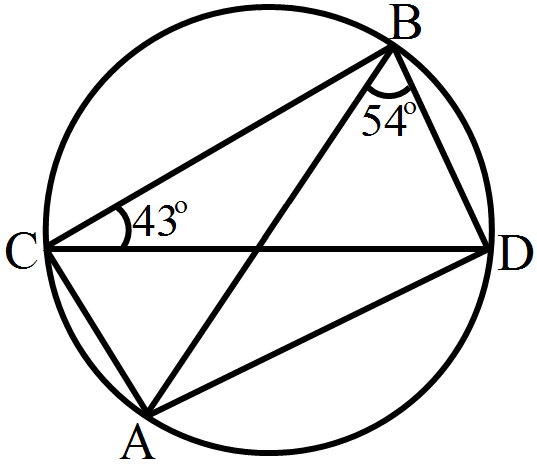
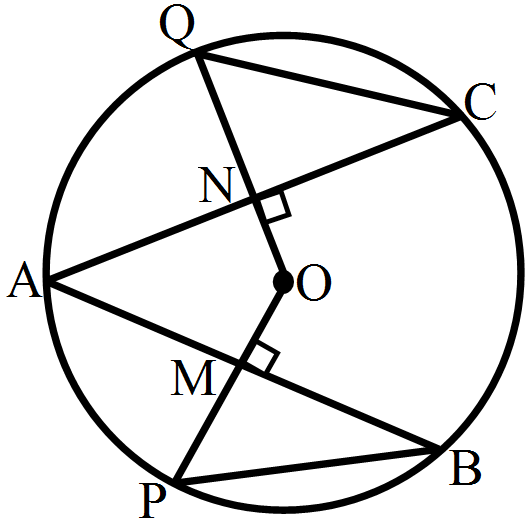
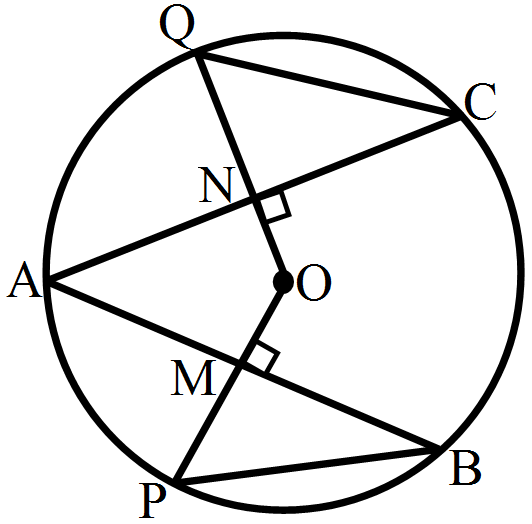 To prove: PB = QC Proof: AB = AC (Given)$\Rightarrow\ \frac{1}{2}\text{AB}=\frac{1}{2}\text{AC}$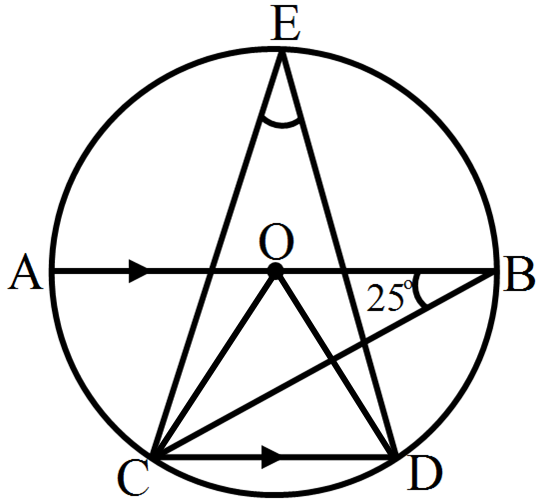
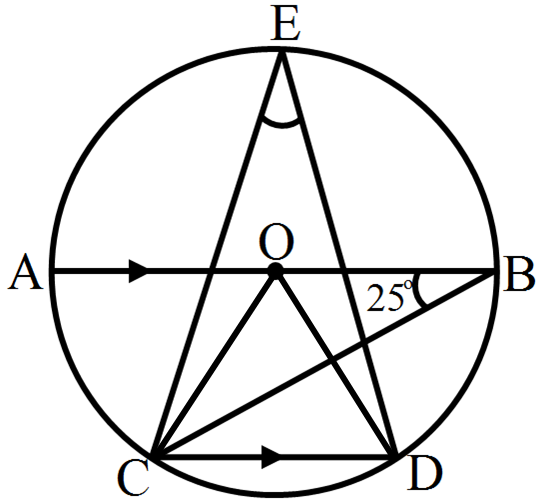 $\angle\text{BCD}=\angle\text{ABC}=25^\circ$ [Alternate angles]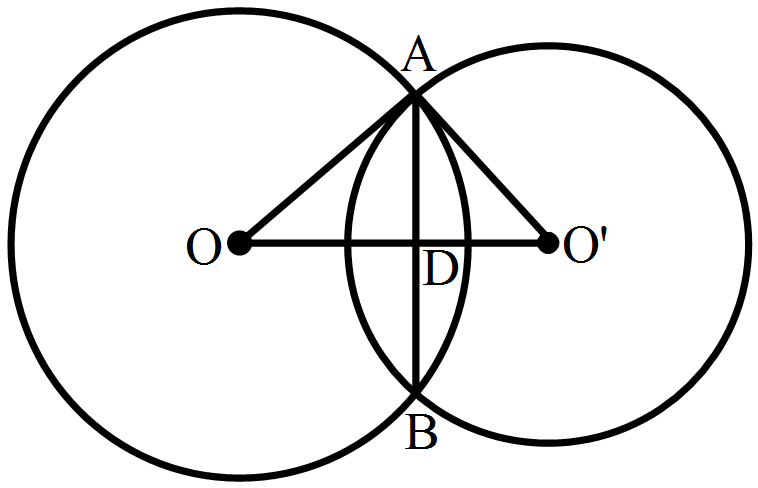
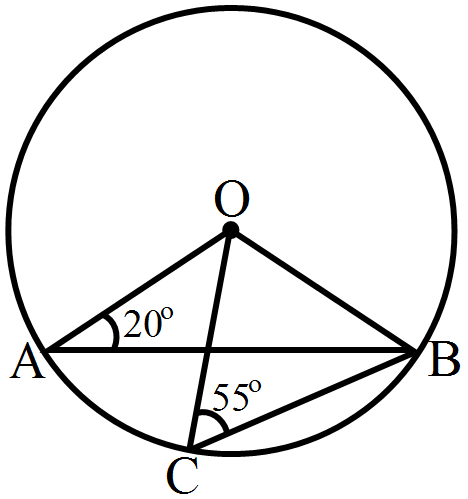
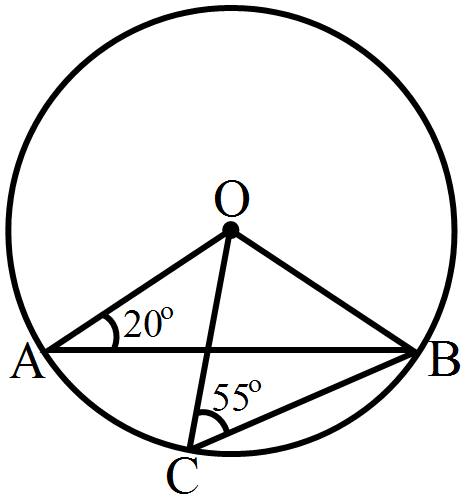
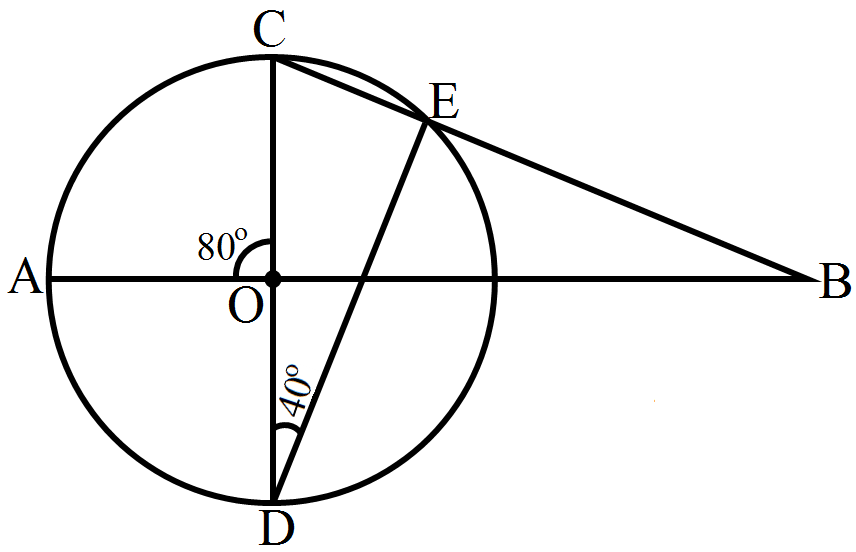
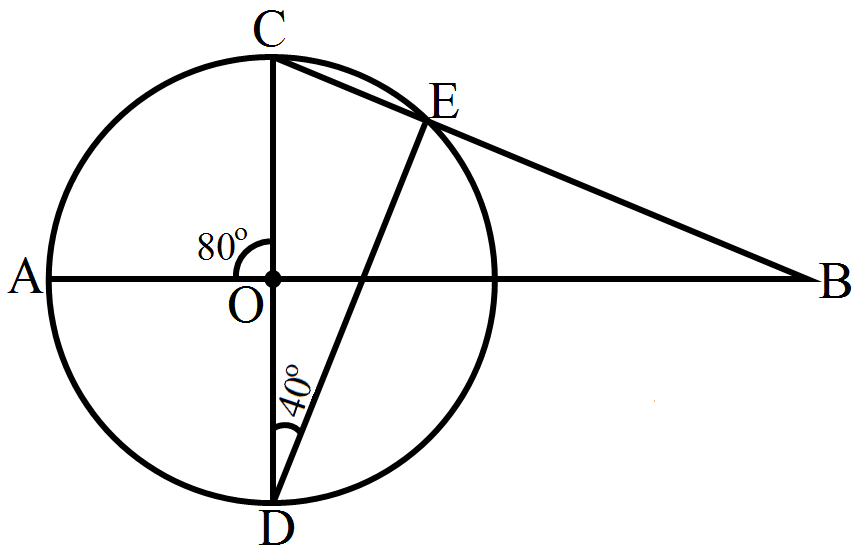
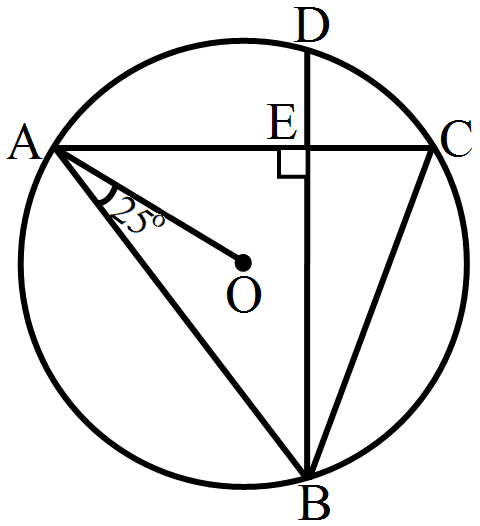
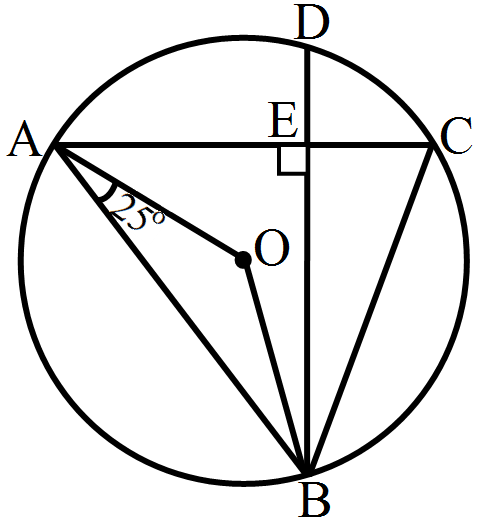 Now in $\triangle\text{OAB},$ we have:$\angle\text{OAB}+\angle\text{OBA}+\angle\text{AOB}=180^\circ$ [Angle sum property of a triangle]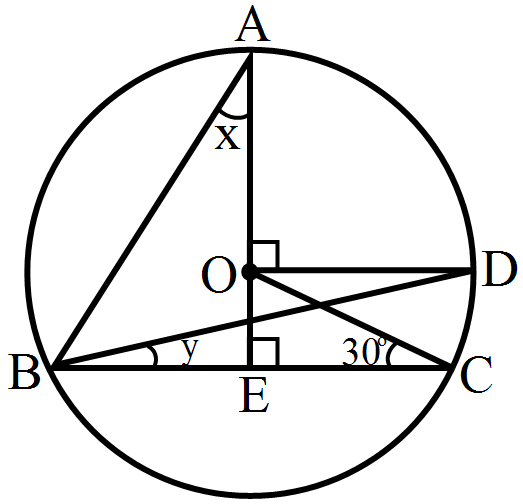
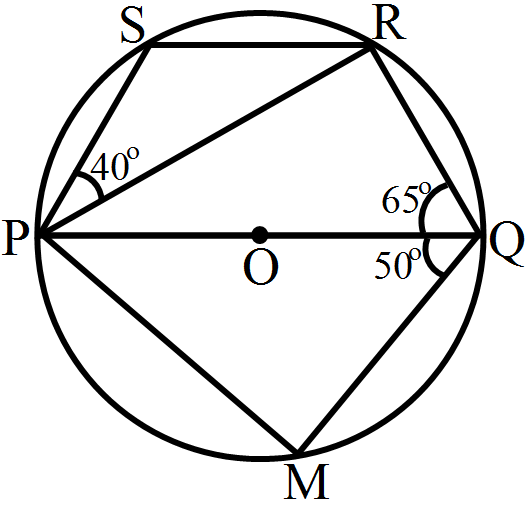
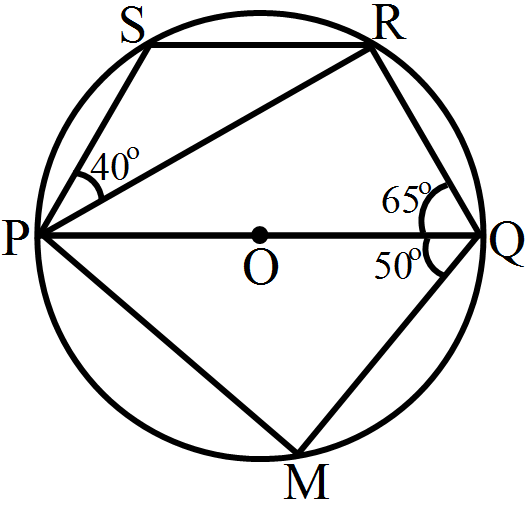 Here, PQ is the diameter and the angle in a semicircle is a right angle.$\text{i.e},\angle\text{PRQ}=90^\circ$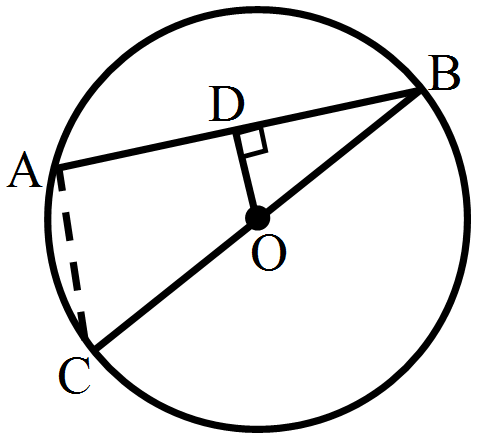
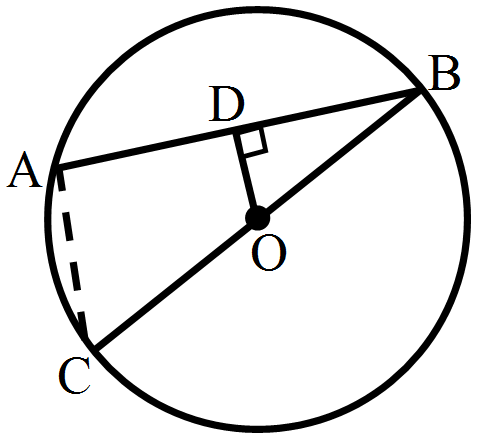 Given: BC is a diameter of a circle with centre O and $\text{OD}\perp\text{AB}.$ To prove: AC parallel to OD and AC = 2 × OD Construction: Join AC. Proof: We know that the perpendicular from the centre of a circle to a chord bisects the chord. Here, $\text{OD}\perp\text{AB}.$ D is the mid point of AB. i.e., AD = BD Also, O is the midpoint of BC. i.e., OC = OB Now, in $\triangle\text{ABC},$ we have: D is the midpoint of AB and O is the mid point of BC. According to the mid point theorem, the line segment joining the mid points of any two sides of a triangle is parallel to the third side and equal to half of it. i.e., OD || AC and $\text{OD}=\frac{1}{2}\text{AC}$$\therefore$ AC = 2 × OD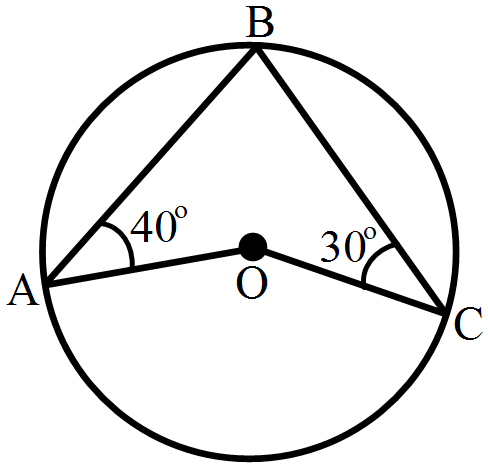
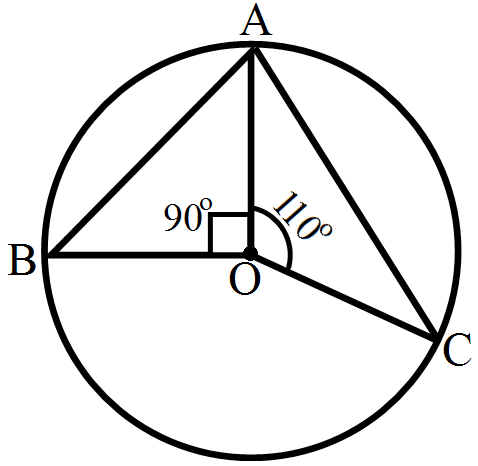
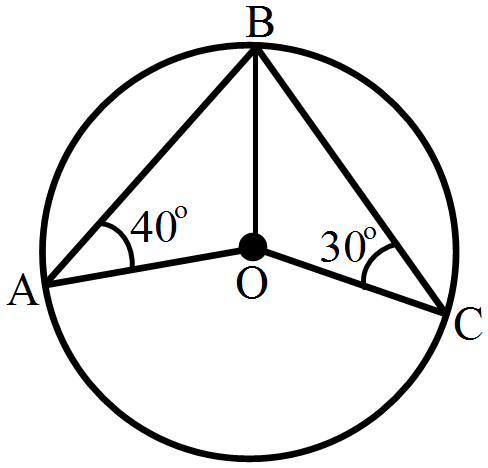
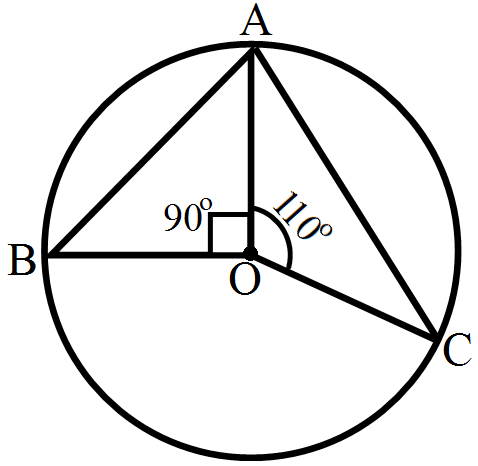
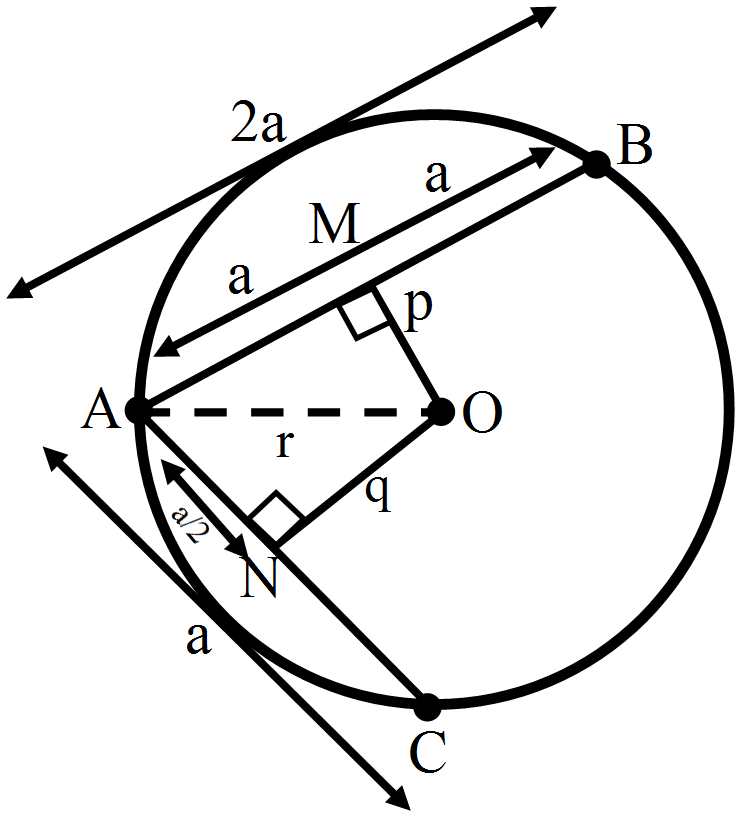
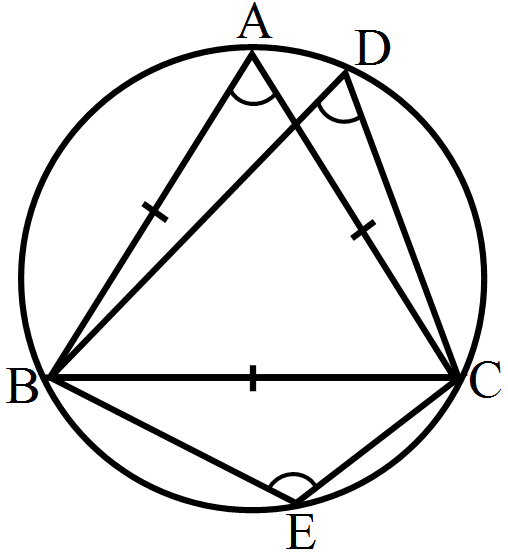
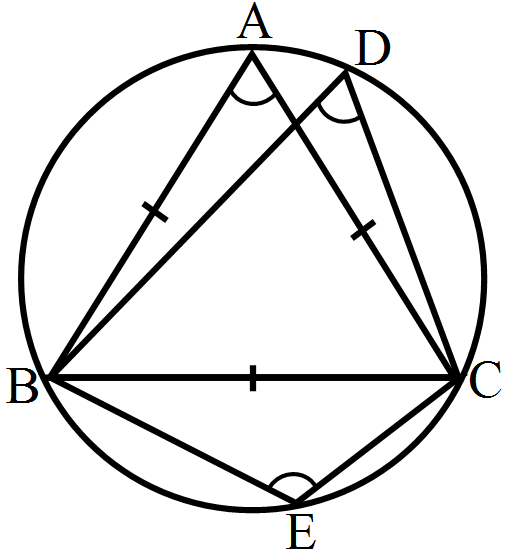
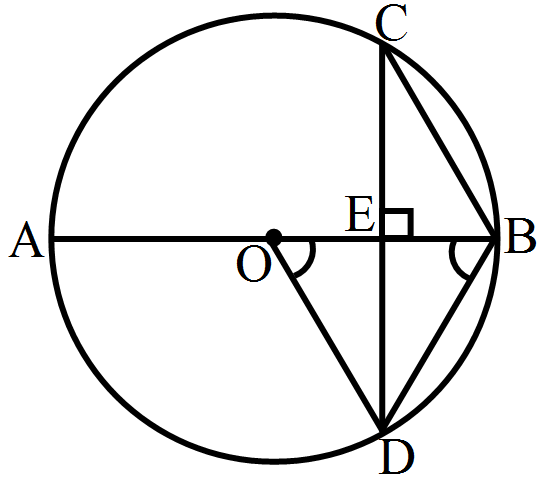
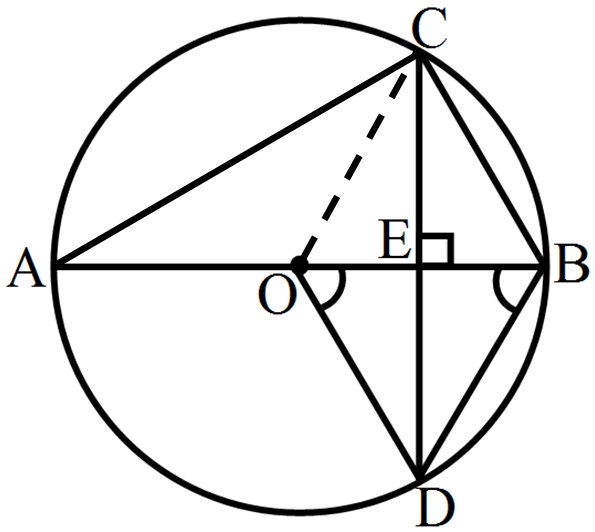 Join AC and OC. In $\triangle\text{ODE}$ and $\triangle\text{DBE},$$\angle\text{DOE}=\angle\text{DBE}$ [given]