MCQ
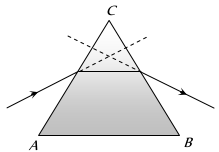
In the given figure, what is the angle of prism
Image
  • A
    $A$
  • B
    $B$
  • $\mathrm{C}$
  • D
    $D$

Answer

Correct option: C.
$\mathrm{C}$
Angle of prism is the angle between incident and emergent surfaces.

Need a full question paper?

Generate a complete, print-ready paper with questions like this in minutes — across 16+ boards, with answer keys.
Start Generating Free

Similar questions

The apparent coefficient of expansion of a liquid when heated in a copper vessel is $C$ and when heated in a silver vessel is $S$. If $A$ is the linear coefficient of expansion of copper, then the linear coefficient of expansion of silver is
Consider a binary star system consisting of two stars of masses $M_1$ and $M_2$ separated by a distance of $30 AU$ with a period of revolution equal to $30$ years. If one of the two stars is $5$ times farther from the centre of mass than the other. The masses of the two stars in terms of solar masses are
Bragg's law for $X$-rays is
The specific heat of hydrogen gas at constant pressure is $C_P=3.4 \times 10^3 \mathrm{cal} / \mathrm{kg}^{\circ} \mathrm{C}$ and at constant volume is $C_V=2.4 \times 10^3 \mathrm{cal} / \mathrm{kg}^{\circ} \mathrm{C}$. If one kilogram hydrogen gas is heated from $10^{\circ} \mathrm{C}$ to $20^{\circ} \mathrm{C}$ at constant pressure, the external work done on the gas to maintain it at constant pressure is
Four identical cells each having an electromotive force (e.m.f.) of $12 \mathrm{~V}$, are connected in parallel. The resistance electromotive force (e.m.f.) of the combination is
A coil of $N=100$ turns carries a current $l=5 \mathrm{~A}$ and creates a magnetic flux $\phi=10^{-5} \mathrm{Tm}^{-2}$ per turn. The value of its inductance $L$ will be
When a stationary wave is formed then its frequency is
Radius of first Bohr orbit is $r$. What is the radius of $2$ Bohr orbit?
Which one is correct relation for thermionic emission
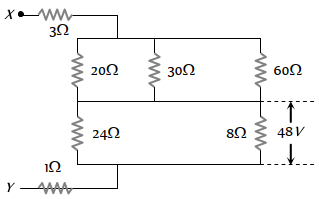
The potential difference across $8 \mathrm{ohm}$ resistance is $48 \mathrm{volt}$ as shown in the figure. The value of potential difference across $X$ and $\gamma$ points will be
Image