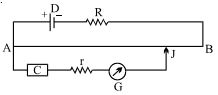
In the given potentiometer circuit, the resistance of the potentiometer wire $AB$ is $R_0$. $C$ is a cell of internal resistance $r$. The galvanometer $G$ does not give zero deflection for any position of the jockey $J$. Which of the following cannot be a reason for this?
Medium
Download our app for free and get started
For potentiometer to measure the internal resistance of cell it should be connected across point $A$ of wire and galvanometer, with positive terminal to point $A$ and negative terminal to galvanometer. Emf of $E$ should not exceed emf of driver cell. Also resistance connected in series with cell in galvanometer circuit should not far more than resistance of wire. If reverses all the above conditions jockey will not show deflection.
Also, $r=R\left(\frac{l_{1}}{l_{2}}-1\right) .$ Hence, $r$ does not depends on resistance of potentiometer wire.

Download our appand get started for free
Experience the future of education. Simply download our apps or reach out to us for more information. Let's shape the future of learning together!No signup needed.*
Similar Questions
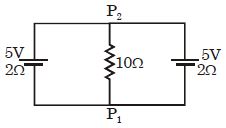
- 1Find the current in the $10\, \Omega$ resistanceView Solution
- 2View SolutionEmf is most closely related to
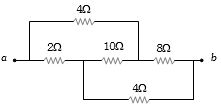
- 3It takes $12$ minutes to boil $1$ litre of water in an electric kettle. Due to some defect it becomes necessary to remove $20 \%$ turns of heating coil of the kettle. After repair, how much time will it take to boil $1$ litre of water.View Solution
- 4When two resistance are connected in parallel then the equivalent resistance is $\frac {6}{5}\Omega $ . When one of the resistance is removed then the effective resistance is $2\, \Omega $. The resistance of the wire removed will be ................ $\Omega$View Solution
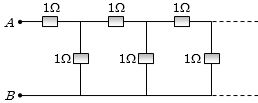
- 5The equivalent resistance between points $A$ and $B$ of an infinite network of resistances each of $1\,\Omega $ connected as shown, isView Solution
- 6A potentiometer having the potential gradient of $2\, mV/cm$ is used to measure the difference of potential across a resistance of $10 \,\Omega$. If a length of $50\, cm$ of the potentiometer wire is required to get the null point, the current passing through the $10 \,\Omega$ resistor is (in $mA$)View Solution
- 7View SolutionIf a high power heater is connected to electric mains, then the bulbs in the house become dim, because there is a
- 8View SolutionA carbon resistance has a following colour code. What is the value of the resistance?
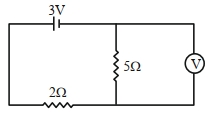
- 9As shown in the figure, the voltmeter reads $2\,V$ across $5\,\Omega$ resistor. The resistance of the voltmeter is $.......\,\Omega$.View Solution
- 10Find the equivalent resistance between the points $a$ and $b$ .......... $\Omega$View Solution