Emf is most closely related to
Easy


Download our appand get started for free
Experience the future of education. Simply download our apps or reach out to us for more information. Let's shape the future of learning together!No signup needed.*
Similar Questions
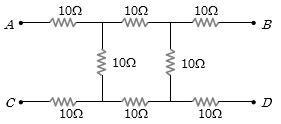
- 1What will be the equivalent resistance between the two points $A$ and $D$ ............. $\Omega$View Solution
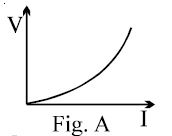
- 2The variation of current $(I)$ and voltage $(V)$ is as shown in figure $A$. The variation of power $P$ with current $I$ is best shown by which of the following graphView Solution
- 3View SolutionThe alloys constantan and manganin are used to make standard resistance due to they have
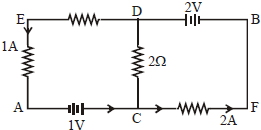
- 4In the circuit, given in the figure currents in different branches and value of one resistor are shown. Then potential at point $B$ with respect to the point $A$ is$.......V$View Solution
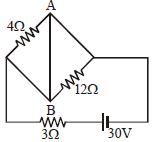
- 5View SolutionConsidering the following circuit, select the correct alternative
- 6There are $8$ equal resistances $R$. Two are connected in parallel, such four groups are connected in series, the total resistance of the system will beView Solution
- 7In a building there are $15$ bulbs of $45\; \mathrm{W}, 15$ bulbs of $100\; \mathrm{W}, 15$ small fans of $10 \;\mathrm{W}$ and $2$ heaters of $1 \;\mathrm{kW}$. The voltage of electric main is $220\; \mathrm{V}$. The minimum fuse capacity (rated value) of the building will be: .......... $A$View Solution
- 8In the diagram resistance between any two junctions is $R$. Equivalent resistance across terminals $A$ and $B$ isView Solution

- 9$(1)$ The product of a volt and a coulomb is a joule.View Solution
$(2)$ The product of a volt and an ampere is a joule/second.
$(3)$ The product of volt and watt is horse power.
$(4)$ Watt-hour can be measured in terms of electron volt.
State if
- 10When a current $I$ is passed through a wire of constant resistance, it produces a potential difference $V$ across its ends. The graph drawn between $\log\, I$ and $\log\, V$ will beView Solution