MCQ
In the interval $(0, 1)$ maximum value of the function $f (x) = |x\ ln\ x|$ is 
  • A
    $0$
  • B
    $1$
  • C
    $e$
  • $e^{-1}$

Answer

Correct option: D.
$e^{-1}$
d
$f(x)=-x \ln x$

$f^{\prime}(x)=-1-\ln x$

$\therefore f'(x) > 0{\rm{ if }}x \in (0,1/c)$

$f^{\prime}(x)=0 \text { if } x=1 / e$

$f^{\prime}(x)<0 \text { if } x>1 / e$

$f(1 / e)=e^{-1}$

${\rm{ \,and\, }}\mathop {\lim }\limits_{x \to {0^ + }} f(x) - 0{\rm{ \,and\, }}\mathop {\lim }\limits_{x \to {1^ - }} f(x) = 0$

Need a full question paper?

Generate a complete, print-ready paper with questions like this in minutes — across 16+ boards, with answer keys.
Start Generating Free

Similar questions

Choose the correct answer from the given four options.
In a college, 30% students fail in physics, 25% fail in mathematics and 10% fail in both. One student is chosen at random. The probability that she fails in physics if she has failed in mathematics is:
If $f(x) = 3x + 10$, $g(x) = {x^2} - 1$, then ${(fog)^{ - 1}}$ is equal to
If $y = {x^{\sin x}},$ then ${{dy} \over {dx}} = $
If $\text{A}=\displaystyle \begin{vmatrix} 2 &\text{amp;}-3 \\ 3 &\text{amp; 2} \end{vmatrix}$ and $\text{B}=\displaystyle \begin{vmatrix} 3 &\text{amp;}-2 \\ 2 &\text{amp; 3} \end{vmatrix}$ then $2\text{ A-B}=$
  1. $\displaystyle \begin{vmatrix} 1 &4 \\ 4 &1\end{vmatrix}$
  2. $\displaystyle \begin{vmatrix} 1 &4 \\ 1 &4\end{vmatrix}$
  3. $\displaystyle \begin{vmatrix} 1 &-4 \\ 4 &1\end{vmatrix}$
  4. $\displaystyle \begin{vmatrix} 4 &1\\ 1 &4\end{vmatrix}$
If $r\,.\,i = r\,.\,j = r\,.\,k$ and $|r|\,\, = 3,$ then $r = $
If x + y = 8, then the maximum value of xy is:
  1. 8
  2. 16
  3. 20
  4. 24
If $f(x) = \frac{{x - 3}}{{x + 1}}$, then $f[f\{ f(x)\} ]$ equals
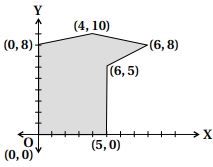
The feasible solution for a $LPP$ is shown in Figure Let $z=3 x-4 y$ be the objective function. Maximum of $Z$ occurs at $......$
Let $f$ be a real-valued function defined on the interval $(0, \infty)$ by $f(x)=\ln x+\int_0^x \sqrt{1+\sin t} d t$. Then which of the following statement(s) is (are) true?

$(A)$ $f^{\prime \prime}(x)$ exists for all $x \in(0, \infty)$

$(B)$ $f^{\prime}(x)$ exists for all $x \in(0, \infty)$ and $f^{\prime}$ is continuous on $(0, \infty)$, but not differentiable on $(0, \infty)$

$(C)$ there exists $\alpha>1$ such that $\left|f^{\prime}(x)\right|<|f(x)|$ for all $x \in(\alpha, \infty)$

$(D)$ there exists $\beta>0$ such that $|f(x)|+\left|f^{\prime}(x)\right| \leq \beta$ for all $x \in(0, \infty)$

The area of the shorter region bounded by $|y| = 4\, -\, x^2$ and $|y| = 3x$ is given by $\left( {3K + \frac{1}{3}} \right)$ sq-unit where $K$ is equal to