MCQ
In the Kjeldahl's method for estimation of nitrogen present in a soil sample, ammonia evolved from $0.75\, g$ of sample neutralized $10\, mL$ of $1\, M \,H_2SO_4.$ The percentage of nitrogen in the soil is
- ✓$37.33$
- B$45.33$
- C$35.33$
- D$43.33$
$10\, \mathrm{m} \,\mathrm{mol} \,\mathrm{H}_{2} \mathrm{SO}_{4}=20\, \mathrm{m}\, \mathrm{mol}$ of $\mathrm{NH}_{3}$
$\left[\mathrm{H}_{2} \mathrm{SO}_{4}+2 \mathrm{NH}_{3} \longrightarrow\left(\mathrm{NH}_{4}\right)_{2} \mathrm{SO}_{4}\right]$
$1\, \mathrm{mol}\; \mathrm{NH}_{3}$ contains $14 \,\mathrm{g}$ nitrogen $20 \times 10^{-3}\, \mathrm{mol}\; \mathrm{NH}_{3}$ contains $14 \times 20 \times 10^{-3}$ nitrogen
$0.75\, \mathrm{g}$ of sample contains
$\%$ Nitrogen $=\frac{14 \times 20 \times 10^{-3}}{0.75} \times 100=37.33 \%$
Generate a complete, print-ready paper with questions like this in minutes — across 16+ boards, with answer keys.

The number of compounds/species which obey Huckel's rule is $..........$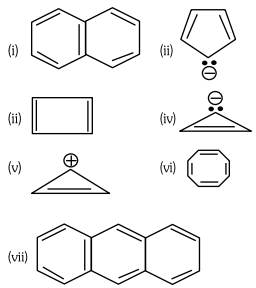
$X$ $ = 1{s^2},\,\,2{s^2}2{p^6},\,\,3{s^2}3{p^6},\,\,4{s^2}$
and $Y$ $ = 1{s^2},\,\,2{s^2}2{p^6},\,\,3{s^2}3{p^5}$
The compound formed by combination of $X$ and $Y$ is