MCQ
In the motion of a projectile freely under gravity, its
  • Total energy is conserved
  • B
    Momentum is conserved
  • C
    Energy and momentum both are conserved
  • D
    None is conserved

Answer

Correct option: A.
Total energy is conserved
a
(a)An external force by gravity is present throughout the motion so momentum will not be conserved.

Need a full question paper?

Generate a complete, print-ready paper with questions like this in minutes — across 16+ boards, with answer keys.
Start Generating Free

Similar questions

Coefficient of volumetric expansion $\alpha_\text{v}$ is not a constant. It depends on temperature. Variation of $\alpha_\text{v}$ with temperature for metals is:
At which of the following temperature would the molecules of a gas have twice the average kinetic energy they have at $20°C$
The temperature below which a gas should be cooled, before it can be liquified by pressure only is termed as
When the gap is closed without placing any object in the screw gauge whose least count is $0.005\ mm$, the $5^{th}$ division on its circular scale with the reference line on main scale, and when a small sphere is placed reading on main scale advances by $4$ divisions, whereas circular scale reading advances by five times to the corresponding reading when no object was placed. There are $200$ divisions on the circular scale. The radius of the sphere is .......... $mm$
A black coloured solid sphere of radius $R$ and mass $M$ is inside a cavity with vacuum inside. The walls of the cavity are maintained at temperature $T_0$. The initial temperature of the sphere is $3T_0$. If the specific heat of the material of the sphere varies as $\alpha T^3$ per unit mass with the temperature $T$ of the sphere, where $\alpha $ is a constant, then the time taken for the sphere to cool down to temperature $2T_0$ will be ( $\sigma $ is Stefan Boltzmann constant)
A monoatomic gas $\left( {\gamma  = \frac{5}{3}} \right)$ is suddenly compressed to $\frac{1}{8}$ of its original volume, then the pressure of gas will change to how many times the initial pressure?
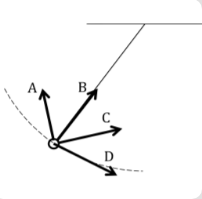
A mass attached to a string that is itself attached to the ceiling swings back and forth. If the bob is observed to be moving upward at a given instance, as shown to the right, which arrow best depicts the direction of the net force acting on the bob at that instant:
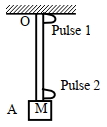
A block $\mathrm{M}$ hangs vertically at the bottom end of a uniform rope of constant mass per unit length. The top end of the rope is attached to a fixed rigid support at $O$. A transverse wave pulse (Pulse $1$ ) of wavelength $\lambda_0$ is produced at point $O$ on the rope. The pulse takes time $T_{O A}$ to reach point $A$. If the wave pulse of wavelength $\lambda_0$ is produced at point $A$ (Pulse $2$) without disturbing the position of $M$ it takes time $T_{A 0}$ to reach point $O$. Which of the following options is/are correct?

(image)

[$A$] The time $\mathrm{T}_{A 0}=\mathrm{T}_{\mathrm{OA}}$

[$B$] The velocities of the two pulses (Pulse $1$ and Pulse $2$) are the same at the midpoint of rope.

[$C$] The wavelength of Pulse $1$ becomes longer when it reaches point $A$.

[$D$] The velocity of any pulse along the rope is independent of its frequency and wavelength.
The dimensions of stress are equal to
If the distance between the earth and the sun becomes half its present value, the number of days in a year would have been