MCQ
A monoatomic gas $\left( {\gamma  = \frac{5}{3}} \right)$ is suddenly compressed to $\frac{1}{8}$ of its original volume, then the pressure of gas will change to how many times the initial pressure?
  • A
    $\frac{{24}}{5}$
  • B
    $8$
  • C
    $\frac{{40}}{3}$
  • $32$

Answer

Correct option: D.
$32$
d
Sudden compression means adiabatic process

Need a full question paper?

Generate a complete, print-ready paper with questions like this in minutes — across 16+ boards, with answer keys.

Start Generating Free

Similar questions

A dimensionless quantity:
A cylinder of mass $1\,kg$ is given heat of $20000\, J$ at atmospheric pressure. If initially temperature of cylinder is $20\,^oC$, then work done by the cylinder will be .......$J$ (Given that Specific heat of cylinder $= 400 \,J\, kg^{-1}$, Coefficient of volume expansion $= 9 \times {10^{-5}}\,^o C^{-1}$, Atmospheric pressure $= 10^5 \,N/m^2$ and density of cylinder $9000\,kg/m^3$)
In the determination of Young's modulus $\left(Y=\frac{4 MLg }{\pi / d ^2}\right)$ by using Searle's method, a wire of length $L=2 \ m$ and diameter $d =0.5 \ mm$ is used. For a load $M =2.5 \ kg$, an extension $\ell=0.25 \ mm$ in the length of the wire is observed. Quantities $d$ and $\ell$ are measured using a screw gauge and a micrometer, respectively. They have the same pitch of $0.5 \ mm$. The number of divisions on their circular scale is $100$ . The contributions to the maximum probable error of the $Y$ measurement
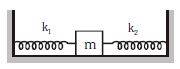
A block of mass $m$ is attached to two springs of spring constants $k_1$ and $k_2$ as shown in figure. The block is displaced by $x$ towards right and released. The velocity of the block when it is at $x/2$ will be
The displacement y of a particle executing periodic motion is given by $y = 4{\cos ^2}(t/2)\sin (1000t)$. This expression may be considered to be a result of the superposition of ........... independent harmonic motions
Let $\text{n}_\text{p}$ and $\text{n}_\text{e}$ be the number of holes and conduction electrons in an intrinsic semiconductor.
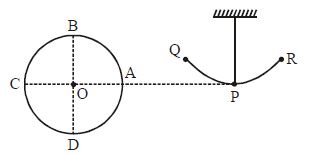
A sound source is moving on a circular path of radius $R$ with constant angular speed $\omega $ in anticlockwise direction and emits a frequency $n$ . An observer performs simple harmonic along the path $QPR$ with time period $T = \frac {2\pi }{\omega }$ as shown in the figure. If at $t = 0$ source is at $A$ and observer is at $Q$ and assume $OP$ is very large as compare to radius $R$ and $QP$ , then 
A bomber plane moves horizontally with a speed of $500\, m/s$ and a bomb released from it, strikes the ground in $10\, sec$. Angle at which it strikes the ground will be $(g = 10\,\,m/{s^2})$
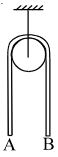
$A$ uniform chain of length $2L$ is hanging in equilibrium position, if end $B$ is given a slightly downward displacement the imbalance causes an acceleration. Here pulley is small and smooth & string is inextensible The acceleration of end $B$ when it has been displaced by distance $x$, is 
A cricketer can throw a ball to a maximum horizontal distance of $100\, m .$ The speed with which he throws the ball is (to the nearest integer)  (in $ms ^{-1}$)