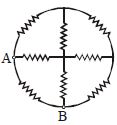
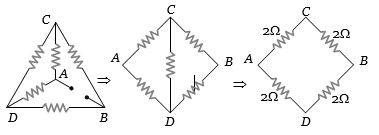
In the network shown in the figure, each of the resistance is equal to $2\,\Omega $. The resistance between the points $A$ and $B$ is .............. $\Omega$
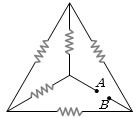
AIPMT 1995, Easy


Download our appand get started for free
Experience the future of education. Simply download our apps or reach out to us for more information. Let's shape the future of learning together!No signup needed.*
Similar Questions
- 1View SolutionOhm's law fails in
- 2View SolutionIn the given circuit
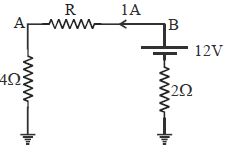
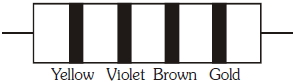
- 3View SolutionThe color code of a resistance is given below
The values of resistance and tolerance, respectively, are :
- 4Consider a wire having current $10\,A$ having area of crossection $1\,cm^2$. If number of electrons per unit volume is $9 \times 10^{28}\, m^{-3}$. Find the drift velocity of electronsView Solution
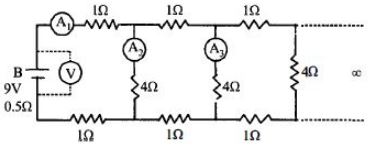
- 5A $9\, V$ battery with internal resistance of $0.5\,\Omega $ is connected across an infinite network as shown in the figure. All ammeters $A_1 , A_2, A_3$ and voltmeter $V$ are ideal. Choose correct statementView Solution
- 6To measure the internal resistance of a battery, potentiometer is used. For $\mathrm{R}=10 \Omega$, the balance point is observed at $\ell=500 \mathrm{~cm}$ and for $\mathrm{R}=1 \Omega$ the balance point is observed at $\ell=400 \mathrm{~cm}$. The internal resistance of the battery is approximately :View Solution
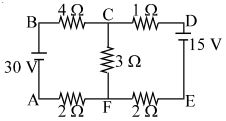
- 7View SolutionThe figure shows a network of five resistances and two batteries Which of the batteries is getting charged.
- 8A heating element has a resistance of $100\,\Omega $ at room temperature. When it is connected to a supply of $220\,V,$ a steady current of $2\,A$ passes in it and temperature is $500\,^oC$ more than room temperature. What is the temperature coefficient resistance of the heating element?View Solution
- 9The resistance per centimeter of a meter bridge wire is $\mathrm{r}$, with $\mathrm{X}\ \Omega$ resistance in left gap. Balancing length from left end is at $40 \mathrm{~cm}$ with $25\ \Omega$ resistance in right gap. Now the wire is replaced by another wire of $2 \mathrm{r}$ resistance per centimeter. The new balancing length for same settings will be atView Solution
- 10Eight resistances each of resistance $5\,\Omega $ are connected in the circuit as shown in figure. The equivalent resistance between $A$ and $B$ isView Solution