MCQ
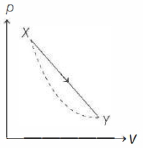
In the $p-V$ diagram below, the dashed curved line is an adiabat.For a process that is described by a straight line joining two points $X$ and $Y$ on the adiabat (solid line in the diagram) heat is (Hint consider the variation in temperature from $X$ to $Y$ along the straight line)
  • A
    absorbed throughout from $X$ to $Y$
  • B
    released throughout from $X$ to $Y$
  • absorbed from $X$ upto an intermediate point $Z$ (not shown in the figure) and then released from $Z$ to $Y$
  • D
    released from $X$ upto an intermediate point $Z$ (not shown in the figure) and then absorbed from $Z$ to $Y$
Answer

Correct option: C.
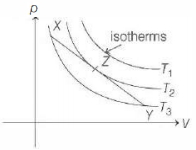
absorbed from $X$ upto an intermediate point $Z$ (not shown in the figure) and then released from $Z$ to $Y$
c
(c)

As we move along line $X Y$, it cuts a isotherm at higher temperature $\left(T_2 > T_3\right)$

$\left(T_2 > T_3\right)$ but then from $Z$ to $Y$ line moves to a low temperature isotherm. So, heat is absorbed upto $Z$ and then it is released from $Z$ to $Y$.

Need a full question paper?

Generate a complete, print-ready paper with questions like this in minutes — across 16+ boards, with answer keys.

Start Generating Free

Similar questions

Aball is thrown from a point on ground at some angle of projection. At the same time a bird starts from a point directly above this point of projection at a height $h$ horizontally with speed $u$. Given that in its flight ball just touches the bird at one point. Find the distance on ground where ball strikes
Water flows into a cylindrical vessel of large cross-sectional area at a rate of $10^{-4}$ $m^3/s$. It flows out from a hole of area $10^{-4}$ $m^2$, which has been punched through the base. How high does the water rise in the vessel?
Two simple harmonic motions are represented by equations ${y_1} = 4\,\sin \,\left( {10t + \phi } \right)$ and ${y_2} = 5\,\cos \,10\,t$ What is the phase difference between their velocities?
The two thin bones $($femurs$),$ each of cross$-$sectional area $10\ cm^2$ support the upper part of human body of mass $40 \ kg.$ Estimate the average pressure sustained by the femurs:
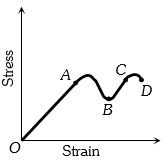
In the below graph, point $D$ indicates
If a new planet is discovered rotating around Sun with the orbital radius double that of earth, then what will be its time period (in earth's days)
A small spherical ball of radius $r$, falling through a viscous medium of negligible density has terminal velocity ' $v$ '. Another ball of the same mass but of radius $2 r$, falling through the same viscous medium will have terminal velocity:
$Assertion :$ The time-period of pendulum, on a satellite orbiting the earth is infinity.
$Reason :$ Time-period of a pendulum is inversely proportional to $\sqrt g$
A small boy is throwing a ball towards a wall $6 \,m$ in front of him. He releases the ball at a height of $1.4 \,m$ from the ground. The ball bounces from the wall at a height of $3 \,m$, rebounds from the ground and reaches the boy's hand exactly at the point of release. Assuming the two bounces (one from the wall and the other from the ground) to be perfectly elastic, .......... $m$ far ahead of the boy did the ball bounce from the ground
A body of mass $40 \,gm$ is moving with a constant velocity of $2\, cm/sec$ on a horizontal frictionless table. The force on the table is  ....... $dyne$