MCQ
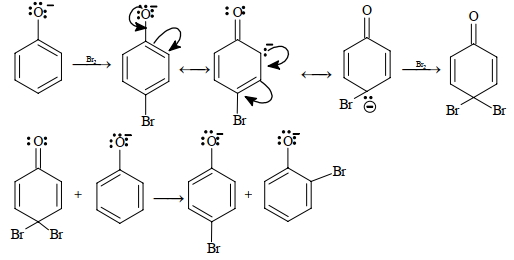
In the reaction $Image$ the intermediate$(s)$ is(are)
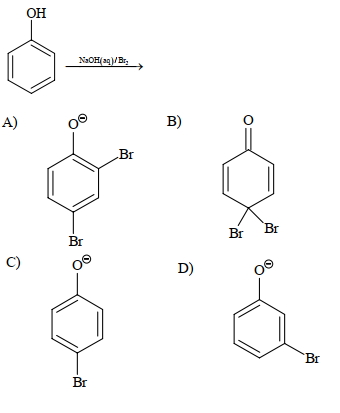
  • $(A,B,C)$
  • B
    $(A,B,D)$
  • C
    $(B,C,D)$
  • D
    $(B,A,C)$

Answer

Correct option: A.
$(A,B,C)$
a
Phenoxide ion is para and ortho directing. (* preferably)

$Image$

Need a full question paper?

Generate a complete, print-ready paper with questions like this in minutes — across 16+ boards, with answer keys.

Start Generating Free

Similar questions

Which one of the following should be most stable
The incorrect expression among the following is :
An organic compound $P$ with molecular formula $C _9 H _{18} O _2$ decolorizes bromine water and also shows positive iodoform test. $P$ on ozonolysis followed by treatment with $H _2 O _2$ gives $Q$ and $R$. While compound $Q$ shows positive iodoform test, compound $R$ does not give positive iodoform test. $Q$ and $R$ on oxidation with pyridinium chlorochromate ($PCC$) followed by heating give $S$ and $T$, respectively. Both $S$ and $T$ show positive iodoform test.

Complete copolymerization of 500 moles of $Q$ and $500$ moles of $R$ gives one mole of a single acyclic copolymer $U$.

[Given, atomic mass: $H=1, C=12, O=16$ ]

($1$) Sum of number of oxygen atoms in $S$ and $T$ is. . . . . .

($2$) The molecular weight of $U$ is

Give the answer or quetion $(1)$ and $(2)$
If for a certain reaction $\Delta_{r} H$ is $30 \;kJ \;mol ^{-1}$ at $450 \;K ,$ the value of $\Delta_{r} S \left(\right.$ in $\left. J K ^{-1} mol ^{-1}\right)$ for which the same reaction will be spontaneous at the same temperature is
One mole of a non-ideal gas undergoes a change of state ($2.0\, atm$, $3.0\, L$ , $95 \,K$ ) $\rightarrow $($4.0\, atm$ , $5.0\, L$ , $245\, K )$ with a change in internal energy, $\Delta U =30.0 \,L$ $atm$. The change in enthalpy $\Delta H$ of the process in $L\,atm$ is.
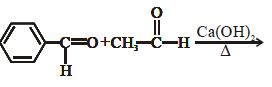
Find the major product of given reaction
An alkane $(mol.\, wt. = 86)$ on bromination gives only two monobromo derivatives (excluding stereoisomers). The alkane is
Knocking sound occurs in engine when fuel
Alkylamine dissolve in hydrochloric acid to form alkylammonium chloride. The nitrogen in the latter salt is:
The number of stereoisomers formed by the given compound is