MCQ
In the reaction $Image$ the intermediate$(s)$ is(are)
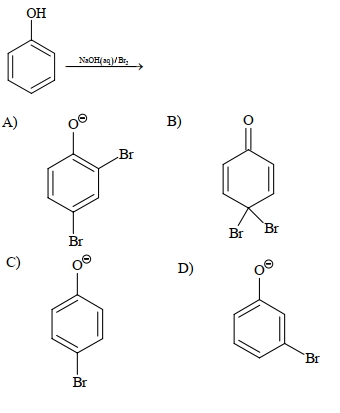
- ✓$(A,B,C)$
- B$(A,B,D)$
- C$(B,C,D)$
- D$(B,A,C)$
$Image$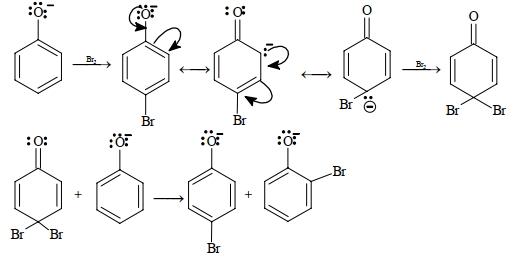
Generate a complete, print-ready paper with questions like this in minutes — across 16+ boards, with answer keys.
(Given : $K_b$ of water $=0.5\ Kkg/mol$ . ; Atomic mass of $Ca =40$ , $Br =80$)
$\mathrm{HX}(\mathrm{aq}) \rightleftharpoons \mathrm{H}^{+}(\mathrm{aq})+\mathrm{X}(\mathrm{aq}), \mathrm{Ka}=1.2 \times 10^{-5}$
$\left[\mathrm{K}_{\mathrm{n}}:\right.$ dissociation constant]
The osmotic pressure of $0.03 \mathrm{M}$ aqueous solution of $\mathrm{HX}$ at $300 \mathrm{~K}$ is ............... $\times 10^{-2}$ bar (nearest integer).
$\left[\right.$ Given : $\mathrm{R}=0.083 \mathrm{~L} \mathrm{bar} \mathrm{Mol}^{-1} \mathrm{~K}^{-1}$ ]
$(A)$ The stronger the temperature dependence of the rate constant, the higher is the activation energy.
$(B)$ If a reaction has zero activation energy, its rate is independent of temperature.
$(C)$ The stronger the temperature dependence of the rate constant, the smaller is the activation energy.
$(D)$ If there is no correlation between the temperature and the rate constant then it means that the reaction has negative activation energy.