MCQ
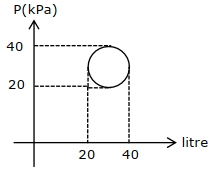
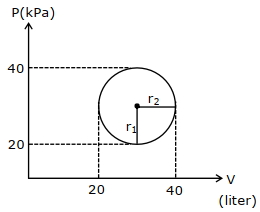
In the reported figure, heat energy absorbed by a system in going through a cyclic process is $......\,\pi J$
  • A
    $50$
  • B
    $150$
  • $100$
  • D
    $200$

Answer

Correct option: C.
$100$
c
For complete cyclic process

$\Delta U=0$

$\therefore \text { from } \Delta Q=\Delta U+W$

$=0+W$

$\Delta Q=W$

$=\text { Area }$

$=\pi r_{1} \cdot r_{2}$

$=\pi \times\left(10 \times 10^{3}\right)\left(10 \times 10^{-3}\right)$

$\Delta Q=100 \pi$

$\therefore \text { Ans. }=100$
Need a full question paper?

Generate a complete, print-ready paper with questions like this in minutes — across 16+ boards, with answer keys.

Start Generating Free

Similar questions

The source that illuminates the double - slit in 'double - slit interference experiment' emits two distinct monochromatic waves of wavelength $500\,nm$ and $600\, nm$, each of them producing its own pattern on the screen. At the central point of the pattern when path difference is zero, maxima of both the patterns coincide and the resulting interference pattern is most distinct at the region of zero path difference. But as one moves out of this central region, the two fringe systems are gradually out of step such that maximum due to on wavelength coincides with the minimum due to the other and the combined fringe system becomes completely indistinct. This may happen when path difference in $nm$ is
A tuning fork vibrating with a sonometer having $20\,cm$ wire produces $5$ beats per sec. The beat frequency does not change if the length of the wire is changed to $21\,cm$. The frequency of the tuning fork must be ..... $Hz$
We can reduce eddy currents in the core of transformer
Two rods of equal length and area of cross-section are kept parallel and lagged between temperatures $20^{\circ} C$ and $80^{\circ} C$. The ratio of the effective thermal conductivity to that of the first rod is: [the ratio $\left.\left( K _1 / K _2\right)=3: 4\right]$
A double convex lens is made of glass of refractive index $1.5$. If its focal length is $30 cm,$ then radius of curvature of each of its curved surface is
Two vibrating tuning forks produce progressive waves given by ${y_1} = 4\,\sin \,\left( {500\pi t} \right)$ and ${y_2} = 2\,\sin \,\left( {506\pi t} \right)$. These tuning forks are held near the ear of a person. The person will hear $\alpha \, beats/s$ with intensity ratio between maxima and minima equal to $\beta $. Find the value of $\beta  - \alpha $
$STATEMENT-1$ If there is no external torque on a body about its center of mass, then the velocity of the center of mass remains constant. because

$STATEMENT-2$ The linear momentum of an isolated system remains constant.

A projectile is thrown with a velocity of $50\,\, ms^{^{-1}}$ at an angle of $53^o$ with the horizontal The equation of the trajectory is given by
The temperature of a gas having $2.0 \times 10^{25}$ molecules per cubic meter at $1.38 \mathrm{~atm}$ (Given, $\mathrm{k}=$ $\left.1.38 \times 10^{-23} \mathrm{JK}^{-1}\right)$ is :
A conducting sphere of radius $10\, cm$ is charged $10\,\mu \,C$. Another uncharged sphere of radius $20\, cm$ is allowed to touch it for some time. After that if the sphere are separated, then surface density of charges, on the spheres will be in the ratio of