MCQ
The source that illuminates the double - slit in 'double - slit interference experiment' emits two distinct monochromatic waves of wavelength $500\,nm$ and $600\, nm$, each of them producing its own pattern on the screen. At the central point of the pattern when path difference is zero, maxima of both the patterns coincide and the resulting interference pattern is most distinct at the region of zero path difference. But as one moves out of this central region, the two fringe systems are gradually out of step such that maximum due to on wavelength coincides with the minimum due to the other and the combined fringe system becomes completely indistinct. This may happen when path difference in $nm$ is
  • A
    $2000$
  • B
    $3000$
  • C
    $1000$
  • $1500$

Answer

Correct option: D.
$1500$
d

Need a full question paper?

Generate a complete, print-ready paper with questions like this in minutes — across 16+ boards, with answer keys.

Start Generating Free

Similar questions

When a ceiling fan is switched off, its angular velocity falls to half while it makes $36$ $rotations.$ How many more rotations will it make before coming to rest (Assume uniform angular retardation)
The linear mass density $(\lambda)$ of a rod of length $L$ kept along $x$-axis varies as $\lambda=\alpha+\beta x$; where $\alpha$ and $\beta$ are positive constants. The centre of mass of the rod is at ..........
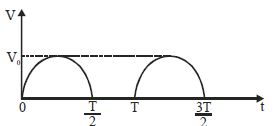
What will be $r.m.s.$ value of given $A.C.$ over one cycle.
A cylinder of mass $10\,kg$ is sliding on a plane with an initial velocity of $10\,m/s$. If coefficient of friction between surface and cylinder is $ 0.5$, then before stopping it will describe ............. $\mathrm{m}$
At any instant the velocity of a particle of mass $500\,g$ is $\left(2 t \hat{ i }+3 t ^2 \hat{ j }\right)\,ms ^{-1}$. If the force acting on the particle at $t=1 s$ is $(\hat{i}+x \hat{j}) N$. Then the value of $x$ will be:
There is a uniformly charged non conducting solid sphere made of material of dielectric constant one. If electric potential at infinity be zero, then the potential at its surface is $V$. If we take electric potential at its surface to be zero, then the potential at the centre will be
A body of weight $200 \mathrm{~N}$ is suspended form a tree branch thought a chain of mass $10 \mathrm{~kg}$. The branch pulls the chain by a force equal to (if $g=10 \mathrm{~m} / \mathrm{s}^2$ ):
An arbitrary shaped closed coil is made of a wire of length $L$ and a current $I$ ampere is flowing in it. If the plane of the coil is perpendicular to magnetic field $\mathop B\limits^ \to $, the force on the coil is
A nucleus of mass $218\, amu$ in free state decays to emit an  $\alpha$- particle. Kinetic energy of the $\alpha$- particle emitted is $6.7\, MeV$. The recoil energy (in $MeV$) of the daughter nucleus is
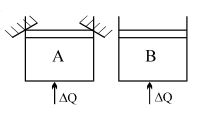
Two identical vessels $A \& B$ contain equal amount of ideal monoatomic gas. The piston of $A$ is fixed but that of $B$ is free. Same amount of heat is absorbed by$A \& B$. If $B'$s internal energy increases by $100 \,\,J$ the change in internal energy of $A$ is ...... .$J$