MCQ
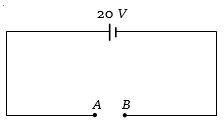
In the shown circuit, what is the potential difference across $A$ and $B$ ......... $V$
  • A
    $50$
  • B
    $45$
  • C
    $30$
  • $20$

Answer

Correct option: D.
$20$
d
(d) Because cell is in open circuit.

Need a full question paper?

Generate a complete, print-ready paper with questions like this in minutes — across 16+ boards, with answer keys.

Start Generating Free

Similar questions

Two capacitors of capacitance 2 μF and 3μF are joined in series. Outer plate first capacitor is at 1000 volt and outer plate of second capacitor is earthed (grounded). Now the potential on inner plate of each capacitor will be
An object is placed at a distance of $40\,\, cm$ from a concave mirror of focal length $15\,\, cm.$ If the object is displaced through a distance of $20\,\, cm$ towards the mirror, the displacement of the image will be 
Let there be a spherically symmetric charge distribution with charge density varying as $\text{p}(\text{r})=\text{p}_0\bigg(\frac{5}{4}-\frac{\text{r}}{\text{R}}\bigg)$ upto $r = R$ and $p(r) = 0$ for $r > R$ where $r$ is the distance from the origin the electric field at a distance $r(r < R)$ from the origin is given by.
In a coil of self inductance 0.5 henry, the current varies at a constant rate from zero to 10 amperes in 2 seconds. The e.m.f. generated in the coil is
In Young's double slit experiment, angular width of fringes is $0.20^\circ$ for sodium light of wavelength $5890 \mathring A$ . If complete system is dipped in water, then angular width of fringes becomes
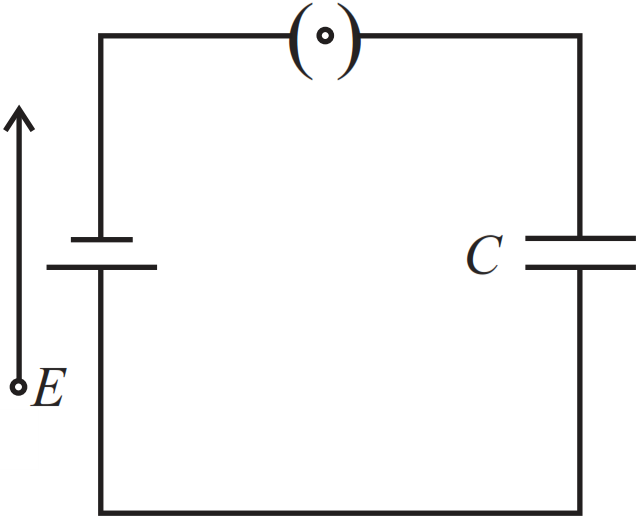
A parallel plate capacitor is connected to a battery as shown in Fig. Consider two situations: A: Key K is kept closed and plates of capacitors are moved apart using insulating handle. B: Key K is opened and plates of capacitors are moved apart using insulating handle. Choose the correct option(s).
The electric field between the two spheres of a charged spherical condenser
The size of an atom is of the order of
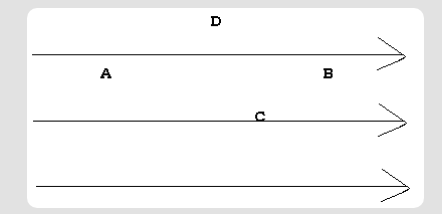
A negative charge is located in the uniform electric field between two plates $($not shown$).$
Where in the diagram will the electron have the greatest change in potential energy before hitting the one of the plates?
In a hypothetical system a particle of mass $m$ and charge $-3\,q$ is moving around a very heavy particle having cahrge $q$. Assuming Bohr’s model to be true to this system, the orbital velocity of mass $m$ when it is nearest to heavy particle is