In the standing wave shown, particles at the positions $A$ and $B$ have a phase difference of
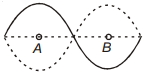
Easy


Download our appand get started for free
Experience the future of education. Simply download our apps or reach out to us for more information. Let's shape the future of learning together!No signup needed.*
Similar Questions
- 1If the fundamental frequency of string is $220 \,cps$, the frequency of fifth harmonic will be ......... $cps$View Solution
- 2The expression $y = a\, sin\, bx\, sin\, \omega t$ represents a stationary wave. The distance between the consecutive nodes is equal toView Solution
- 3Sound waves have the following frequencies that are audible to human beings .... $c/s$View Solution
- 4What should be the velocity of a sound source moving towards a stationary observer so that apparent frequency is double the actual frequency (Velocity of sound is $v$)View Solution
- 5A source and listener are both moving towards each other with speed $v/10$, where $v$ is the speed of sound. If the frequency of the note emitted by the source is $f$, the frequency heard by the listener would be nearlyView Solution
- 6If velocity of sound in a gas is $360\, m/s$ and the distance between a compression and the nearest rarefaction is $1m$, then the frequency of sound is ..... $Hz$View Solution
- 7Two waves of frequencies $20 Hz$ and $30 Hz.$ Travels out from a common point. The phase difference between them after $0.6 sec$ isView Solution
- 8Velocity of sound in vacuum is .... $ms^{-1}$View Solution
- 9View SolutionA closed organ pipe and an open organ pipe are tuned to the same fundamental frequency. What is the ratio of lengths
- 10If the equation of transverse wave is $Y = 2\sin (kx - 2t),$ then the maximum particle velocity is .... $units$View Solution