Sound waves have the following frequencies that are audible to human beings .... $c/s$
Easy
Download our app for free and get started
(c) Audiable range of frequency is $20\,Hz$ to $20\,kHz$

Download our appand get started for free
Experience the future of education. Simply download our apps or reach out to us for more information. Let's shape the future of learning together!No signup needed.*
Similar Questions
- 1The equation of a wave travelling in a string can be written as $y = 3\cos \pi (100\,t - x)$. Its wavelength is .... $cm$View Solution
- 2View SolutionTwo wires are producing fundamental notes of the same frequency. Change in which of the following factors of one wire will not produce beats between them
- 3When two progressive waves $\mathrm{y}_1=4 \sin (2 \mathrm{x}-6 \mathrm{t})$ and $\mathrm{y}_2=3 \sin \left(2 \mathrm{x}-6 \mathrm{t}-\frac{\pi}{2}\right)$ are superimposed, the amplitude of the resultant wave isView Solution
- 4A person carrying a whistle emitting continuously a note of $272 Hz$ is running towards a reflecting surface with a speed of $18\, km/hour. $ The speed of sound in air is $345m{s^{ - 1}}$. The number of beats heard by him isView Solution
- 5Length of a string tied to two rigid supports is $40 cm$. Maximum length (wavelength in $cm$) of a stationary wave produced on it is ... $cm$View Solution
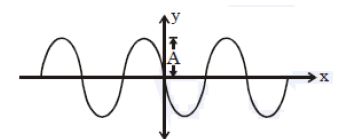
- 6A progressive wave travelling along the positive $x-$ direction is represented by $y(x, t) = A\,sin\,\left( {kx - \omega t + \phi } \right)$. Its snapshot at $t = 0$ is given in the figure For this wave, the phase $\phi $ isView Solution
- 7A transverse wave is represented by $y=2 \sin$ $(\omega t - kx ) cm$. The value of wavelength (in $cm$ ) for which the wave velocity becomes equal to the maximum particle velocity, will be.View Solution
- 8Two tuning forks $A$ and $B$ give $4$ beats per second. The frequency of $A$ is $256 Hz$. On loading $B$ slightly, we get $5$ beats in $2$ seconds. The frequency of $B$ after loading is .... $Hz$View Solution
- 9A whistle giving out $450 Hz$ approaches a stationary observer at a speed of $33 m/s.$ The frequency heard by the observer in $Hz$ isView Solution
- 10View SolutionIt is possible to distinguish between the transverse and longitudinal waves by studying the property of