In the Young’s experiment, If length of wire and radius both are doubled then the value of $Y$ will become
Easy


Download our appand get started for free
Experience the future of education. Simply download our apps or reach out to us for more information. Let's shape the future of learning together!No signup needed.*
Similar Questions
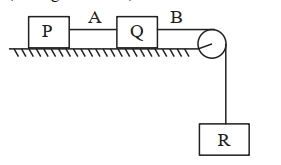
- 1Each of three blocks $P$, $Q$ and $R$ shown in figure has a mass of $3 \mathrm{~kg}$. Each of the wire $A$ and $B$ has cross-sectional area $0.005 \mathrm{~cm}^2$ and Young's modulus $2 \times 10^{11} \mathrm{~N} \mathrm{~m}^{-2}$. Neglecting friction, the longitudinal strain on wire $B$ is____________ $\times 10^{-4}$. $\left(\right.$ Take $\mathrm{g}=10 \mathrm{~m} / \mathrm{s}^2$ )View Solution
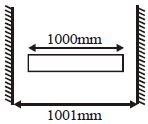
- 2$A$ rod of length $1000\, mm$ and coefficient of linear expansion $a = 10^{-4}$ per degree is placed symmetrically between fixed walls separated by $1001\, mm$. The Young’s modulus of the rod is $10^{11} N/m^2$. If the temperature is increased by $20^o C$, then the stress developed in the rod is ........... $MPa$View Solution
- 3A weight of $200 \,kg$ is suspended by vertical wire of length $600.5\, cm$. The area of cross-section of wire is $1\,m{m^2}$. When the load is removed, the wire contracts by $0.5 \,cm$. The Young's modulus of the material of wire will beView Solution
- 4Match the type of elasticity involvedView Solution
$(i)$ Suspension fibre of galvanometer $(a)$ Linear $(ii)$ Bending of beam $(b)$ Shear $(iii)$ cutting piece of paper $(c)$ Bulk $(iv)$ mechanical waves in fluid $(d)$ Shear - 5Three bars having length $l, 2l$ and $3l$ and area of cross-section $A, 2 A$ and $3 A$ are joined rigidly end to end. Compound rod is subjected to a stretching force $F$. The increase in length of rod is (Young's modulus of material is $Y$ and bars are massless)View Solution
- 6View SolutionYoung's modulus depends upon
- 7Density of rubber is $d$. $ A$ thick rubber cord of length $L$ and cross-section area $A$ undergoes elongation under its own weight on suspending it. This elongation is proportional toView Solution
- 8View SolutionIf the density of the material increases, the value of Young's modulus
- 9A copper wire of length $1.0\, m$ and a steel wire of length $0.5\, m$ having equal cross-sectional areas are joined end to end. The composite wire is stretched by a certain load which stretches the copper wire by $1\, mm$. If the Young's modulii of copper and steel are respectively $1.0\times10^{11}\, Nm^{-2}$ and $2.0\times10^{11}\, Nm^{- 2}$, the total extension of the composite wire is ........ $mm$View Solution
- 10View SolutionShearing stress causes change in