Question
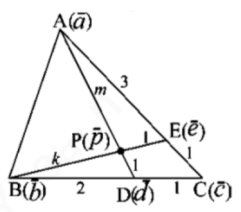
In $\triangle A B C, D$ and $E$ are points on $B C$ and $A C$ respectively, such that $B D=2 D C$ and $A E=$
$3 E C$. Let $P$ be the point of intersection of $A D$ and $B E$. Find $\frac{B P}{P E}$ using vector method.
Answer

Let $\bar{a}, \bar{b}, \bar{c}$ be the position vectors of $A, B$ and $C$ respectively with respect to some origin.
Image
$D$ divides $B C$ in the ratio $2:1$ and $E$ divides $A C$ in the ratio $3: 1$.
$\therefore \bar{d}=\frac{\bar{b}+2 c}{3} $ and $ \bar{e}=\frac{\bar{a}+3 c}{4}$
Let point of intersection $P$ of $A D$ and $B E$ divides $B E$ in the ratio $k: 1$ and $A D$ in the ratio $m: 1,$ then position vectors of $P$ in these two cases are
$\frac{\bar{b}+k\left(\frac{\bar{a}+3 \bar{c}}{4}\right)}{k+1} \text { and } \frac{\bar{a}+m\left(\frac{b+2 \bar{c}}{3}\right)}{m+1}$ respectively.
Equating the position vectors of $P$ we get,
$\frac{k}{4(k+1)} \bar{a}+\frac{1}{k+1} \bar{b}+\frac{3 k}{4(k+1)} \bar{c}$
$=\frac{1}{m+1} \bar{a}+\frac{m}{3(m+1)} \bar{b}+\frac{2 m}{3(m+1)} \bar{c}$
$\therefore \frac{k}{4(k+1)}=\frac{1}{m+1}.......(1)$
$\therefore \frac{1}{k+1}=\frac{m}{3(m+1)}......(2)$
$\therefore \frac{3 k}{4(k+1)}=\frac{2 m}{3(m+1)}......(3)$
Dividing equation $(3)$ by equation $(2),$
$\frac{\frac{3 k}{4(k+1)}}{\frac{1}{k+1}}$
$=\frac{\frac{2 m}{3(m+1)}}{\frac{m}{3(m+1)}}$
$\frac{3 k}{4}=2$
$k=\frac{8}{3}$
$\therefore \frac{B P}{P E}=\frac{k}{1}$
$\therefore \frac{B P}{P E}=\frac{8}{3}$

Need a full question paper?

Generate a complete, print-ready paper with questions like this in minutes — across 16+ boards, with answer keys.

Start Generating Free

Similar questions

Verify Rolle's theorem for the following function: $f(x)=x^2-4 x+10$ on $[0,4]$
Integrate the following w.r.t. x:

$\frac{1}{x\left(x^5+1\right)}$

Solve the following L.P.P. graphically.
Minimize $Z =6 x+2 y$
Subject to $5 x+9 y \leq 90, x+y \geq 4, y \leq 8, x \geq 0, y \geq 0$
Solve the following LPP by using graphical method.
Maximize : $Z =6 x+4 y$
Subject to $x \leq 2, x+y \leq 3,-2 x+y \leq 1, x \geq 0, y \geq 0$.
The following is the p.d.f. (Probability Density Function) of a continuous random variable $X$ :
$\begin{aligned}
f(x) & =\frac{x}{32}, & 0& =0, & \text { otherwise }
\end{aligned}$
(a) Find the expression for c.d.f. (Cumulative Distribution Function) of $X$.
(b) Also find its value at $x=0.5$ and 9 .
Show that volume of parallelepiped with coterminous edges as $\bar{a}, \bar{b}$ and $\bar{c}$ is $[\bar{a} \bar{b} \bar{c}]$. hence find the volume of the parallelepiped whose coterminous are $\hat{i}+\hat{j}, \hat{j}+\hat{k}, \hat{k}+\hat{i}$
If $l, m, n$ are the direction cosines of a line then prove that $l^2+m^2+n^2=1$. Hence find the direction angle of the line with the $X$-axis, which makes direction angles of $135^{\circ}$ and $45^{\circ}$ with $Y$ and $Z$ axes respectively.
Show that $\frac{d y}{d x}=\frac{y}{x}$ in the following, where a and $p$ are constants.

$\sec \left(\frac{x^5+y^5}{x^5-y^5}\right)=a^2$

In $\triangle A B C$, prove that $\frac{ b ^2- c ^2}{ a } \cos A +\frac{ c ^2- a ^2}{ b } \cos B +\frac{ a ^2- b ^2}{ c } \cos C =0$
Let $A (\bar{a})$ and $B (\bar{b})$ be any two points in the space $R (\bar{r})$ be a point on the line segment $AB$ dividing it internally in the ratio $m: n$, then prove that $\bar{r}=\frac{m \bar{b}+n \bar{a}}{m+n}$. Hence find the position vector $R$ which divides the line segment joining the points $A(1,-2,1)$ and $B(1,4,-2)$ internally in the ratio $2: 1$