Question
Let $A (\bar{a})$ and $B (\bar{b})$ be any two points in the space $R (\bar{r})$ be a point on the line segment $AB$ dividing it internally in the ratio $m: n$, then prove that $\bar{r}=\frac{m \bar{b}+n \bar{a}}{m+n}$. Hence find the position vector $R$ which divides the line segment joining the points $A(1,-2,1)$ and $B(1,4,-2)$ internally in the ratio $2: 1$
Answer

Image
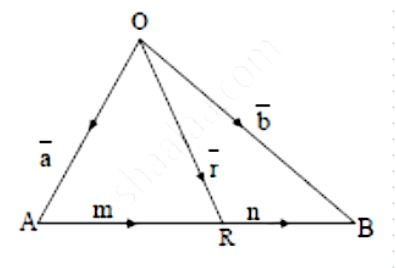
Consider a line segment AB. 
Let R be any point on it such that point R divides AB internally in the ratio m : n.
bar(OA) = bara, bar(OR) = barr and bar(OB) = barb are the position vectors of points A, R, B respectively. Since point R divides AB internally in the ratio m : n,
$\begin{aligned} & \frac{A R}{R B}=\frac{m}{n} \\ & n(A R)=m(R B)\end{aligned}$
$\overline{A R}$ and $\overline{R B}$ are in the same direction.
$\therefore n(\overline{A R})=m(\overline{R B})$
$n(\bar{r}-\bar{a})=m(\bar{b}-\bar{r})$
$n \bar{r}-n \bar{a}=m \bar{b}-m \bar{r}$
$n \bar{r}+m \bar{r}=m \bar{b}+m \bar{a}$
$\bar{r}(m+n)=m \bar{b}+n \bar{a}$
$\bar{r}=\frac{m \bar{b}+n \bar{a}}{m+n}$......(1)
This is the section formula for internal division
Let P. V. of point $A \bar{a}=\hat{i}-2 \hat{j}+\widehat{k}$
P. V. of point $B \bar{b}=\hat{i}+4 \hat{j}-2 \widehat{k}$
Given, $\frac{m}{n}=\frac{2}{1}$
Now, $\bar{r}=\frac{2(\hat{i}+4 \hat{j}-2 \widehat{k})+1(\hat{i}-2 \hat{j}+\widehat{k})}{2+1}$......from (1)
$\bar{r}=\frac{3 \hat{i}+6 \hat{j}-3 \widehat{k}}{3}$
P. V. of $R$ is $\bar{r}=\hat{i}+2 \hat{j}-\widehat{k}$

Need a full question paper?

Generate a complete, print-ready paper with questions like this in minutes — across 16+ boards, with answer keys.

Start Generating Free

Similar questions

If a fair coin is tossed 10 times and the probability that it shows heads (i) 5 times (ii) in the first four tosses and tail in the last six tosses.
Find the expected value, variance and standard derivation of random variable $X$ whose probability mass function $(p.m.f.)$ is given below
$X =x$ $1$ $2$ $3$
$P ( X =x)$ $\frac{1}{5}$ $\frac{2}{5}$ $\frac{2}{5}$
The rate of growth of bacteria is proportional to the number present. If initially, there were 1000 bacteria and the number doubles in 1 hour, find the number of bacteria after 2½ hours. [Take √2 = 1.414]
Show that the lines $\frac{x+1}{-3}=\frac{y-3}{2}=\frac{z+2}{1}$ and $\frac{x}{1}=\frac{y-7}{-3}=\frac{z+7}{2}$ are coplanar. Find the equation of the plane containing them.
Integrate the following functions w.r.t x:

$\frac{1}{\sin x \cdot \cos x+2 \cos ^2 x}$

$\int \frac{\sin 2 x}{3 \sin ^4 x-4 \sin ^2 x+1} d x$
Without using truth table prove that $(p \wedge q) \vee(\sim p \wedge q) \vee(p \wedge \sim q) \equiv p \vee q$
The cost of $2$ books, $6$ notebooks and $3$ pens is $₹ 40$ . The cost of $3$ books, $4$ notebooks and $2$ pens is $₹ 35$ , while the cost of $5$ books, $7$ notebooks and $4$ pens is $₹ 61$ . Using this information and matrix method, find the cost of $1$ book, $1$ notebook and $1$ pen separately.
A telephone company in a town has $5000$ subscribers on its list and collects fixed rent charges of $₹ 3.000$ per year from each subscriber. The company proposes to increase annual rent and it is believed that for every increase of one rupee in the rent, one subscriber will be discontinued. Find what increased annual rent will bring the maximum annual income to the company.
Find the inverse of $A=\left[\begin{array}{lll}1 & 0 & 1 \\ 0 & 2 & 3 \\ 1 & 2 & 1\end{array}\right]$ by elementary column transformations.