Question
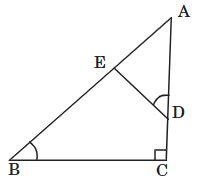
In $\triangle A B C$, If $\angle A D E=\angle B$, then prove that $\triangle A D E \sim \triangle A B C$.
Also if $A D=7.6 cm, A E=7.2 cm, B E=4.2 cm$ and $B C=5.4 cm$, then find $D E$.
Image

Answer

In $\triangle A D E$ and $\triangle A B C$
Given,
$
\begin{array}{ll}
\angle A D E=\angle B & (\text { Given }) \\
\angle A=\angle A & \text { (Common) } \\
\angle C=\angle E & \left(\text { each } 90^{\circ}\right)
\end{array}
$
Hence, $\triangle A D E \sim \triangle A B C$ by R.H.S criterion.
Now $\triangle A D E \sim \triangle A B C$
So,
$
\begin{array}{l}
\frac{A C}{A E}=\frac{A B}{A D}=\frac{B C}{D E} \\
A B=B E+A E \\
\Rightarrow A B=4.2+7.2=11.4 cm
\end{array}
$
Now, $\frac{A C}{A E}=\frac{A B}{A D}=\frac{B C}{D E}$
$
\Rightarrow \frac{A C}{7.2}=\frac{11.4}{7.6}=\frac{5.4}{D E}
$
Now, $\Rightarrow \frac{11.4}{7.6}=\frac{5.4}{D E}$
$
\begin{array}{l}
\Rightarrow 11.4 \times D E=5.4 \times 7.6 \\
\Rightarrow D E=\frac{7.6 \times 5.4}{11.4}
\end{array}
$
Hence $D E=3.6 cm$.

Need a full question paper?

Generate a complete, print-ready paper with questions like this in minutes — across 16+ boards, with answer keys.

Start Generating Free

Similar questions

In $\triangle\text{PQR},\text{PD}\perp\text{QR}$ such that D lies on QR. If PQ = a, PR = b, QD = C and DR = d, prove that (a + b)(a - b)=(a + b)(c - d).
Explain why 7 $\times$ 11 $\times$ 13 + 13 and 7 $\times$ 6 $\times$ 5 $\times$ 4 $\times$ 3 $\times$ 2 $\times$ 1 + 5 are composite numbers.
The following table shows the ages of the patients admitted in a hospital during a month:
$\text{Age(in years)}$ $6 - 15$ $16 - 25$ $26 - 35$ $36 - 45$ $46 - 55$ $56 - 65$
$\text{Number of patients}$ $6$ $11$ $21$ $23$ $14$ $5$
Find the mode and the mean of the data given above. Compare and interpret the two measures of central tendency.
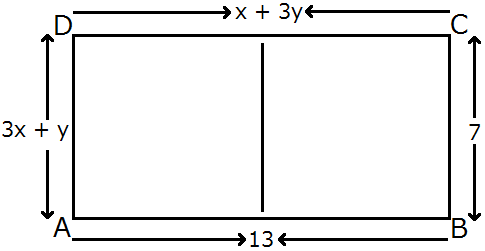
Find the values of x and y in the following rectangle.
A bag contains cards numbered from 1 to 49. A card is drawn from the bag at random, after mixing the card thoroughly. Find the probability that the number on the drawn card is:
  1. An odd number.
  2. A multiple of 5.
  3. A perfect square.
  4. An even prime number.
Find two consecutive positive odd integers whose product is 483.
Draw a circle of radius 4cm. Construct a pair of tangents to it, the angle between which is 60º. Also justify the construction. Measure the distance between the centre of the circle and the point of intersection of tangents.
A box contains 100 red cards, 200 yellow cards and 50 blue cards. If a card is drawn at random from the box, then find the probability that it will be:
  1. A blue card.
  2. Not a yellow card.
  3. Neither yellow nor a blue card.
Solve for x and y:
$\frac{\text{x}}{\text{a}}-\frac{\text{y}}{\text{b}}=0,$
$\text{ax}+\text{by}=(\text{a}^2+\text{b}^2)$
Find the quotient and the remainder when:
$f(x)=x^4-3 x^2+4 x+5$ is divided by $g(x)=x^2+1-x$