Question
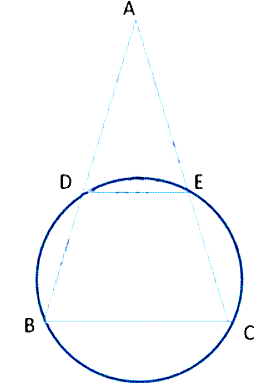
In triangle ABC, AB = AC. A circle passing through B and c intersects the sides AB and AC at D and E respectively. Prove that DE || BC.
Answer


To prove = DE II BC
Proof: In cydic quadrilateral DECB
∠ DEC + ∠ DBC = 80° - ( 1) (Opposite angles of cyclic quadrilateral)
Also, ∠ AED + ∠ DEC = 80° - (2) (Linear pair)
From (1) and (2), we get,
∠ DBC = ∠ AED - (3)
AB= AC (given)
∴ ∠ABC = ∠ ACB - (4) (angles opposite to equal sides of triangle)
From (3) and ( 4) ⇒ ∠ AED = ∠ ACB
But, these are corresponding angles
∴ DE II BC

Need a full question paper?

Generate a complete, print-ready paper with questions like this in minutes — across 16+ boards, with answer keys.
Start Generating Free

Similar questions

A shopkeeper sells an item for ₹ $ 2,150$. For a customer, he reduced the price of the item in such a way that the customer has to pay only ₹ $ 2,124$ including GST. If the rate of GST is $18 \%$, calculate the amount of reduction allowed by the shopkeeper.
A man invests Rs 20,020 in buying shares of nominal value Rs 26 at 10% premium. The dividend on the shares is 15% per annum. Calculate
1) the number of shares he buys
2) the dividend he receives annually.
3) the rate of interest he gets on his money.
Three numbers are in the ratio $\frac{1}{2}: \frac{1}{3}: \frac{1}{4}$ If the sum of their squares is 244 , find the numbers.
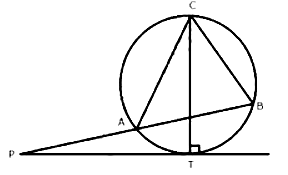
PT is a tangent to the circle at T. If ∠ ABC = 70° and ∠ ACB = 50° ; calculate : ∠ APT
Find the least value of $n$ for which the sum $1+3+3^2+\ldots$ to $n$ terms is greater than $7000$.
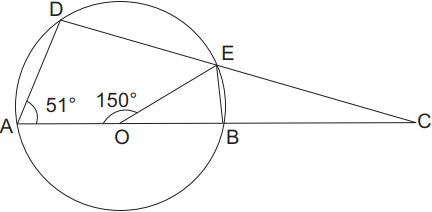
In the figure, $O$ is the centre of the circle.
$\angle \mathrm{AOE}=150^{\circ}, \angle \mathrm{DAO}=51^{\circ} .$
Calculate the measures of $\angle \mathrm{BEC}$ and $\angle \mathrm{EBC}$.
Image
Solve the following linear in$-$equation and graph the solution set on a real number line: $\frac{5}{4} x>1+\frac{1}{3}(4 x-1), x \in R$
The sum of diameter of two circles is $112 \ cm$ and the sum of their areas is $5236 \ cm^2$ Find the radii of the two circles.
Construct a rhombus ABCD with AB= 5.0 cm and AC= 8 cm. Draw its lines of symmetry.
If $b$ is the mean proportion between $a$ and $c,$ show that:
$\frac{a^4+a^2 b^2+b^4}{b^4+b^2 c^2+c^4}=\frac{a^2}{c^2}$