Questions

[4 marks sum]

🎯

Test yourself on this topic

45 questions · timed · auto-graded

Question 14 Marks
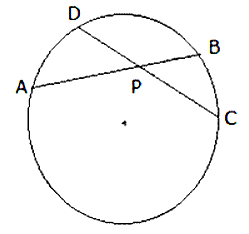
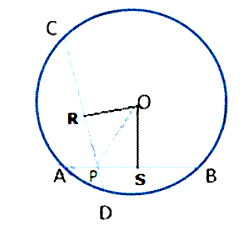
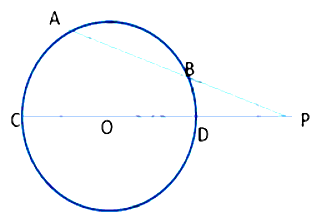
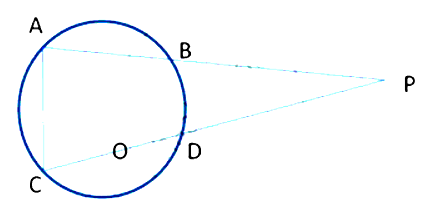
In fig., chords AB and CD of a circle intersect at P. AP = 5cm, BP= 3cm and CP = 2.5cm. Determine the length of DP.
Answer
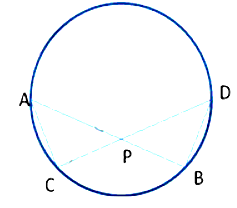

$\text { Let DP }= x cm$
$\text { In } \triangle APC \text { and } \triangle DPB$
$\angle PAC =\angle PDB \text { (angles in the some segment) }$
$\angle APC =\angle DPB \text { (vertically opposite angle) }$
$\therefore \triangle APC \sim \triangle DPB \quad\{ AA \text { corollary) }$
$\frac{ AP }{ DP }=\frac{ PC }{ PB } \text { (similar sides of similar triangles) }$
$\frac{5}{ x }=\frac{2.5}{3}$
$\Rightarrow x =\frac{15}{2.5}=\frac{150}{25}=6 cm $
View full question & answer
Question 24 Marks
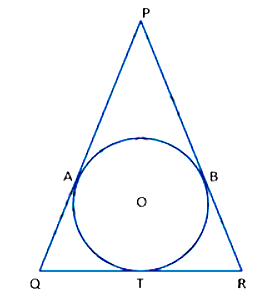
If Δ PQR is isosceles with PQ = PR and a circle with centre O and radius r is the incircle of the Δ PQR touching QR at T, prove that the point T bisects QR.
Answer

To proof:- QT = TR
Proof: Let the circle touches sides PQ and PR at points A and B respectively.
PA = PB , AQ = QT and BR = TR .....(Lengths of tangents drawn from an external point to a circle are equal)
Given, PQ = PR
PA + AQ = PB + BR
AQ = BR {Using (1))
⇒ QT = TR
View full question & answer
Question 34 Marks
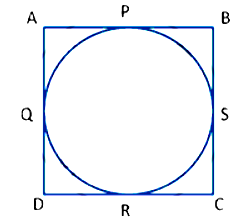
If all the sides of a parallelogram touch a circle, show that the parallelogram is a rhombus.
Answer

Let the sides of parallelogram ABCD touch the circle at points P, Q, R and S.
AP = AS - (1)
PB = BQ - {2} {Length of tangents drawn from an external point to a circle a equal)
DR = DS - {3}
RC = CQ - (4)
Adding (1), {2}, {3} and (4)
AP + PB + DR + RC = AS + BQ + DS + CQ
AB + CD = AD + BC
2 AB = 2 BC => AB = BC {Opposite sides of a parallelogram are equal)
:. AB = BC = CD = DA,
Hence , ABCD is a rhombus.
View full question & answer
Question 44 Marks
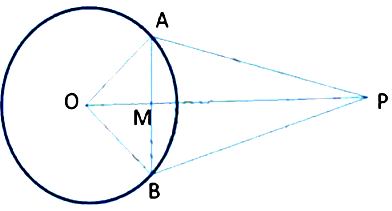
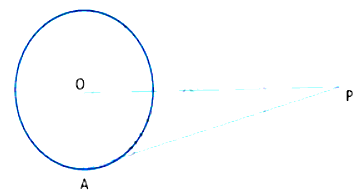
From a point P outside a circle, with centre O. tangents PA and PB are drawn as following fig., Prove that ∠ AOP = ∠ BOP and OP is the perpendicular bisector of AB.
Answer
In Δ AOP =Δ BOP
AP = PB (lengths of tangents drawn from and external point to a circle are equal)
OP = PO (common)
∠ PAO = ∠ PBO = 90 ° (radius is ⊥  to tangent at the point of contact)
∴  Δ AOP ≅  Δ BOP   {By RHS}
Δ AOP =  Δ BOP {By CPCT}
In Δ AMO and Δ BMO
AO = OB (radius of same circle)
∠ MOA = ∠ MOB {Proved above)
OM = MO {Common)
∴ Δ AMO ≅  Δ BMO {By CPCT}
∠ AMO = ∠ BMO
∠ AMO + ∠ BMO = 180°
∴ 2 ∠ AMO = 180°
∠ BMO = ∠ AMO =  90°
Hence, OP is the perpendicular bisector of AB. 
View full question & answer
Question 54 Marks
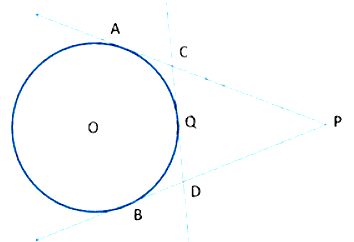
Two tangents are drawn to a circle from an external point P. touching the circle at the points A and B. A third tangent intersects segment PA in C and segment PB in D and touches the circle at Q. if PA = 20 units, find the perimeter of Δ PCD.
Answer

PA = PB = 20 Units ---(1) {Length of tangents drawn from an external point to a circle are equal }
CQ = CA and DQ = DB
Perimeter of Δ PCD
= PC+ CD+ PD
= PC+ CQ + QD + PD {Using {1)}
= PA+ PB
= 2PA
= 2{20}
= 40 Units
View full question & answer
Question 64 Marks
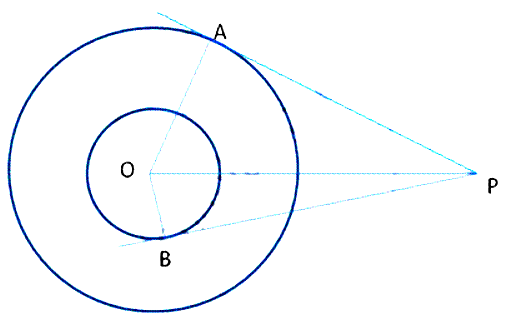
In followinf fig., two concentric circles with centre 0 are of radii 5 cm and 3 cm. from an external point P, tangents PA and PB are drawn to these circles. If AP = 12cm, find BP.
Answer
$\angle OAP =\angle OBP =90^{\circ}$ (radius is. $I$ to tangent at the point of contact)
In right $\triangle O A P$,
$O P^2=O A^2+A P^2$
$O P^2=5^2+12^2=25+144=169$
$OP =13 cm$
In right $\triangle OBP$,
$O P^2=O S^2+B P^2$
$B P^2=13^2-3^2$
$BP ^2=169-9=160$
$BP =4 \sqrt{10} cm$
View full question & answer
Question 74 Marks
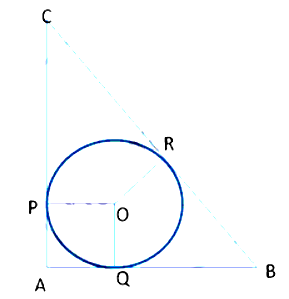
In following fig., ABC is a right- angled triangle at A with sides $AB = 5 cm$ and $BC = 13 cm$ . A circle with centre $O$ has been inscribed in the triangle $ABC$. Calculate the radius of the incircle.
Answer
In right $\triangle BAC,$
$BC^2= AC^2+ AB^2$
$AC^2= 13^2 -5^2$
$AC^2 = 169 - 25$
$AC^2 = 144$
$AC = 12$
$Let OP = OQ = r$ (say) (radius of same circle)
$\angle OQP = \angle OPQ = 90^\circ $ (radius is .L to tangent at the point of contact)
$\therefore OPAQ$ is a square.
$AQ = AP = OP = OQ = r$
$BQ = BR = 5 - r ---(1)$    (length of tangents drawn from an external point)
$PC = CR = 12 - r - (2)$  to a circle are equal}
$BC = CR+ BR$
$13 = 12 - r + 5 - r  $  [from (1) and {2}]
$2r = 4$
$r = 2$
Thus , radius of the circle is $2 cm$
View full question & answer
Question 84 Marks
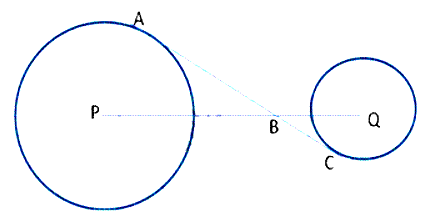
In the following fig. , AC is a transversal common tangent to tvvo circles with centres P and Q and of radii $6\ cm$ and $3\ cm$ respectively. Given that $AB = 8\ cm,$ calculate PQ.
Answer
To find :- PQ
Let $B C=x cm$
$\therefore A C=8+x$
By Pythagcras theorem $BQ =\sqrt{ x ^2+9}$
$A C^2= PQ ^2-9^2 $
$\Rightarrow(8+ x )^2=\left(10+\sqrt{ x ^2+9}\right)^2-81 $
$\Rightarrow 64+ x ^2+16 x =100+ x ^2+9+20 \sqrt{ x ^2+9} $
$\Rightarrow 5 \sqrt{ x ^2+9}=9+4 x$
Squaring both sides
$\Rightarrow 25\left(x^2+9\right)=81+16 x^2+72 x $
$\Rightarrow 9 x^2-72 x-144=0 $
$\Rightarrow x^2-8 x-16=0 $
$(x-4)^2=0 $
$\Rightarrow x=4 $
$B Q=\sqrt{4^2+9}=\sqrt{25}=5 $
$\Rightarrow P Q=P B+B Q $
$\Rightarrow P Q=10+5 $
$\Rightarrow P Q=15 cm$
View full question & answer
Question 94 Marks
A point A is $17\ cm$ from the centre of the circle. The length of the tangent drawn from A to the circle is $15\ cm$. find the radius of the circle.
Answer

$OA \perp AP$ (radius is perpendicular to tangent at the point of contact)
In right $\triangle OAP,$
$OP^2 = OA^2 + AP^2$
$AP^2 = 17^2 + 15^2$
$= 289 - 225$
$= 64$
$AP = 8$
The radius of the circle is $8 cm.$
View full question & answer
Question 104 Marks
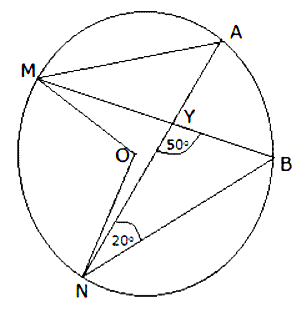
MABN are points on a drde having centre O. AN and MB cut at Y. If ∠ NYB = 50" and ∠ YNB = 200, find ∠ MAN and reflex angle MON.
Answer
∠ NYB =50 °
∠ YNB = 20°
In  Δ NYB,
20° + ∠ NBY + 50 ° = 180°
⇒ ∠ NBY = 180°  - 70 ° = 110 °
Now, ∠ MAN = ∠ NBM = 110°  (Angles in the same segment)
∠ MON = 2 ∠ MAN (Arc MN subtends ∠ MON at centre and ∠ MAN at remaining part of the circle)
∠ MON = 2(110°) = 220°
Reflex ∠ MON = 360° - ∠ MON
= 360° - 220°
Reflex ∠ MON = 140°. 
View full question & answer
Question 114 Marks
In the given Figure, AB and CD are two chords of a circle, intersecting each other at P such that AP = CP. Show that AB= CD.
Answer

If two chords of a circle interest internally then the products of the lengths of segments are equal, then
AP x BP= CP x DP ... ( 1)
But, AP= CP (Given) ....(2)
Then from ( 1) and (2), we have
BP= DP ......(3)
Adding (2) and (3),
AP + BP= CP + DP
⇒ AB = CD
Hence Proved.
View full question & answer
Question 124 Marks
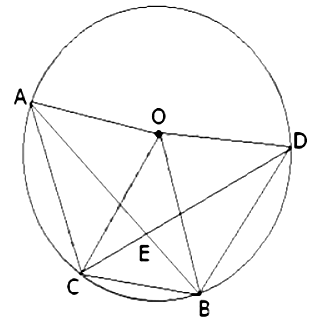
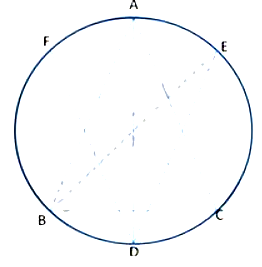
In a circle with centre O , chords AB and CD intersets inside the circle at E . Prove that ∠ AOC = ∠ BOD = 2 ∠ AEC.
Answer

Arc AC subtends LAOC at the centre of circle and LABC on the circumference of the cirde .
∴ ∠ AOC = 2 ∠ ABC ...(1)
Similarly, ∠ BOD and ∠ DCB are the angles subtended by the arc DB at the centre and on the circumference of the circle respectively .
∴ ∠ BOD = 2 ∠ DCB ... (2)
Adding ( 1) and (2),
∠ AOC+ ∠ BOD = 2(∠ ABC + ∠ DCB) ... (3)
In triangle ECB ,
∠ AEC = ∠ ECB + ∠ EBC = ∠ DCB + ∠ ABC
From (3),
∠ AOC+ ∠ BOD = 2 ∠ AEC
Hence Proved.
View full question & answer
Question 134 Marks
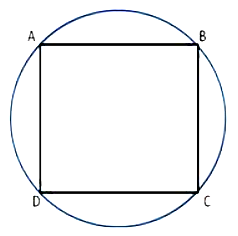
In a cyclic quadrialteral ABCD , if m ∠ A = 3 (m ∠C). Find m ∠ A.
Answer

m ∠ A = 3 (m ∠C)
∠ A + ∠ C = 180 (Opposite angles of a cyclic quadrilateral)
3∠C + ∠ C = 180
4 ∠ C = 180
∠ C = 45
m ∠ A = 3 (m ∠ C)
= 3 × 45
= 135
m ∠ A = 135°
View full question & answer
Question 144 Marks
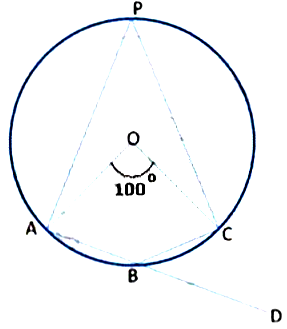
In following fig., O is the centre of the circle. Find ∠ CBD.
Answer
It is given that $\angle AOC =100^{\circ}$
Arc $A C$ subtends $\angle A O C$ at the centre of circle and $\angle A P C$ on the circumference of the circle
$\therefore \angle AOC =2 c$
$\Rightarrow \angle APC =\frac{100^{\circ}}{2}=50^{\circ}$
It can be seen that APCB is a cyclic quadrilateral.
$\therefore \angle APC +\angle ABC =180^{\circ}$ (Sum of opposite angles of a cyclic quadrilateral)
$\Rightarrow \angle A B C=180^{\circ}-50^{\circ}=130^{\circ}$
Now, $\angle ABC +\angle CBD =180^{\circ}$ (Linear pair angles)
$\angle C B D=180^{\circ}-130^{\circ}=50^{\circ}$
View full question & answer
Question 154 Marks
In following figure , chord ED is parallel to the diameter AC of the circle. Given ∠ CBE = 65° , calculate ∠DEC .
Answer
Let O be the centre of the cirde on diameter AC of the circle
Since, EC make ∠ EOC at the centre and ∠ EBC on the remaining part of the circle
∴ ∠ EOC = 2 ∠EBC = 2 (65) = 130°
In Δ EOC ,
∠EOC + ∠ OCE + ∠ CEO =  180°
130 + x + x = 180°  (OE = OC , ∴ ∠ OEC = ∠ OCE = x)
2x = 50
x = 25
∠ OCE = ∠ OEC  = 25°
Also , ∠ OCE = ∠ CED = 25°   (alternate interior angles)
View full question & answer
Question 164 Marks
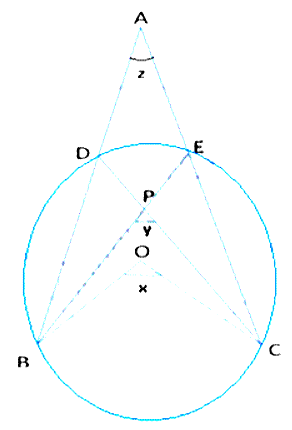
In following fig., O is the centre of the circle, prove that ∠x =∠ y + ∠ z.
Answer
Since arc $BC$ makes $\angle BOC$ at the centre and $\angle BDC$ on the remaining part of the circle
$\therefore \angle BDC =\frac{1}{2} \angle BOC =\frac{1}{2}( x )=\frac{1}{2} x$
$\angle B D C=\angle B E C=\angle \frac{x}{2}$ (angles in the same segment)
$\angle ADB = AEP =180-\angle \frac{ x }{2}$
Also, $\angle BPC =\angle DPE =\angle Y$ (Vertically opposite)
In quadrilateral ADPE,
$\angle A D P+\angle D E P+\angle P E A+\angle E A D=360^{\circ} /180-\angle \frac{x}{2}+\angle Y+180-\angle \frac{x}{2}+z=360^{\circ}$
$-\angle x+\angle y+\angle z=0$
$\angle x=\angle y+\angle z$;
View full question & answer
Question 174 Marks
The bisectors of the opposite angles A and C of a cydic quadrilateral ABCD intersect the cirde at the points E and F, respectively. Prove that EF is a diameter of the circle.
Answer

In cyclic quadrilateral ABCD
∠A + ∠ C = 180°
1/2 ∠A + 1/2 ∠C = 90°
∠EAB + ∠BCF = 90° -(1) (AE bisects ∠ A ; CF bisects ∠C)
Also ,
∠BCF = ∠BAF - (2) (Angles in the same segment)
Using (1) in (2) we get ,
∠EAB + ∠BAF = 90°
∠FAE = 90°
EF is the diameter of the circle ,
∴ angle in a semi circle is a right angle.
View full question & answer
Question 184 Marks
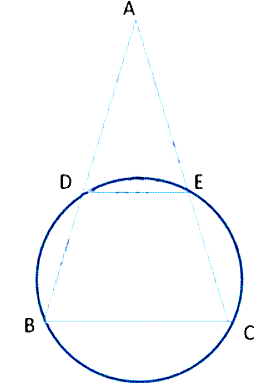
In triangle ABC, AB = AC. A circle passing through B and c intersects the sides AB and AC at D and E respectively. Prove that DE || BC.
Answer

To prove = DE II BC
Proof: In cydic quadrilateral DECB
∠ DEC + ∠ DBC = 80° - ( 1) (Opposite angles of cyclic quadrilateral)
Also, ∠ AED + ∠ DEC = 80° - (2) (Linear pair)
From (1) and (2), we get,
∠ DBC = ∠ AED - (3)
AB= AC (given)
∴ ∠ABC = ∠ ACB - (4) (angles opposite to equal sides of triangle)
From (3) and ( 4) ⇒ ∠ AED = ∠ ACB
But, these are corresponding angles
∴ DE II BC
View full question & answer
Question 194 Marks
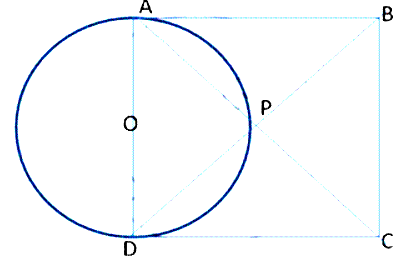
Prove that the circle drawn with any side of a rhombus as a diameter, passes through the point of intersection of its diagonals.
Answer

We know that the diagonals of a rhombus bisect each other at right angles.
∴ ∠ APO =90° - (1)
Also, AD is the diameter of the circle with centre 0
∴ ∠ APD=90° - (2) (Angle in semi circle)
From ( 1) and (2), we get, The cirde drawn with any side of a rhombus as a diameter, passes through point of intersection of its diagonals.
View full question & answer
Question 204 Marks
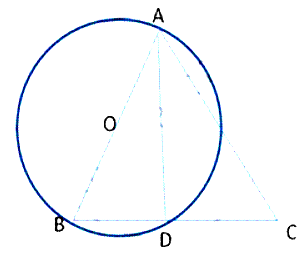
Prove that the circle drawn on any one of the equal sides of an isosceles triangle as diameter bisects the base.
Answer

To prove: BD =DC
Proof: let .AB be the diameter of the circle with centre O
∴ ∠ ADB = 900 (Angles in a semicirde is a right triangle)
∠ ADB + ∠ ADC = 180 (linear pair)
∴ ∠ ADC = 180 - 90 = 90°
In Δ ADB and Δ ADC
AB= AC (given)
∠ ADB = ∠ ADC (90"each)
AD= AD (Common)
∴ Δ ADB ≅ Δ ADC (RHS)
Hence BD = DC (CPCT)
View full question & answer
Question 214 Marks
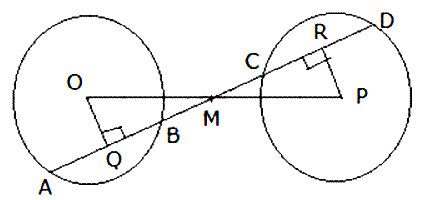
Two congruent drdes have their centres at 0 and P. Mis the midpoint of the line segment OP. A straight line is drawn through M cutting the two circles at the points A, B, C and D. Prove that the chords AB and CD are equal.
Answer

Given: Two congruent circles with centre 0 and P. Mis the mid-point of OP
To prove: Chord AB and CD are equal.
Construction: Draw OQ ⊥ AB and PR ⊥ CD.
Proof: In Δ OQM and Δ PRM
∠ OQM = ∠ PRC ...(Each 90°)
OM =MP ....(As M is the mid-point)
∠OMQ = ∠ PMR ...(Verically opposite angles)
Therefore, Δ OQM ≅ ΔPRM
⇒ OQ = PR ...(By CPCT)
Now the perpendicular distances of two chords 1n two congruent circles are equal, therefore chords are also equal.
⇒ AB = CD
Hence proved.
View full question & answer
Question 224 Marks
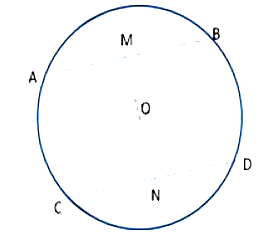
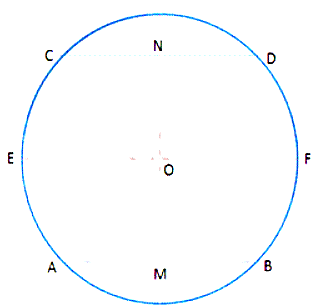
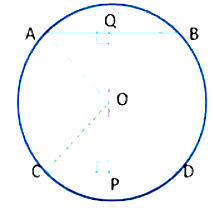
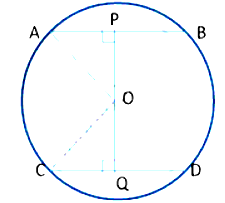
M and N are the midpoints of chords AB and CD . The line MN passes through the centre O . Prove that AB || CD.
Answer

AM = MB
CN = ND
∴ OM ⊥ AB
and ON ⊥ CD
(A line bisecting the chord and passing through the centre of the circle is perpendicular to the chord)
∴ ∠ OMA = ∠ OND = 90° each
But these are alternate interior angles
∴ AB || CD
View full question & answer
Question 234 Marks
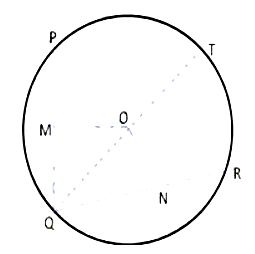
PQ and QR are two equal chords of a circle. A diameter of the circle is drawn through Q . Prove that the diameter bisects ∠ PQR.
Answer

Let QT be the diameter of ∠ PQR
Since , PQ = QR
∴ OM = ON
In Δ OMQ and Δ ONQ
OM = ON (equal chords are equidistant from the centre)
∠ OMQ = ∠ ONQ (90 ° each)
OQ = OQ (common)
Δ OMQ ≅ Δ ONQ (RHS)
∴ ∠ OQM = ∠ OQN (CPCT)
Thus QT i.e. diameter of the circle visects ∠ PQR.
View full question & answer
Question 244 Marks
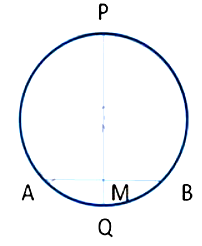
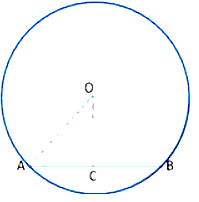
In following figure , AB , a chord of the circle is of length $18 \ cm$. It is perpendicularly bisected at M by $PQ.$
Answer
Given : $AB = 18 cm , MQ = 3 cm$
To find : $PQ$

$OQ = OA = r $cm (say)
$\therefore OM = OQ = MQ = (r - 3) cm$
$AM = MB = 9 cm (PQ \perp AB)$
In right $\triangle OMA ,$
$OM^2 + MA^2 = OA^2$
$\Rightarrow (r - 3)^2 + 9^2 = r^2$
$\Rightarrow r^2 - 6r + 9 + 81 = r^2$
$\Rightarrow 6r = 90$
$\Rightarrow r = 15 cm$
$PQ = 2r$
(Perpendicular bisector of a chord passes through the centre of the circe)
$PQ = 2(15)$
$PQ = 30 cm$
View full question & answer
Question 254 Marks
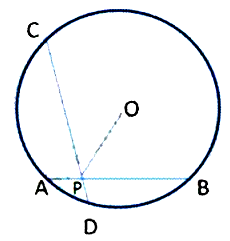
AB and CD are two equal chords of a drde intersecting at Pas shown in fig. P is joined to O , the centre of the cirde. Prove that OP bisects ∠ CPB.
Answer

Draw perpendiculars OR and OS to CD and AB respectively.
In triangle ORP and triangle OSP
OP= OP
OR = OS (Distance of equal chords from centre are equal)
∠ PRO = ∠ PSO (right angles)
Therefore, Δ ORP ≅ Δ OSP
Hence, ∠ RPO = ∠ SPO
Thus OP bisects ∠ CPB.
View full question & answer
Question 264 Marks
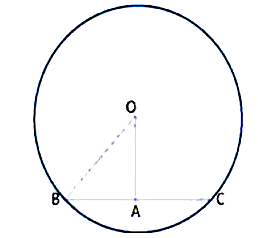
A chord of length 8cm is drawn inside a circle of radius 6cm. Find the perpendicular distance of the chord from the centre of the circle.
Answer

$
A C=C B=4 cm
$
(Perpendicular from centre to a chord bisects the chord)
In right $\triangle ABO$,
By Pythagoras theorem, $OA ^2= OC ^2+ AC ^2$
$O C^2-6^2+4^2$
$O C=36-16=20$
$O C^2=2 \sqrt{5} cm$
Perpendicular distance of chord from centre is $2 \sqrt{5} cm$
View full question & answer
Question 274 Marks
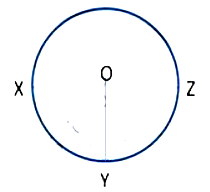
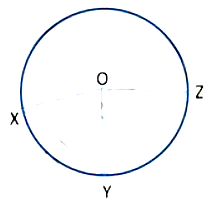
In following figure .,XY and YZ are two equal chords of a circle with centre O. Prove that the bisector of ∠ XYZ passes through O.
Answer

Join OX and OZ
In Δ XOY and Δ ZOY
OX = YZ (radii of same circle)
XY = YZ (given)
OY = OY (common)
∴ Δ XOY ≅ Δ ZOY (SSS)
∴ ∠ OYX = ∠ OYZ (CPCT)
Hence , OY is the bisector of ∠XYZ passing through O.
View full question & answer
Question 284 Marks
Find the length of the chord of a circle in the following when:
Radius is $6.5$ cm and the distance from the centre is $2.5$ cm
Answer

BA = AC ----(1) (Perpendicular from centre to a chord bisects the chord)
In right Δ OAB,
By Pythagoras theorem, $OB^2 = OA^2 + AB^2$
$AB^2 = 6.5^2 + 2.5^2$
$= 42.25 - 6.25 = 36$
$AB = 6cm$
∴ Length of chord BC = 2 AB (from (1))
= 2 (6) = 12 cm
View full question & answer
Question 294 Marks
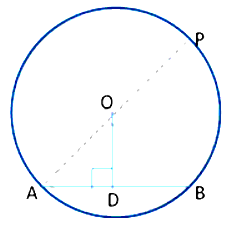
Find the diameter of the circle if the length of a chord is $3.2 cm$ and itd distance from the centre is $1.2 cm$.
Answer

AD = DB = 1.6 cm (Perpendicular from centre to a chord bisects the chord)
In right Δ ODA ,
By Pythagoras theorem , $OA^2 = OD^2 + AD^2$
$= 1.6^2 + 1.2^2$
$= 2.56 + 1.44$
$OA^2 = 4$
$OA = 2 cm$
Diameter (AP) = 2 (OA) = 2 (1) = 4 cm
View full question & answer
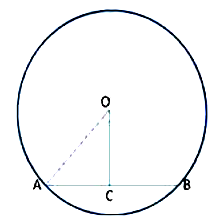
Question 304 Marks
Find the length of the chord of a circle in the following when:
Radius is $1. 7\ cm$ and the distance from the centre is $1.5 \ cm$
Answer

$AC = CB ----(1)$ (Perpendicular from centre to a chord bisects the chord)
In right $\triangle ACO,$
By Pythagoras theorem, $OA^2 = OC^2 + AC^2$
$AC^2 = (1. 7)^2 - (1.5)^2 = 2.89 - 2.25 =.64$
$AC = 0.8 cm$
$\therefore $ length of chord AB = 2AC (from $( 1))$
$= 2(0.8) = 1.6 cm$
View full question & answer
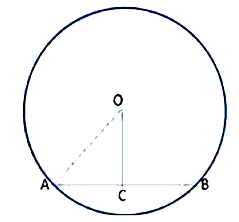
Question 314 Marks
Find the length of the chord of a circle in the following when:
Radius is $13 \ cm$ and the distance from the centre is $12 \ cm$
Answer

$AC = CB ----(1)$ (Perpendicular from centre to a chord bisects the chord)
In right t. $ACO,$
By Pythagoras theorem, $OA^2 = OC^2 + AC^2$
$13^2 -12^2 = AC^2$
$AC^2 = 169 - 144 = 25$
$AC = 5 cm$
$\therefore $ length of chord $AB = 2AC$ (from $(1)$)
View full question & answer
Question 324 Marks
In fig. $, AB$ and $DC$ are two chords of a circle with centre $O$. these chords when produced meet at $P$. if $PB =$ Bern $, BA = 7\ cm$ and $PO = 14.5\ cm,$ find the radius of the circle.
Answer

Let $O D=O C=r \ ($say$)$
$P O=14.5, C P=r+14.5$
$P D=14.5-r$
In $\triangle BPD$ and $\triangle APC$
$\angle BPD =\angle APC \ ($Common$)$
$\angle ABD +\angle DBP =180^{\circ}\ldots(1) \ ($ Linear pair $)$
Also, $\angle ABD +\angle ACD =180^{\circ}\ldots(2$
$($Opposite angles of a cyclic quadrilateral$)$
From $(1)$ and $(2)$
$\angle DBP =\angle ACD$
$\therefore \triangle BPD \sim \triangle CPA \ (AA$ corollary$)$
$\frac{8}{ r +14.5}=\frac{4.5- r }{15}$
$120^{\circ}=14.5^2- r ^2$
$r 2=210.25-120$
$r ^2=90.25$
$r =9.50$
Radius of the circle is $9.5 \ cm$.
View full question & answer
Question 334 Marks
Bisectors of angles $A, B$ and $C$ of a triangle $\text{ABC}$ intersect its circumcircle at $D, E$ and $F$ respectively. Prove that the angles of $\triangle D E F$ are $90^{\circ}-\frac{ A }{2}, 90^{\circ}-\frac{ B }{2}$ and $90^{\circ}-\frac{ C }{2}$ respectively.
Answer

Since $A D, B E$ and $C F$ are bisectors of $\angle A, \angle B$ and $\angle C$ respectively.
$\therefore \angle 1=\angle 2=\angle \frac{ A }{2}$
$\angle 3=\angle 4=\angle \frac{ B }{2}$
$\angle 5=\angle 6=\angle \frac{ C }{2}$
$\angle ADE =\angle 3$
Also $\angle ADF =\angle 6 \ldots...(2)\  ($angles in the same segment$)$
Adding $(1)$ and $(2)$
$\angle ADE +\angle ADF =\angle 3+\angle 6$
$\angle D =\frac{1}{2} \angle B +\frac{1}{2} \angle C$
$\angle D =\frac{1}{2}( B +\angle C )$
$=\frac{1}{2}(180-\angle A )\left(\angle A +\angle B +\angle C =180^{\circ}\right)$
$\angle D =90-\frac{1}{2} \angle A$
Similarly,
$\angle E =90-\frac{1}{2} \angle B , \angle F $
$=90-\frac{1}{2} \angle C$
View full question & answer
Question 344 Marks
Prove that the angles bisectors of the angles formed by producing opposite sides of a cyclic quadrilateral (provided they are not parallel) intersect at right triangle.
Answer

Here, ABCD is a cyclic quadrilateral. PM is bisector of ∠ APB and QM is bisector of ∠ AQD
In Δ PDL and Δ PBN, ∠ 1=∠ 2 (PM is a bisector of LP)
∠ 3 = ∠ 9 (exterior angle of cydic quad. = interior opposite angle)
∴ ∠ 4 = ∠ 7
But, ∠ 4 = ∠ 8 (vertical opposite angles)
∴ ∠ 7 = ∠ 8
Now in Δ QMN and Δ QML
∠ 7 = ∠ 8 (proved above)
∠ S = ∠ 6 (QM is bisector of Q)
∴ Δ QMN ~ Δ QML
⇒ ∠ QMN and ∠ QML
But, ∠ QMN + ∠ QML = 180°
∴ ∠ QMN = ∠ QML = 90°
Hence, ∠ PMQ = 90 °
View full question & answer
Question 354 Marks
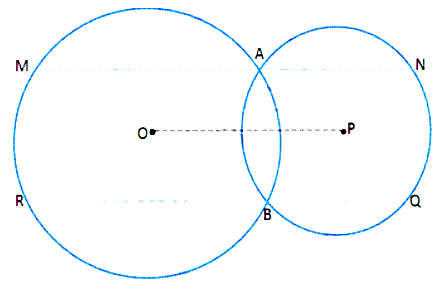
Two circles with centres O and P intersect each other at A and B as shown in following fig. Two straight lines MAN and RBQ are drawn parallel to OP.
Prove that (i) MN = 20 P (ii) MN= RQ.
Answer

Given: Two cirdes with centres 0 and P, and MN II OP || RQ
To prove: (i) MN = 20P (ii) MN= RQ.
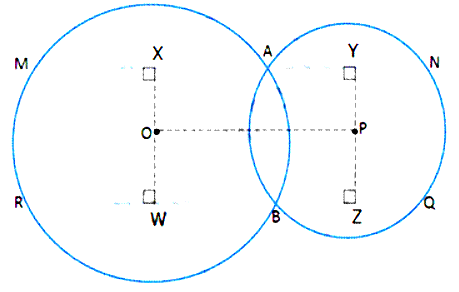
Construction: OX ⊥ MN, PY ⊥ MN, OW ⊥ RZ, PZ ⊥ RQ
Proof: Since each angle of the quadrilateral XYZW is a right angle, sc XYZW is a rectangle.
Also, XYPO is a rectangle. ...(1)
Now, perpendicular drawn from the centre to the chord bisects the chord.
Therefore, MA = 2 XA and AN = 2 AY ...(2)
Now, MN = MA + AN = 2 XA + 2 AY [from (2)]
⇒ MN = 2(XA + AY) = 2 XY
⇒ MN = 2 OP [As XYPO is a rectangle, XY = OP] ... (3)
This proves part (i).
By similar arguments, we have RQ = 2 OP ...(4)
Using (3) and ( 4), we get
MN= RQ.
This proves part (ii).
View full question & answer
Question 364 Marks
Prove that the line segment joining the midpoints of two parallel chords of a circle passes through its centre. 
Answer

Given: AB and CO are two chords of a cirde with centre O.
AB II CD , M and N are midpoints of AB and CO respectively.
To prove : MN passes through centre O.
Construction : Join OM, ON, and through O, draw a straight line EF parallel to AB.
Proof : OM ⊥ AB
(line joining the midpoin t of a chord to the centre of a circle is perpendicular to it)
∠ AMO = 90°
∠ MOE = 90° [cointerior angle of ∠ AMO]
∠ NOE = 90° [corresponding angle of ∠ AMO]
∠ MOE + ∠ NOE = 180°
∠ MON is a straight line .
Hence, MN passes through centre O.
View full question & answer
Question 374 Marks
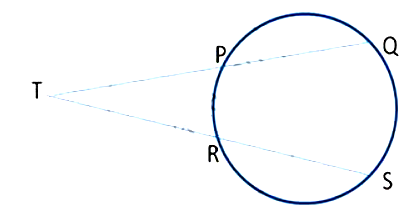
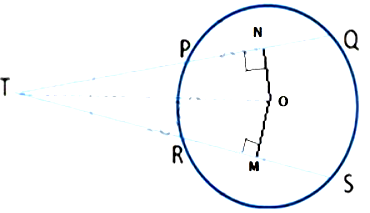
In fig. the centre of the circle is $O. PQ$ and $RS$ are two equal chords of the circle which , when produced , meet at $T$ outside the circle . Prove that $(a) TP = TR (b) TQ = TS.$
Answer


Given $PQ = RS$
To prove : $TP = TR$ and $TQ = TS$
Construction: Draw $ON \perp PQ$ and $OM \perp RS$
Proof: Since equal vhords are equidistance from the circle therefore
$P Q=R S $
$\Rightarrow O N=O M\ldots(1)$
Also perpendicular drawn from the centre bisects the chord.
So, $PN = NQ =\frac{1}{2} "PQ"$ and $RM = MS =\frac{1}{2} "RS"$
But $P Q=R S$, we get
$P N=R M\ldots(2)$
And,$N Q=M S\ldots(3)$
Now in $\triangle TMO$ and $\triangle TNO$,
$TO = TO...($common$)$
$M O=N O \ ($BY $(1))$
$\angle TMO =\angle TNO...\ ($Each $90$ degrees$)$
Therefore , $\triangle TMO \cong \triangle TNO ,..($By $\text{RHS})$
$\Rightarrow TN = TM...($ by $\text{CPCT})\ldots(4)$
Substracting, $(2)$ from $(4),$ we get
$TN - PN = TM - RM$
$\Rightarrow TP = TR$
Adding $(3)$ and $(4),$ we get
$TN + NQ = TM + MS$
$\Rightarrow TQ = TS$
Adding $(3)$ and $(4),$ we get
$TN + NQ = TM + MS$
$\Rightarrow TQ = TS$
Hence proved.
View full question & answer
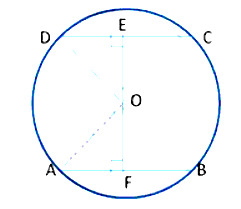
Question 384 Marks
Two chords of lengths $10\ cm$ and $24\ cm$ are drawn parallel $O$ each other in a circle. If they are on the same side of the centre and the distance between them is $17\ cm,$ find the radius of the circle.
Answer

$CP = PO = 12\ cm$
Let $OA = OC = r \ ($say$)$
Also, let $OQ = x,$
$\therefore OP = 17 - x$
In right $\triangle \text{OPC},$
By Pythagoras theorem,
$OC^2 = OP^2 + PC^2$
$r^2 = (17- x)^2 + 122 ----( 1 )$
Similarly, In $\triangle \text{OQA},$
$OA^2 = AQ^2 + QO^2$
$r^2 = 5^2 + x^2 ----(2)$
From $(1)$ and ${2}$
$( 17 - x)^2 + 12^2 = 52 + x^2$
$289 - 34 x + 144 - 25 = 0$
$34x = 408$
$x = 12$
From ${2}$
$r^2 = 5^2 + 12^2$
$25+ 144= 169$
$r = 13$
The radius of the circle is $13\ cm .$
View full question & answer
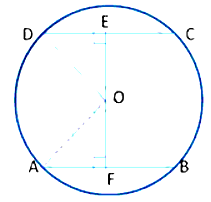
Question 394 Marks
Two chords $AB$ and $CD$ of lengths $6\ cm$ and $12\ cm$ are drawn parallel inside the circle. If the distance between the chords of the circle is $3\ cm,$ find the radius of the circle.
Answer


$A P=P B=3 \ cm$
$C Q=Q D=6 \ cm \ ($Perpendicular from centre to a chord bisects the chord$)$
$O A=O C=r \ ($say$)$
Let $OP = x ,$
$ \therefore OQ =3- x$
In right $\triangle O Q C$,
By Pythagoras theorem,
$O C^2=O Q^2+C Q^2$
$r^2=(3-x)^2+6^2\ldots(1)$
Similarly, In $\triangle O P A$,
$OA ^2= AP ^2+ PO ^2$
$r^2=3^2+x^2\ldots(2)$
From $(1)$ and $(2)$
$(3-x)^2+6^2=3^2+x^2$
$-6 x+36=0$
$x=6$
from $(2)$
$r^2=3^2+6^2$
$=9+36=45$
$r=3 \sqrt{5}$
Thus, radius of the circle is $3 \sqrt{5} \ cm$
View full question & answer
Question 404 Marks
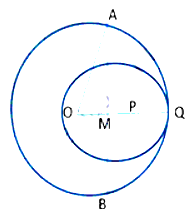
Two circles of radii $5\ cm$ and $3\ cm$ with centres $O$ and $P$ touch each other internally. If the perpendicular bisector of the line segment $OP$ meets the circumference of the larger circle at $A$ and $B,$ find the length of $AB$.
Answer


$OA = OQ =5 \ cm \ ($Radius of bigger circle$)$
$PQ =3 \ cm \  ($Radius of smaller circle$)$
$OP =2 \ cm$
Perpendicular bisector of $OP$
i.e. $ AB $  meets  $OP$ at $ M $
$OM = MP =\frac{1}{2} OP =1 \ cm$
In right $ \triangle OMA \text {, }$
By Pythagoras theorem,
$OA ^2= OM ^2+ MA ^2$
$MA ^2=5^2-1^2$
$=25-1$
$=24$
$AM =2 \sqrt{6} \ cm$
$AM = MB =2 \sqrt{6} \ cm$
$AB = AM + MB $
$=2 \sqrt{6}+2 \sqrt{6}$
$=4 \sqrt{6}$
View full question & answer
Question 414 Marks
A chord of length $6 \ cm$ is at a distance of $7.2 \ cm$ from the centre of a circle. Another chord of the same circle is of length $14.4 \ cm$. Find its distance from the centre.
Answer

$AF = FB = 3\ cm$
$CE = ED = 7.2\ cm$
$($Perpendicular from centre to a chord bisects the chord$)$
In right $\triangle \text{AFO},$ By Pythagoras theorem,
$OA^2 =OF^2+ AF^2$
$OA^2 = (7.2)^2 + (3)^2$
$OA^2 = 51.84 + 9$
$OA^2 = 60.84$
$OA = 7.8\ cm$
$OA = OC = 7.8\ cm\  ($radii of same circle$)$
Similarly, In right $\triangle \text{OFC},$
$OC^2 = OE^2 + EC^2$
$OE^2 = (7 .8)^2 - (7.2)^2$
$= 60.84 - 51.84$
$OE^2 = 9$
$OE = 3\ cm$
Distance from centre of chord $CD$ with length $14.4\ cm$ is $3\ cm.$
View full question & answer
Question 424 Marks
A chord of a length $16.8 \ cm$ is at a distance of $11.2 \ cm$ from the centre of a circle . Find the length of the chord of the same circle which is at a distance of $8.4 \ cm$ from the centre.
Answer

$AF = FB = 8.4 \ cm$
And $DE = EC .....(1)$
$($Perpendicular from centre to a chord bisects the chord$)$
In right $\triangle \text{ODA},$
By Pythagoras theorem$, OA^2 = OF^2 + AF^2$
$= (11.2)^2 + (8.4)^2$
$= 125.44 + 70.56$
$OA^2 = 196$
$OA = 14 \ cm$
$OA = OD = 14\ cm \ ($radii of same circle$)$
Similarly, In $\triangle \text{DEO}$
$OD^2 = OE^2 + DE^2$
$DE^2 = 14^2 + 8.4^2$
$= 196 - 70.56$
$DE^2 = 125.44$
$DE = 11.2 \ cm$
$\therefore$ length of chord $DC = 2DE = 2(11.2) = 22.4 \ cm$
View full question & answer
Question 434 Marks
AB and AC are two equal chords of a circle with centre o such that LABO and LCBO are equal. Prove that AB = BC. 
Answer

Given: AB = AC, ∠ ABO = ∠ CBO
To Prove: AB = BC
Construction : Draw ON ⊥ AB and OM ⊥ BC
Proof : In triangles BNO and BMO,
∠ NBO = ∠ MBO (Given)
∠ BNO = ∠ BMO (Each 90 ° )
BO= BO (common)
Thus , Δ BNO ≅ Δ BMO (By AAS)
⇒ BN =BM
⇒ 2 BN = 2 BM (Since perpendicular drawn from the centre bisects the chord)
⇒ AB = BC
Hence Proved.
View full question & answer
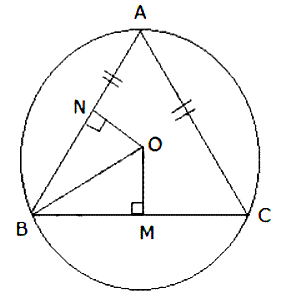
Question 444 Marks
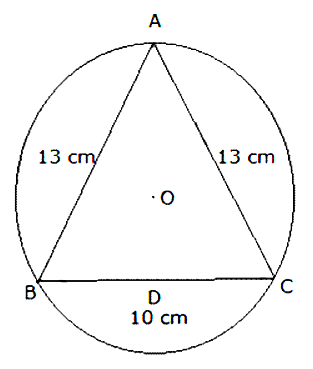
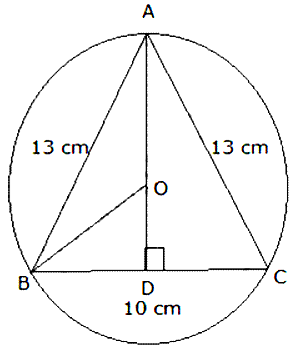
In figure $, \text{ABC}$ is an isosceles triangle inscribed in a circle with centre $O$ such that $AB = AC = 13 \ cm$ and $BC = 10 \ cm$ .Find the radius of the circle.
Answer

Since $\text{ABC}$ is an isosceles triangle$, \text{AOO}$ is the perpendicular bisector of $BC.$
In triangle $\text{ADC},$ by Pythagoras theorem we have
$AD^2 = AC^2 - DC^2 = 13^2 - 5^2 = 169 - 25 = 144$
$\Rightarrow AD = 12 \ cm \Rightarrow AO + OD = 12 \Rightarrow AO = 12 - x ...($Assuming $OD = x \ cm)$
Again in triangle $\text{OBD},$
$BO^2 = BD^2 + OD^2 = 25 + x^2 ..($As $BD = 5 \ cm)$
$\Rightarrow (12 - x)^2 = 25 + x^2 ..($As $AO = BO =$ radius$)$
$\Rightarrow 144 + x^2 - 24 x = 25 + x^2$
$\Rightarrow -24 x = 25 - 144 = - 119$
$\Rightarrow x = 4.96 \ cm$
$\Rightarrow AO = 12 - 4. 96 = 7 .04 \ cm$
View full question & answer
Question 454 Marks
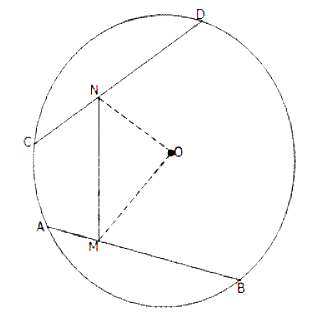
In fig, AB and CD are two equal chords of a circle with centre O. If M and N are the midpoints of AB and CD respectively,
prove that (a) ∠ ONM = ∠ ONM (b) ∠ AMN = ∠ CNM.
Answer

M and N are mid points of equal diords AB and CD respectively.
ON ⊥ CD and OM ⊥ AB
∴ ∠ ONC = ∠ OMA (90° each) ...(1)
(A line bisecting the chord and passing through the centre of the circle is perpendicular to the chord)
∴ AB = CD
ON = OM (equal chords are equidistant from the centre)
In Δ MON ,
MO = NO
∴ ∠ ONM = ∠ OMN ..(2)
Subtracting (2) from ( 1)
∠ONC - ∠ ONM = ∠ OMA - ∠ OMN
∠ CNM =∠ AMN
View full question & answer
[4 marks sum] - Mathematics STD 10 Questions - Vidyadip