Question
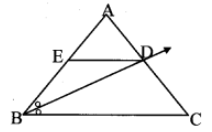
In $\triangle \mathrm{ABC}$, ray $\mathrm{BD}$ bisects $\angle \mathrm{ABC}$. $A-D-C$, side DE $\|$ side $B C, A-E-B$ then prove that, $\frac{A B}{B C}=\frac{A E}{E B}$

Answer

self

Need a full question paper?

Generate a complete, print-ready paper with questions like this in minutes — across 16+ boards, with answer keys.
Start Generating Free

Similar questions

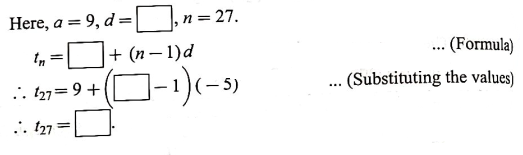
Complete the following activity to find the 27 th term or the A.P. 9. 4. -1,-6,-11, ........
Image
Complete the following table:
Sr.
No.
Face ValueTypeMarket
Value
(i)₹ 100Premium
₹ 25
 
(ii) At par₹ 175
(iii)₹ 100Discount
₹ 40
 
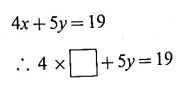
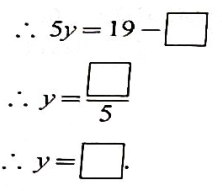
To draw the graph of $4 x+5 y=19$, complete the following activity to find $y$, when $x=1$.
Image
Image
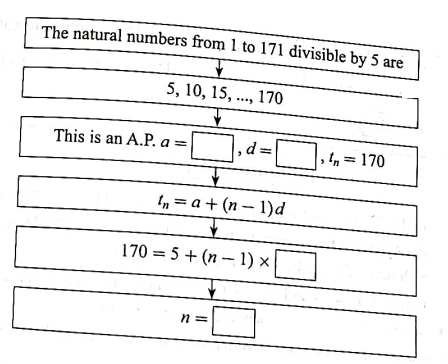
Complete the following activity to find the number of natural numbers from 1 to 171 which are divisible by 5 .
Image
prove the theorem Opposite angles of a cyclic quadrilateral are supplementry.
Write the correct number in the given boxes from the following A. P.
3, 6, 9, 12, . . .
Here
$t _1$ = ⬜,$t _2$ = ⬜,$t _3$ = ⬜,$t _4$ = ⬜
$t _2- t _1$ = ⬜,$t _3- t _2$ = ⬜
d = ⬜
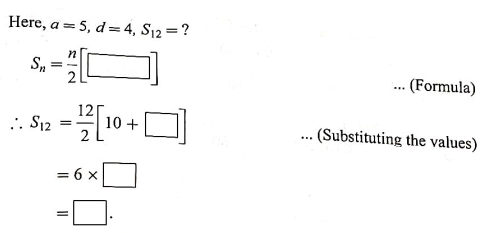
The first term of an A.P. is 5 and the common difference is 4 . Complete the following activity to find the sum of first 12 terms of this A.P.

Image
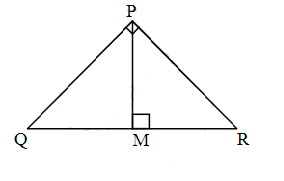
From given figure, in $\triangle P Q R$, if $\angle Q P R=90^{\circ}, P M \perp Q R, P M=10, Q M=8$, then for finding the value of $Q R$, complete the following activity.
Image
Activity: In $\triangle P Q R$, if $\angle Q P R=90^{\circ}, P M \perp Q R$,
[Given]
In $\triangle P M Q^1$ by Pythagoras Theorem,
$\therefore PM ^2+\square= PQ ^2$
$\therefore P Q^2=10^2+8^2$
$\therefore P Q^2=\square+64$
$\therefore P Q^2=\square$
$\therefore P Q=\sqrt{164}$
Here, $\triangle QPR \sim \triangle QMP \sim \triangle PMR$
$\therefore \triangle QMP \sim \triangle PMR$
$\therefore \frac{ PM }{ RM }=\frac{ QM }{ PM }$
$\therefore PM ^2= RM \times QM$
$\therefore 10^2= RM \times 8$
$RM =\frac{100}{8}=\square$
And,
$Q R=Q M+M R$
$QR =\square+\frac{25}{2}=\frac{41}{2}$
In $\triangle A B C$, ray $B D$ bisects $\angle A B C . A-D-C$, side $D E \|$ side $B C, A-E-B$, then prove that $\frac{A B}{B C}=\frac{A E}{E B}$
Image
In $\triangle A B C$, ray $B D$ bisects $\angle B$.
$\therefore \quad \frac{ AB }{ BC }=\frac{ AD }{ DC }$
In $\triangle ABC , DE \| BC$
$\therefore \quad \frac{ AE }{ EB }=\frac{ AD }{ DC }$
$\therefore \frac{ AB }{ ⬜ }=\frac{ ⬜ }{ EB }$
[Given]
[Angle biscetor theorem]
[Given]

[From (i) and (ii)]