Question
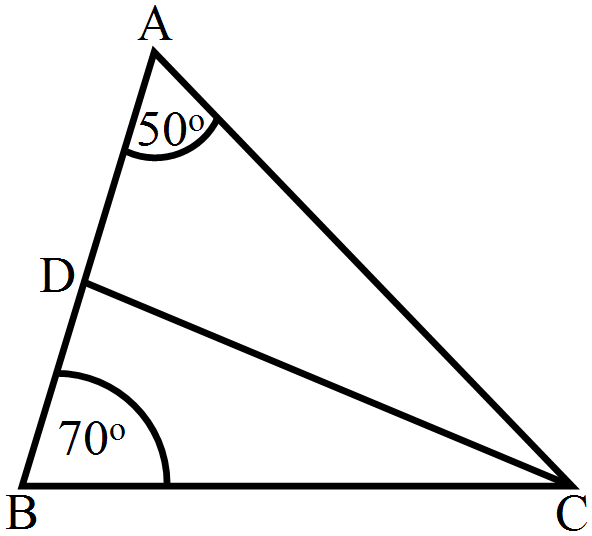
In $\triangle \text{ABC}, \angle \text{A}=50^\circ, \angle \text{B}=70^\circ$ and bisector of $\angle \text{C}$ meets $AB$ in $D$. Find the angles of the triangles $ADC$ and $BDC.$
Answer


We know that the sum of all three angles of a triangle is equal to $180^\circ $
Therefore, for the given $\triangle \text{ABC},$ we can say that:
$\angle \text{A}+\angle \text{B}+\angle \text{C}=180^\circ$
$($Sum of angles of $\triangle \text{ABC})$
$\Rightarrow 50^\circ+70^\circ+\angle \text{C}=180^\circ$
$\angle \text{C}=180^\circ-120^\circ$
$\angle \text{C}=60^\circ$
$\angle \text{ACD}=\angle \text{BCD}=\frac{\angle \text{C}}{2}$ (CD bisects $\angle \text{C}$ and meets $AB$ is $D.)$
$\Rightarrow \angle \text{ACD}=\angle \text{BCD}=\frac{60^\circ}{2}=30^\circ$
Using the same logic for the given $\triangle \text{ACD},$ we can sat that:
$\angle \text{DAC}+\angle \text{ACD}+\angle \text{ADC}=180^\circ$
$\Rightarrow 50^\circ+30^\circ+\angle \text{ADC}=180^\circ$
$\angle \text{ADC}=180^\circ-80^\circ$
$\angle \text{ADC}=100^\circ$
If we use the same logic for the given $\triangle \text{BCD},$ we can say that:
$\angle \text{DBC}+\angle \text{BCD}+\angle \text{BDC}=180^\circ$
$\Rightarrow 70^\circ+30^\circ+\angle \text{BDC}=180^\circ$
$\angle \text{BDC}=180^\circ-100^\circ$
$\angle \text{BDC}=80^\circ$
Thus,
For $\triangle \text{ADC}:\angle \text{A}=50^\circ, \ \angle \text{D}=100^\circ, \ \angle \text{C}=30^\circ$
For $\triangle \text{BDC}:\angle \text{B}=70^\circ, \ \angle \text{D}=80^\circ, \ \angle \text{C}=30^\circ$

Need a full question paper?

Generate a complete, print-ready paper with questions like this in minutes — across 16+ boards, with answer keys.
Start Generating Free

Similar questions

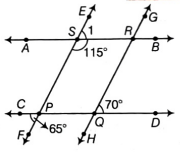
In the given figure, examine whether the following pairs of lines are parallel or not.
Image
Q.1. EF and GH
Q.2. AB and CD
If $P=7 x^2+5 x y-9 y^2, Q=4 y^2-3 x^2-6 x y$ and $R=-4 x^2+x y+5 y^2$, show that $P+Q+R=0$.
$\frac{\text{5x}-1}{3}-\frac{2\text{x}-2}{3}=1$
Find the value of n, where n is an integer and $2^{\text{n-5}}\times6^{\text{2n-4}}=\frac{1}{12^{4}\times2}$
Two parallel lines $l$ and $m$ are cut by a transversal $t.$ If the interior angles of the same side of t be $(2x - 8)o$ and $(3x - 7)o,$ find the measure of each of these angles.
From the sum of $3 x^2-5 x+2$ and $-5 x^2-8 x+9$ subtract $4 x^2-7 x+9$
Subtract the following :
(a) 7a + 8b – c from 5a – b + 3c
(b) 2x – 3y from z – x
(c) 3pq – 2p + q from 4pq + 7p – 2p
(d) 11 xy – 5y + 2x from 15xy + y – x
Complete the following multiplication table:
Second number
First number
$x$
$-4$
$-3$
$-2$
$-1$
$0$
$1$
$2$
$3$
$4$
$-4$


$-3$


$-2$


$-1$


$0$


$1$


$2$


$3$


$4$


ls the multiplication table symmetrical about the diagonal joining the upper left corner to the lower right corner?
What's the error? A student said that $\frac{3^5}{9^5}$ is the same as $\frac{1}{15}$. What mistake has the student made?
Find $x, y, z$ (whichever is required) from the figure given below: