Question
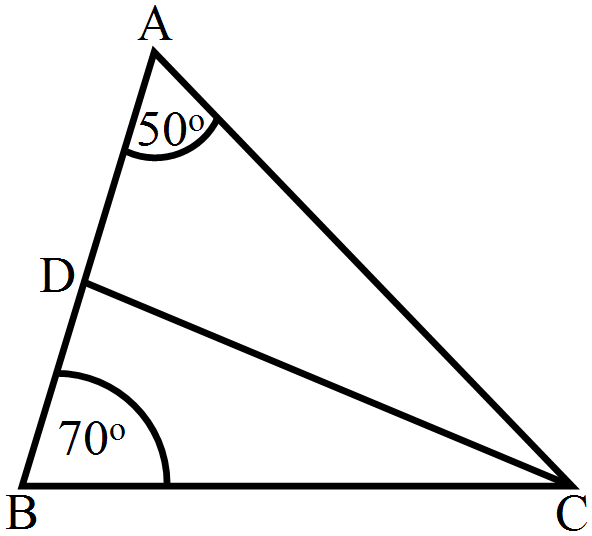
In $\triangle \text{ABC}, \angle \text{A}=50^\circ, \angle \text{B}=70^\circ$ and bisector of $\angle \text{C}$ meets AB in D. Find the angles of the triangles ADC and BDC.
Answer


We know that the sum of all three angles of a triangle is equal to 180º
Therefore, for the given $\triangle \text{ABC},$ we can say that:
$\angle \text{A}+\angle \text{B}+\angle \text{C}=180^\circ$ $($Sum of angles of $\triangle \text{ABC})$
$\Rightarrow 50^\circ+70^\circ+\angle \text{C}=180^\circ$
$\angle \text{C}=180^\circ-120^\circ$
$\angle \text{C}=60^\circ$
$\angle \text{ACD}=\angle \text{BCD}=\frac{\angle \text{C}}{2}$ (CD bisects $\angle \text{C}$ and meets AB is D.)
$\Rightarrow \angle \text{ACD}=\angle \text{BCD}=\frac{60^\circ}{2}=30^\circ$
Using the same logic for the given $\triangle \text{ACD},$ we can sat that:
$\angle \text{DAC}+\angle \text{ACD}+\angle \text{ADC}=180^\circ$
$\Rightarrow 50^\circ+30^\circ+\angle \text{ADC}=180^\circ$
$\angle \text{ADC}=180^\circ-80^\circ$
$\angle \text{ADC}=100^\circ$
If we use the same logic for the given $\triangle \text{BCD},$ we can say that:
$\angle \text{DBC}+\angle \text{BCD}+\angle \text{BDC}=180^\circ$
$\Rightarrow 70^\circ+30^\circ+\angle \text{BDC}=180^\circ$
$\angle \text{BDC}=180^\circ-100^\circ$
$\angle \text{BDC}=80^\circ$
Thus,
For $\triangle \text{ADC}:\angle \text{A}=50^\circ, \ \angle \text{D}=100^\circ, \ \angle \text{C}=30^\circ$
For $\triangle \text{BDC}:\angle \text{B}=70^\circ, \ \angle \text{D}=80^\circ, \ \angle \text{C}=30^\circ$

Need a full question paper?

Generate a complete, print-ready paper with questions like this in minutes — across 16+ boards, with answer keys.
Start Generating Free

Similar questions

Reduce the fractions $\frac{348}{319}, \frac{221}{247}, \frac{437}{551}$ to the lowest terms.
Draw triangle with the measures given. In ∆FUN, l(FU) = 5 cm, l(UN) = 4.6 cm, m∠U = 110°.
In the given figure $\text{l || m}$ and t is a transversa. If $\angle1\ \text{and}\ \angle2$ are in the ratio 5 : 7 find the measure of each of the angles $\angle1,\ \angle2,\ \angle3\ \text{and}\ \angle8.$
Draw $\triangle\text{ABC}$ in which AB = 5.5cm. BC = 6cm and CA = 7cm. Also, draw perpendicular bisector of side BC.
The maximum and minimum temperatures of five Indian cities are given in °C. Draw a joint bar graph for this data.
MumbaiKolkataNagpurKapurthala
3747wQbNPTDJp9hMYdvogK2hAUiHsGeiybwaWe36bwtRQ3UTpYV7YuZ8FV5j9nauFCWwcjM6dTzpL5s2N79Rp5unwdMvc8ZKU>2625262926
Choose the lengths of the sides yourself and draw one equilateral, one isosceles and one scalene triangle.
Draw the pairs of angles as described below. If that is not possible, say why.
i. Complementary angles that are not adjacent.
ii. Angles in a linear pair which are not supplementary.
iii. Complementary angles that do not form a linear pair.
iv. Adjacent angles which are not in linear pair.
v. Angles which are neither complementary nor adjacent.
vi. Angles in a linear pair which are complementary.
Arrange the following fractions in ascending order:
$\frac{3}{8},\frac{5}{6},\frac{6}{8},\frac{2}{4},\frac{1}{3}$
8(2x - 5) - 6(3x - 7) = 1
Daily wages of 45 workers in a factory are given below:
Daily wages (in Rs) 300 375 450 525 600
Number of workers 6 8 9 12 10
Find the median and the mean.
Using empirical formula, calculate its mode.