Questions

5 Mark Question

Take a timed test

6 questions · self-marked practice — reveal the answer and mark yourself.

Question 15 Marks
In Figure, ABC is a right triangle right angled at A. D lies on BA produced and DE perpendicular to BC intersecting AC at F. If $\angle \text{AFE}=130^\circ,$ find.
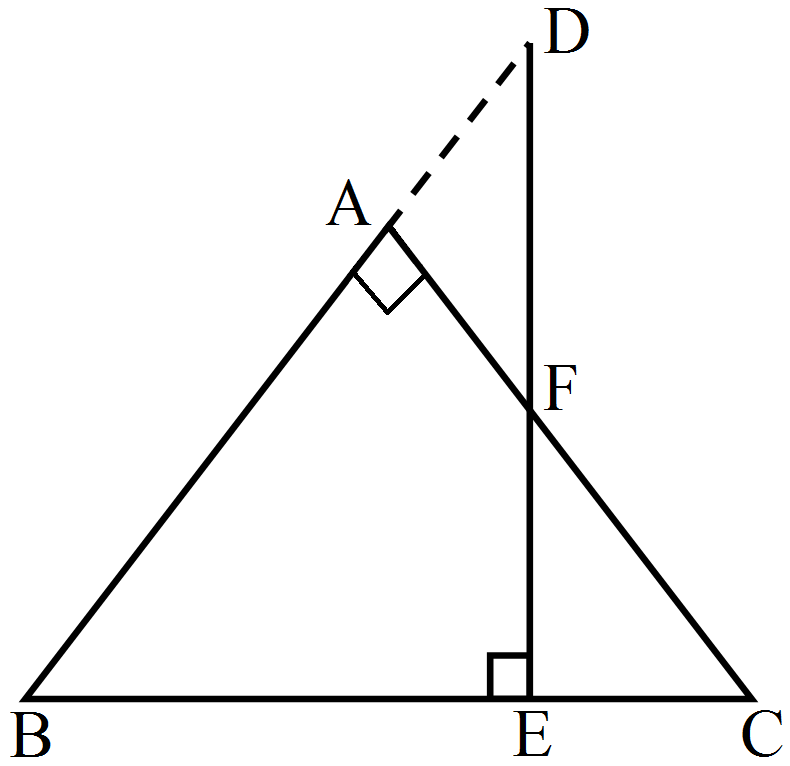
  1. $\angle \text{BDE}$
  2. $\angle \text{BCA}$
  3. $\angle \text{ABC}$
Answer
  1. Here,
$\angle \text{BAF}+\angle \text{FAD}=180^\circ$ (Linear pair)

$\angle \text{FAD}=180^\circ-\angle \text{BAF}=180^\circ-90^\circ$

$=90^\circ$

Also,

$\angle \text{AFE}=\angle \text{ADF}+\angle \text{FAD}$ (Exterior angle property)

$\angle \text{ADF}+90^\circ=130^\circ$

$\angle \text{ADF}=130^\circ-90^\circ$

$=40^\circ$
  1. We know that the sum of all the angles of a triangle is 180°
Therefore, for $\triangle \text{BDE},$ we can say that:

$\angle \text{BDE}+\angle \text{BED}+\angle \text{DBE}=180^\circ$

$\angle \text{DBE}=180^\circ-\angle \text{BDE }\angle \text{BED}$

$=180^\circ-90^\circ-40^\circ$

$=50^\circ...(\text{i})$

Also,

$\angle \text{FAD}=\angle \text{ABC}+\angle \text{ACB}$ (Exterior angle property)

$90^\circ=50^\circ+\angle \text{ACB}$

Or,

$\angle \text{ACB}=90^\circ-50^\circ$

$=40^\circ$
  1. $\angle \text{ABC}=\angle \text{DBE}=50^\circ$ [From (i)]
View full question & answer
Question 25 Marks
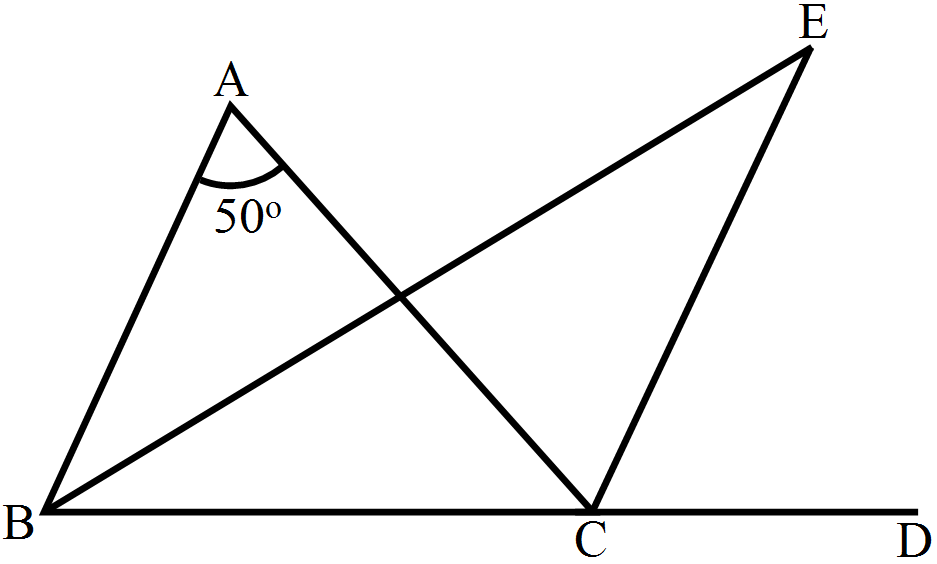
In $\triangle \text{ABC}, \angle \text{A}=50^\circ$ and BC is produced to a point D. The bisectors of $\angle \text{ABC}$ and $\angle \text{ACD}$ meet at E. Find $\angle \text{E}$
Answer

In the given triangle,
$\angle \text{ACD}=\angle \text{A}+\angle \text{B}$ (Exterior angle is equal to the sum of two opposite interior angles.)
We know that the sum of all three angles of a triangle is 180°
Therefore, for the given triangle, we can say that:
$\angle \text{ABC}+\angle \text{BCA}+\angle \text{CAB}=180^\circ$ $($Sum of all angles of $\angle \text{ABC})$
$\angle \text{A}+\angle \text{B}+\angle \text{BCA}=180^\circ$
$\angle \text{BCA}=180^\circ-(\angle \text{A}+\angle \text{B})$
$\angle \text{ECA}=\frac{\angle \text{ACD}}{2}$ $($EC bisects $\angle \text{ACD})$
$\angle \text{ECA}=\frac{\angle \text{A}+\angle \text{B}}{2}$ $(\angle \text{ACD}=\angle \text{A}+\angle \text{B})$
$\angle \text{EBC}=\frac{\angle \text{ABC}}{2}=\frac{\angle \text{B}}{2}$ $($EB bisects $\angle \text{ABC})$
$\angle \text{ECB}=\angle \text{ECA}+\angle \text{BCA}$
$\angle \text{ECB}=\frac{\angle \text{A}+\angle \text{B}}{2}+180^\circ-(\angle \text{A}+\angle \text{B})$
If we use the same logic for $\angle \text{EBC},$ we can say that:
$\angle \text{EBC}+\angle \text{ECB}+\angle \text{BEC}=180^\circ$ $($Sum of all angles of $\triangle \text{EBC})$
$\frac{\angle \text{B}}{2}+\frac{\angle \text{A}+\angle \text{B}}{2}+180^\circ-(\angle \text{A}+\angle \text{B})+\angle \text{BEC}=180^\circ$
$\angle \text{BEC}=\angle \text{A}+\angle \text{B}-\Big(\frac{\angle \text{A}+\angle \text{B}}{2}-\frac{\angle \text{B}}{2}\Big)$
$\angle \text{BEC}=\frac{\angle \text{A}}{2}$
$\angle \text{BEC}=\frac{50^\circ}{2}$
$=25^\circ$
View full question & answer
Question 35 Marks
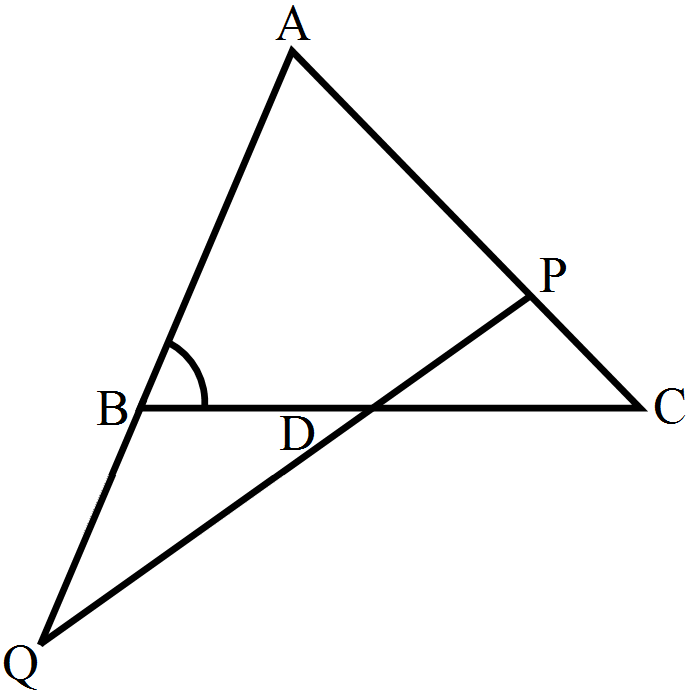
D is a point on the side BC of $ \triangle \text{ABC}.$ A line PDQ through D, meets side AC in P and AB produced at Q. If $\angle \text{A}=80^\circ, \angle \text{ABC}=60^\circ$ and $\angle \text{PDC} = 15^\circ,$ find.
$\angle \text{AQD}$
$\angle \text{APD}$
Answer

$\angle \text{ABD}$ and $\angle \text{QBD}$ form a linear pair
$\angle \text{ABC}+\angle \text{QBC}=180^\circ$
$=60^\circ+\angle \text{QBC}=180^\circ$
$\angle \text{QBC}=120^\circ$
$\angle \text{PDC}=\angle \text{BDQ}$ (Vertically opposite angles)
$\angle \text{BDQ}=75^\circ$
In $\triangle \text{QBD}:$
$\angle \text{QBD}+\angle \text{QDB}+\angle \text{BDQ}=180^\circ$ $($Sum of angles of $\triangle \text{QBD})$
$120^\circ+15^\circ+\angle \text{BQD}=180^\circ$
$\angle \text{BQD}=180^\circ-135^\circ$
$\angle \text{BQD}=45^\circ$
$\angle \text{AQD}=\angle \text{BQD}=45^\circ$
In $\triangle \text{AQP}:$
$\angle \text{QAP}+\angle \text{AQP}+\angle \text{APQ}=180^\circ$ $($Sum of angles of $\triangle\text{AQP})$
$80^\circ+45^\circ+\angle \text{APQ}=180^\circ$
$\angle \text{APQ}=55^\circ$
$\angle \text{APD}=\angle \text{APQ}$
View full question & answer
Question 45 Marks
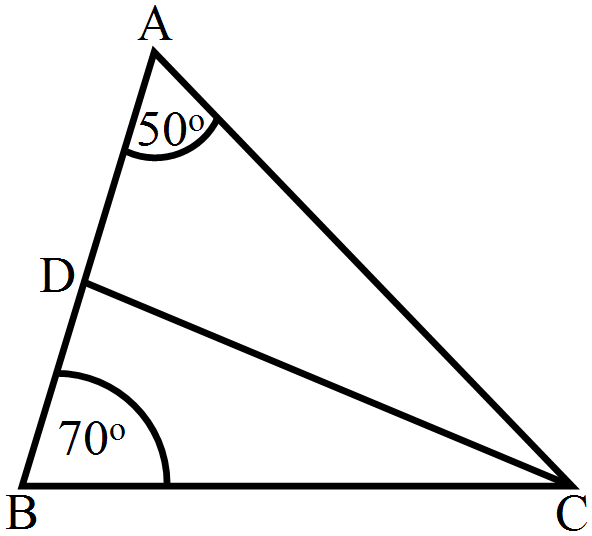
In $\triangle \text{ABC}, \angle \text{A}=50^\circ, \angle \text{B}=70^\circ$ and bisector of $\angle \text{C}$ meets AB in D. Find the angles of the triangles ADC and BDC.
Answer

We know that the sum of all three angles of a triangle is equal to 180º
Therefore, for the given $\triangle \text{ABC},$ we can say that:
$\angle \text{A}+\angle \text{B}+\angle \text{C}=180^\circ$ $($Sum of angles of $\triangle \text{ABC})$
$\Rightarrow 50^\circ+70^\circ+\angle \text{C}=180^\circ$
$\angle \text{C}=180^\circ-120^\circ$
$\angle \text{C}=60^\circ$
$\angle \text{ACD}=\angle \text{BCD}=\frac{\angle \text{C}}{2}$ (CD bisects $\angle \text{C}$ and meets AB is D.)
$\Rightarrow \angle \text{ACD}=\angle \text{BCD}=\frac{60^\circ}{2}=30^\circ$
Using the same logic for the given $\triangle \text{ACD},$ we can sat that:
$\angle \text{DAC}+\angle \text{ACD}+\angle \text{ADC}=180^\circ$
$\Rightarrow 50^\circ+30^\circ+\angle \text{ADC}=180^\circ$
$\angle \text{ADC}=180^\circ-80^\circ$
$\angle \text{ADC}=100^\circ$
If we use the same logic for the given $\triangle \text{BCD},$ we can say that:
$\angle \text{DBC}+\angle \text{BCD}+\angle \text{BDC}=180^\circ$
$\Rightarrow 70^\circ+30^\circ+\angle \text{BDC}=180^\circ$
$\angle \text{BDC}=180^\circ-100^\circ$
$\angle \text{BDC}=80^\circ$
Thus,
For $\triangle \text{ADC}:\angle \text{A}=50^\circ, \ \angle \text{D}=100^\circ, \ \angle \text{C}=30^\circ$
For $\triangle \text{BDC}:\angle \text{B}=70^\circ, \ \angle \text{D}=80^\circ, \ \angle \text{C}=30^\circ$
View full question & answer
Question 55 Marks
In $\triangle \text{ABC},$ if $3\angle \text{A}=4\angle \text{B}=6\angle \text{C},$ calculate the angles.
Answer
calculate the angles. calculate the angles $3\angle \text{A}=6\angle \text{C}$
$\angle \text{A}=2\angle \text{C} ...(\text{i})$
We also know that for the same triangle, $4\angle \text{B}=6\angle \text{C}$
$\angle \text{B}=\frac{6}{4}\angle \text{C}...(\text{ii})$
We know that the sum of all three angles of a triangle is 180°
Therefore, we can say that:
$\angle \text{A}+\angle \text{B}+\angle \text{C}=180^\circ$ $($Angles of $\triangle \text{ABC})...(\text{iii})$
On putting the values of $\angle \text{A}$ and $\angle \text{B}$ in equation (iii), we get:
$2\angle \text{C}+\Big(\frac{6}{4}\Big)\angle \text{C}+\angle \text{C}=180^\circ$
$\Big(\frac{18}{4}\Big)\angle \text{C}=180^\circ$
$\angle \text{C}=40^\circ$
From equation (i), we have:
$\angle \text{A}=2\angle \text{C}=2\times 40$
$\angle \text{A}=80^\circ$
From equation (ii), we have:
$\angle \text{B}=\Big(\frac{6}{4}\Big)\angle \text{C}=\Big(\frac{6}{4}\Big)\times40^\circ$
$\angle \text{B}=60^\circ$
$\angle \text{A}=80^\circ, \angle \text{B}=60^\circ, \angle \text{C}=40^\circ$
Therefore, the three angles of the given triangle are 80°, 60°, and 40°
View full question & answer
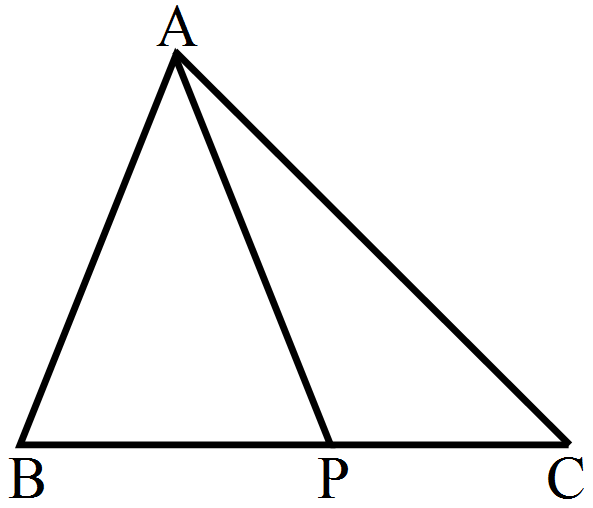
Question 65 Marks
In Fig, P is the point on the side BC. Complete each of the following statements using symbol ‘=’,’ > ‘or ‘< ‘so as to make it true:
  1. AP… AB+ BP
  2. AP… AC + PC
  3. $\text{AP}...\frac{1}{2}(\text{AB}+\text{AC}+\text{BC})$
Answer
  1. In triangle APB, AP < AB + BP because the sum of any two sides of a triangle is greater than the third side.
  2. In triangle APC, AP < AC + PC because the sum of any two sides of a triangle is greater than the third side.
  3. AP < 12(AB + AC + BC) In triangles ABP and ACP, we can see that:
AP < AB + BP…(i) (Because the sum of any two sides of a triangle is greater than the third side)

AP < AC + PC…(ii) (Because the sum of any two sides of a triangle is greater than the third side)

On adding (i) and (ii), we have:

AP + AP < AB + BP + AC + PC

2AP < AB + AC + BC (BC = BP + PC)

$\text{AP}<\frac{1}{2}(\text{AB}+\text{AC}+\text{BC})$
View full question & answer
5 Mark Question - Maths STD 7 Questions - Vidyadip