MCQ
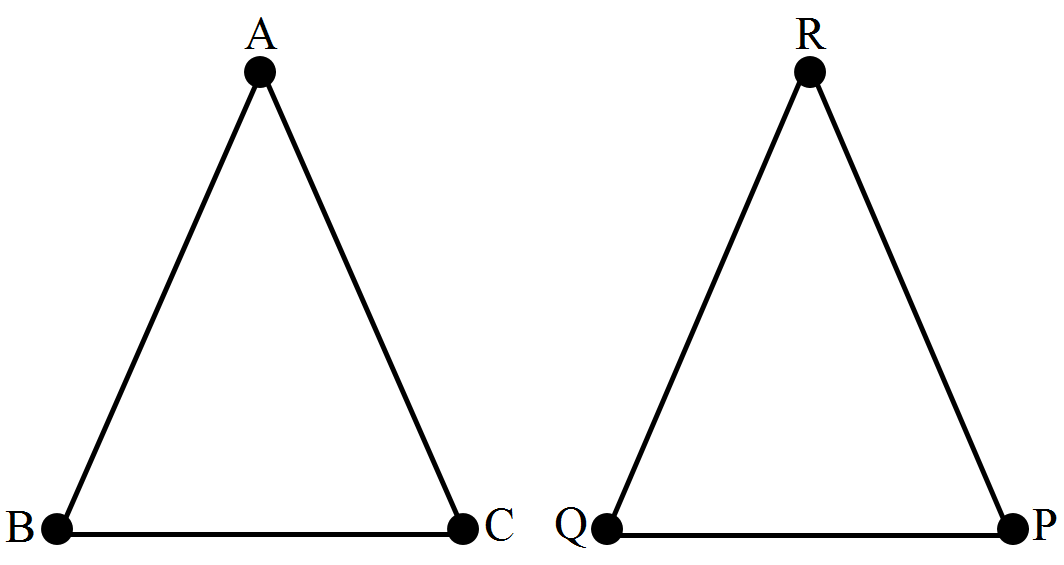
In triangles $ABC$ and $PQR, AB = AC$, $\angle\text{C} = \angle\text{P}$ and $\angle\text{B} = \angle\text{Q}.$ The two triangles are:
  • A
    Congruent but not isosceles.
  • B
    Isosceles and congruent.
  • Isosceles but not congruent.
  • D
    Neither congruent nor isosceles.

Answer

Correct option: C.
Isosceles but not congruent.
Given: $\triangle\text{ABC}$ and $\triangle\text{PQR}, \ \text{AB = AC}, \ \angle\text{C} = \angle\text{P}$ and $\angle\text{B} = \angle\text{Q}.$

$\text{AB = AC}$
$\Rightarrow\ \angle\text{B} = \angle\text{C}$ (opposite angles to equal sides are equal)
Hence, $\triangle\text{ABC}$ is an isosceles triangle.
$\angle\text{C} = \angle\text{P}$ and $\angle\text{B} = \angle\text{Q}$ (given)
$\Rightarrow \angle\text{P} = \angle\text{Q}\ \ (\therefore \angle\text{B} = \angle\text{C})$
$\Rightarrow \text{QR} = \text{PR}$ (opposite sides to equal angles are equal)
Hence, $\triangle\text{PQR}$ is an isosceles triangle.
So, the two triangles are isosceles but not congruent.
As $AAA$ is not the criterion for a triangle to be congruent.

Need a full question paper?

Generate a complete, print-ready paper with questions like this in minutes — across 16+ boards, with answer keys.

Start Generating Free