Question
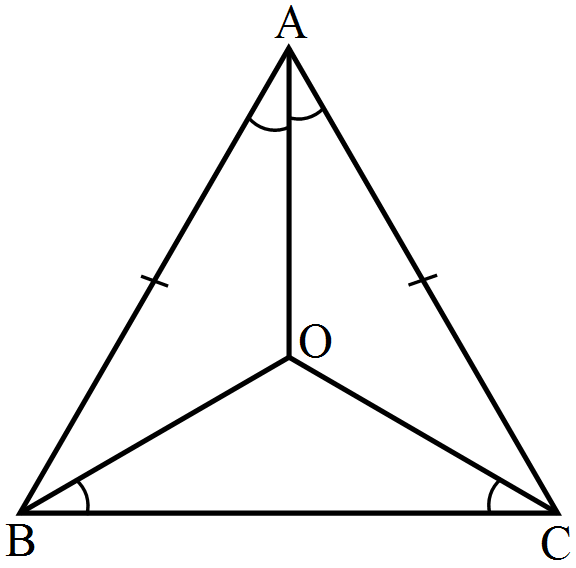
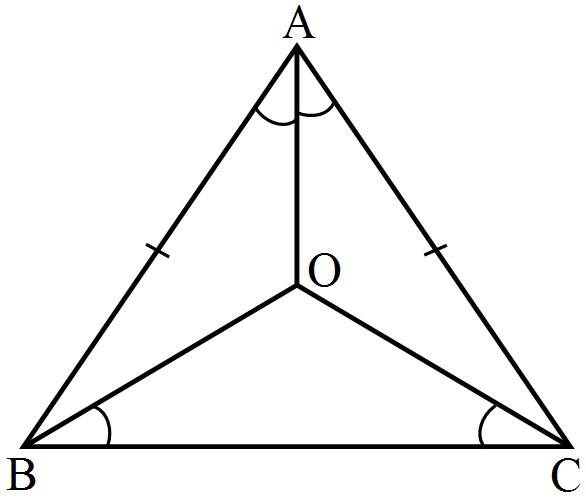
In $\triangle\text{ABC,}$ $AB = AC$ and the bisectors of $\angle\text{B}$ and $\angle\text{C}$ meet at a point $O$.
Prove that $BO = CO$ and the ray $AO$ is the bisector of $\angle\text{A}.$
Answer

Given: A $\triangle\text{ABC}$ in which $AB = AC, BO$ and $CO$ are bisectors of $\angle\text{B}$ and $\angle\text{C}$
To Prove: In $\triangle\text{BOC},$
we have, $\angle\text{OBC}=\frac{1}{2}\angle\text{B}$ and,
$\angle\text{OBC}=\frac{1}{2}\angle\text{C}$ But, $\angle\text{B}=\angle\text{C}$ [$\therefore$ $AB = AC$ (given)]
SO, $\angle\text{OBC}=\angle\text{OCB}$
Since base angle are equal, sides are equal
$\Rightarrow\text{OB = OC}...(1)$
​​​​​​​Since $OB$ and $OC$ are the bisectors of angles,
$\angle\text{B}$ and $\angle\text{C}$ respectively,
we have $\angle\text{ABO}=\frac{1}{2}\angle\text{B}$
$\angle\text{ACO}=\frac{1}{2}\angle\text{C}$
$\Rightarrow\angle\text{ABO}=\angle\text{ACO}...(2)$
Now, in $\triangle\text{ABO}$ and $\triangle\text{ACO}$
$\text{AB = AC}$ [Given] $\angle\text{ABO}=\angle\text{ACO}$ [from $(2)$]
$\text{BO = OC}$ [from $(1)$] Thus, by Side-Angle-side criterion of congruence,
we have $\triangle\text{ABO}\cong\triangle\text{ACO}$ [BY $SAS$]
The corresponding parts of the congruent triangles are equal
$\therefore\angle\text{BAO}=\angle\text{CAO}$ [By $C.P.C.T.$] i.e. $AO$ bisects $\angle\text{A}.$

Need a full question paper?

Generate a complete, print-ready paper with questions like this in minutes — across 16+ boards, with answer keys.

Start Generating Free

Similar questions

$\triangle\text{ABC}$ is a right triangle right angled at $A$ such that $AB = AC$ and bisector of $\angle\text{C}$ intersects the side $AB$ at $D$. Prove that $AC + AD = BC$.
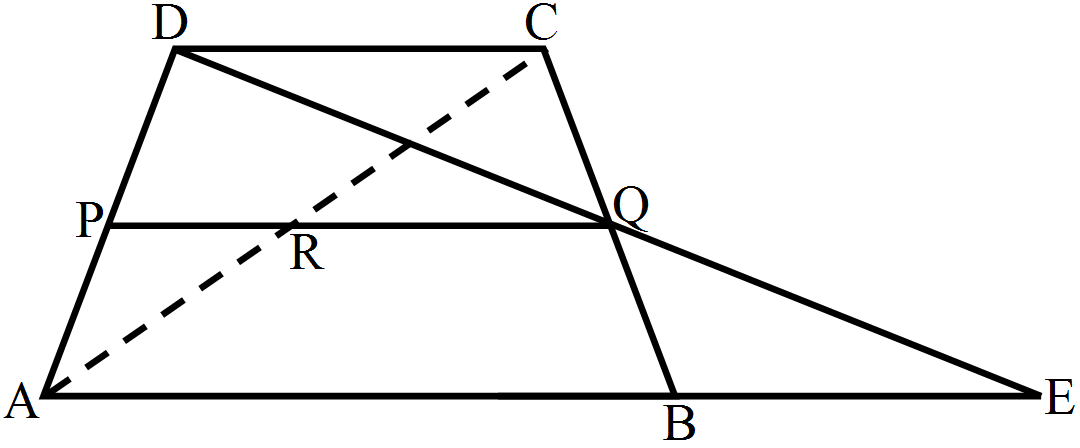
In the adjoining figure, $\text{ABCD}$ is a trapezium in which $AB\ \|\ DC$ and $P, Q$ are the midpoints of $AD$ and $BC$ respectively. $DQ$ and $AB$ when produced meet at $E$. Also, $AC$ and $PQ$ intersect at $R$. Prove that:
$i. DQ = QE,$
$ii. PR \| AB,$
$iii. AR = RC.$
Represent each of the numbers $\sqrt{5}, \sqrt{6}$ and $\sqrt{7}$ the real line.
Given below are the seats won by different political parties in the polling outcome of a state assembly elections:
Political party $A$ $B$ $C$ $D$ $E$ $F$
Seats won $75$ $55$ $37$ $29$ $10$ $37$
$i.$ Draw a bar graph to represent the polling results.
$ii.$ Which political party won the maximum number of seats$?$
The numbers $50, 42, 35, (2x + 10), (2x - 8), 12, 11, 8$ have been written in a descending order. If their median is $25$, find the value of $x$.
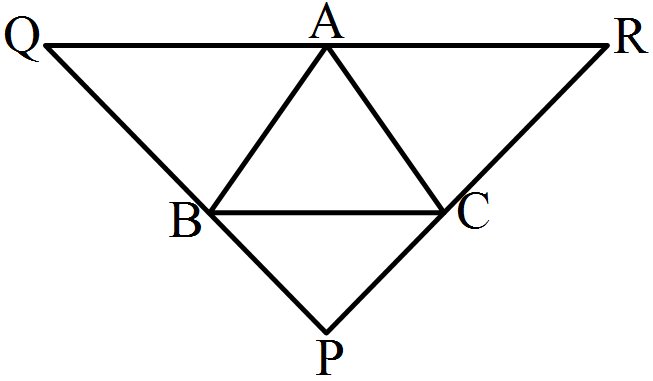
A $\triangle\text{ABC}$ is given. If lines are drawn through $A, B, C,$ parallel respectively to the sides $BC, CA$ and $AB$, forming $\triangle\text{PQR},$ as shown in the adjoining figure, show that $\text{BC}=\frac{1}{2}\text{QR}.$
Show that the quadrilateral formed by joining the midpoints of the pairs of adjacent sides of a rhombus is a rectangle.
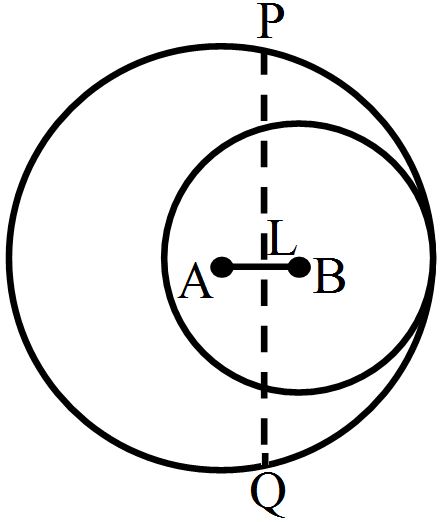
In the adjoining figure, two circles with centres at $A$ and $B$ , and of radii $5\  cm$ and $3\ cm$ touch each other internally. If the perpendicular bisector of $A B$ meets the bigger circle in $P$ and $Q$, find the length of $P Q$.
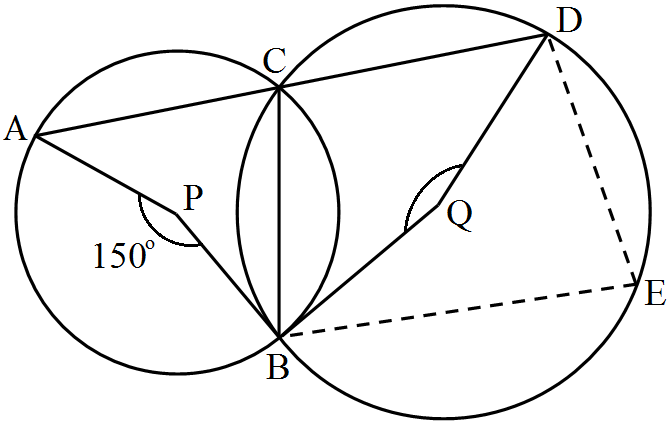
In the given figure, $P$ and $Q$ are centres of two circles intersecting at $B$ and $C.\  ACD$ is a straight line. Then, $\angle\text{BQD} =$
If $O$ is a point within $\triangle\text{ABC,}$ show that:
$i. AB + AC > OB + OC$
$ii. AB + BC + CA > OA + OB + OC$
$iii. OA + OB + OC >\frac{1}{2}(AB + BC + CA)$.