Question
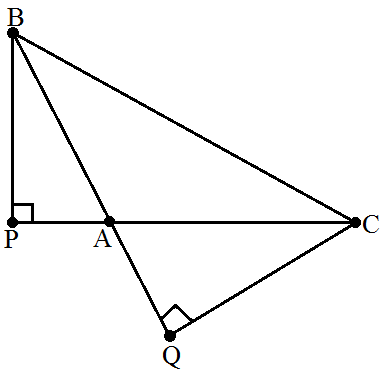
In $\triangle\text{ABC},\ \angle\text{A}$ is obtuse, $\text{PB}\perp\text{AC}$ and $\text{QC}\perp\text{AB}$ Prove that:
AB × AQ = AC × AP

Answer


Then, $\triangle\text{APB}\sim\triangle\text{AQC}$ [By AA similarity]
$\therefore\frac{\text{AP}}{\text{AQ}}=\frac{\text{AB}}{\text{AC}}$ [Corresponding parts of similar $\triangle$ are proportional]
⇒ AP × AC = AQ × AB .....(i)

Need a full question paper?

Generate a complete, print-ready paper with questions like this in minutes — across 16+ boards, with answer keys.
Start Generating Free

Similar questions

In what ratio does the point $\left(\frac{24}{11}, y\right)$ divide the line segment joining the points $P (2,-2)$ and $Q(3,7)$ ? Also find the value of $y$
A bag contains lemon-flavoured condies only. Hema takes out one condy without looking into the bag. What is the probability that she takes out
  1. An orange-flavoured candy?
  2. A lemon-flavoured candy?
If an integer is added to its square, the sum is $90$. Find the integer with the help of quadratic equation.
Solve for x and y:
2x - y + 3 = 0,
3x - 7y + 10 = 0
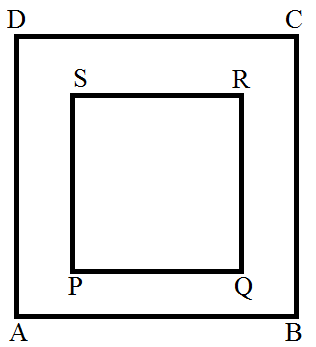
In the figure, a square dart board is shown. The length of a side of the larger square is $1.5$ times the length of a side of the smaller square. If a dart is thrown and lands on the larger square. What is the probability that it will land in the interior of the smaller square?
Write the first five terms of the following sequences whose $n^{th}$​​​​​​​ terms are:
$\text{a}_\text{n}=\frac{\text{n}(\text{n}-2)}{2}$
In a triangle $PQR, N$ is a point on PR such that $\text{QN}\perp\text{PR}$ . If $PN \times NR = QN^2,$ prove that $\angle\text{PQR}=90^\circ.$
Show that the following sets of points are collinear.
(1, -1), (2, 1) and (4, 5).
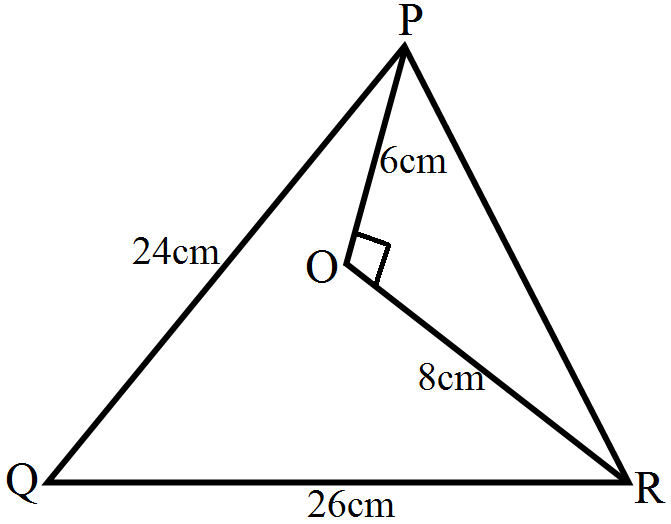
In the given figure, O is a point inside a $\triangle\text{PQR}$ such that $\angle\text{PQR}=90^\circ,\text{OP}=6\text{cm}$ and $\text{OR}=8\text{cm}.$ If $\text{PQ}=24\text{cm}$ and $\text{QR}=26\text{cm},$ prove that $\triangle\text{PQR}$ is right-angled.
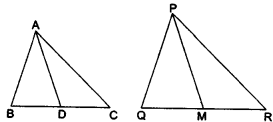
Sides AB and BC and median AD of a triangle ABC are respectively proportional to sides PQ and QR and median PM of $\triangle$PQR (see figure). Show that $\triangle A B C \sim \triangle P Q R$.