Question
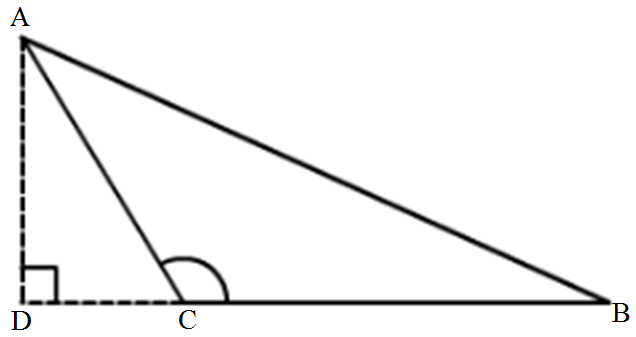
In $\triangle\text{ABC},\ \angle\text{C}$ is an obtuse angle. $\text{AD}\perp\text{BC}$ and $AB^2 = AC^2 + 3BC^2$. Prove that $BC = CD.$
Answer

Given: $\triangle\text{ABC}$ where $\angle\text{C}$ is an obtuse angle, $\text{AD}\perp\text{BC}$ and A$B^2 = AC^2 + 3BC^2$

To prove: $BC = CD$
Proof: In $\triangle\text{ABC},\ \angle\text{C}$ is obtuse.
Therefore, $AB^2 = AC^2 + BC^2 + 2BC \times DC$ (Obtuse angle theorem) ....(1)
$AB^2 = AC^2 + 3BC^2 (Given) .....(2)$
From (1) and (2) we get,
$AC^2 + 3BC^2 = AC^2 + BC^2 + 2BC \times DC$
$\Rightarrow 3BC^2 = BC^2 + 2BC \times DC$
$\Rightarrow 2BC^2 = 2BC \times DC$
$\Rightarrow BC = DC.$

Need a full question paper?

Generate a complete, print-ready paper with questions like this in minutes — across 16+ boards, with answer keys.
Start Generating Free

Similar questions

Each side of a rhombus is $10\ cm$. If one its diagonals is $16\ cm$ find the length of the other diagonal.
The numbers $525$ and $3000$ are both divisible only by $3, 5, 15, 25$ and $75$. What is $HCF (525, 3000)$? Justify your answer.
Prove the following trigonometric identities.
$\frac{\tan\text{A}}{1+\sec\text{A}}-\frac{\tan\text{A}}{1-\sec\text{A}}=2\text{cosec A}$
Prove the following trigonometric identities.
$\tan\theta-\cot\theta=\frac{2\sin^2\theta-1}{\sin\theta\cos\theta}$
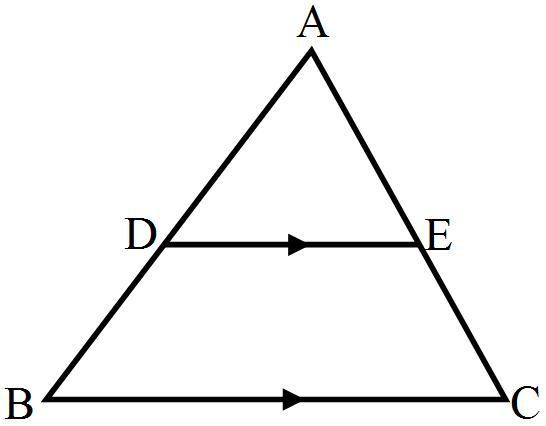
D and E are points on the sides AB and AC respectively of a $\triangle\text{ABC}$ such that DE || BC:
AD = (7x - 4)cm, AE = (5x - 2)cm, DB = (3x + 4)cm and EC = 3x cm.
In what ratio does the point P(2, 5) divide the join of A(8, 2) and B(-6, 9)?
Let ABCD be a square of side 2a. Find the coordinates of the vertices of this square when, The centre of the square is at the origin and coordinate axes are parallel to the sides AB and AD respectively.
Prove the following trigonometric identities.
$\sqrt{\frac{1+\cos\theta}{1-\cos\theta}}+\sqrt{\frac{1-\cos\theta}{1+\cos\theta}}=2\text{cosec }\theta$
If two pipes function simultaneously, a reservoir will be filled in $12$ hours. One pipe fills the reservoir $10$ hours faster than the other. How many hours will the second pipe take to fill the reservoir?
A solid is in the shape of a cone surmounted on a hemisphere, the radius of each of them is being 3.5cm and the total height of solid is 9.5cm. Find the volume of the solid.$\Big(\text{use}\ \pi=\frac{22}{7}\Big)$