Question
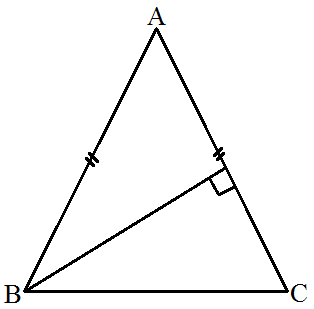
In $\triangle\text{ABC},$ given that $AB = AC$ and $\text{BD}\perp\text{AC}.$ Prove that $BC^2 = 2AC \times CD.$
Answer

Given: In $\triangle\text{ABC},$
$\text{AB} = \text{AC, } \text{BD}\perp\text{AC}$

To prove: $BC^2 = 2AC \times CD$
$\therefore$
$AB^2 = BD^2 + AD^2 $(Pythagoras Theorem)
$\Rightarrow BD^2 = AB^2 - AD^2 .....(i)$ Similarly in right
$\triangle\text{BDC},$$ BC^2 = BD^2 + DC^2 = AB^2 - AD^2 + DC^2$^ [From (i)]
$= AB^2 - (AC - CD)^2 + CD^2 $
$= AB^2 - (AC^2 + CD^2 - 2AC \times CD) + CD^2 $
$= AC^2 - AC^2 - CD^2 + 2AC \times CD + CD^2$​​​​​​​^
($\because$
$AB = AC) = 2AC \times CD$ (given)
Hence $BC^2 = 2AC \times CD$

Need a full question paper?

Generate a complete, print-ready paper with questions like this in minutes — across 16+ boards, with answer keys.

Start Generating Free

Similar questions

In $\triangle\text{ABC},\ \angle\text{A}=60^\circ.$ Prove that $BC^2 = AB^2 + AC^2 - AB \times AC.$
If $\alpha$ and $\beta$ are the zeroes of the quadratic polynomial $p(y) = 5y^2 - 7y + 1$, find the value of $\frac{1}{\alpha}+\frac{1}{\beta}$
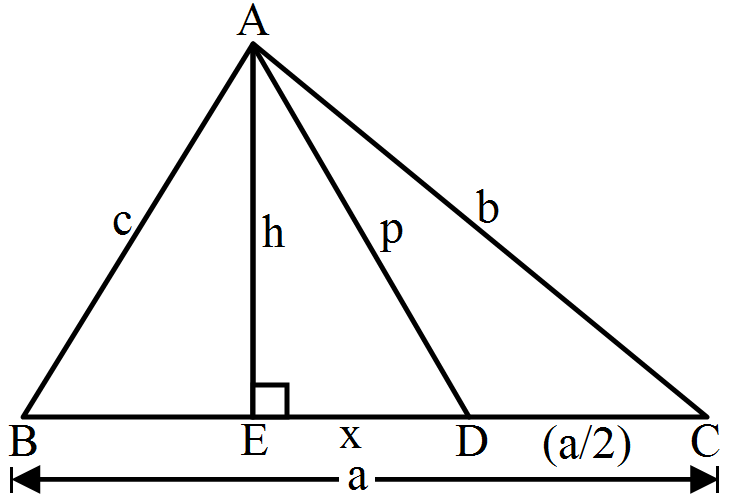
In the given figure, D is the midpoint of side BC and $\text{AE}\perp\text{BC}.$ If BC = a, AC = b, AB = c, ED = x, AD = p and AE = h, prove that.
$(\text{b}^2-\text{c}^2)=2\text{ax}$
Lead spheres of diameter 6cm are dropped into a cylindrical beaker containing some water and are fully submerged. If the diameter of the beaker is 18cm and water rises by 40cm. find the number of lead spheres dropped in the water.
A shopkeeper sells a saree at 8% profit and a sweater at 10% discount, thereby, getting a sum Rs. 1008. If she had sold the saree at 10% profit and the sweater at 8% discount, she would have got Rs. 1028. Find the cost price of the saree and the list price (price before discount) of the sweater.
A solid iron cuboidal block of dimensions 4.4m × 2.6m × 1m is recast into a hollow cylindrical pipe of internal radius 30cm and thickness 5cm. Find the length of the pipe.
The slant height of the frustum of a cone is $4\ cm$ and the perimeters of its circular ends are $18\ cm$ and $6\ cm$. Find the curved surface of the frustum.
Ten years later, A will be twice as old as B and five years ago, A was three times as old as B. What are the present ages of A and B?
Find the volume of the largest right circular cone that can be cut out of a cube whose edge is 9cm.
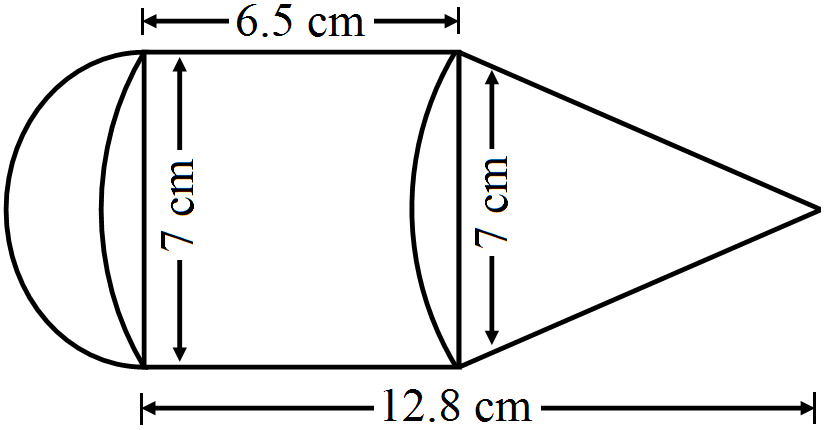
The given figure represents a solid consisting of a cylinder surmounted by a cone at one end and a hemisphere at the other. Find the volurne of the solid.