Question
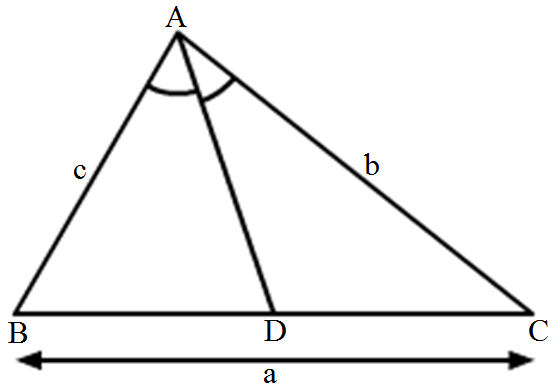
In $\triangle\text{ABC},$ ray AD bisects $\angle\text{A}$ and intersects BC in D. If BC = a, AC = b and AB = c, prove that
$\text{BD}=\frac{\text{ac}}{\text{b}+\text{c}}$
Answer

Given: In $\triangle\text{ABC}$ ray AD bisects angle A and intersects BC in D,
If BC = a, AC = b and AB = c
$\text{BD}=\frac{\text{ac}}{\text{b}+\text{c}}$
The corresponding figure is as follows

Proof: In triangle ABC, AD is the bisector of $\angle\text{A}$
Therefore $\frac{\text{AB}}{\text{AC}}=\frac{\text{BD}}{\text{CD}}$
Substitute BC = a, AC = b and AB = c we get,
$\frac{\text{c}}{\text{b}}=\frac{\text{BD}}{\text{BC}-\text{BD}}$
$\frac{\text{c}}{\text{b}}=\frac{\text{BD}}{\text{a}-\text{BD}}$
By cross multiplication we get.
$\text{c(a}-\text{BD})=\text{b}\times\text{BD}$
$\text{ac}-\text{cBD}=\text{bBD}$
$\text{ac}=\text{bBD}+\text{cBD}$
$\text{ac}=(\text{b}+\text{c})\text{BD}$
$\frac{\text{ac}}{\text{b}+\text{c}}=\text{BD}$
We proved that $\text{BD}=\frac{\text{ac}}{\text{b}+\text{c}}$

Need a full question paper?

Generate a complete, print-ready paper with questions like this in minutes — across 16+ boards, with answer keys.

Start Generating Free