Question
In $\triangle ABC , \angle B =35^{\circ}, \angle C =65^{\circ}$ and the bisector of $\angle BAC$ meets$ BC$ in $P$ . Arrange $AP , BP$ and $CP$ in descending order.

Answer

In angle $A+B+C=180 A+35+65=180 A=180-100 A=80$
So $\angle BAP$ and $\angle CAP =\frac{80}{2}=40$
we know that side opposite to the greater angle is longer $\ln \triangle BAP$
we know that side opposite to the greater angle is longer so $BP > AP$
In $\triangle CAP ACP (65)> CAP (40)$ so $AP > CP$ so $BP > AP > CP$

Need a full question paper?

Generate a complete, print-ready paper with questions like this in minutes — across 16+ boards, with answer keys.
Start Generating Free

Similar questions

$P$ is the mid-point of the side $CD$ of a parallelogram $ABCD.$ A line through $C$ parallel to $PA$ intersects $AB$ at $Q$ and $DA$ produced at $R.$ Prove that $DA = AR$ and $CQ = Q$
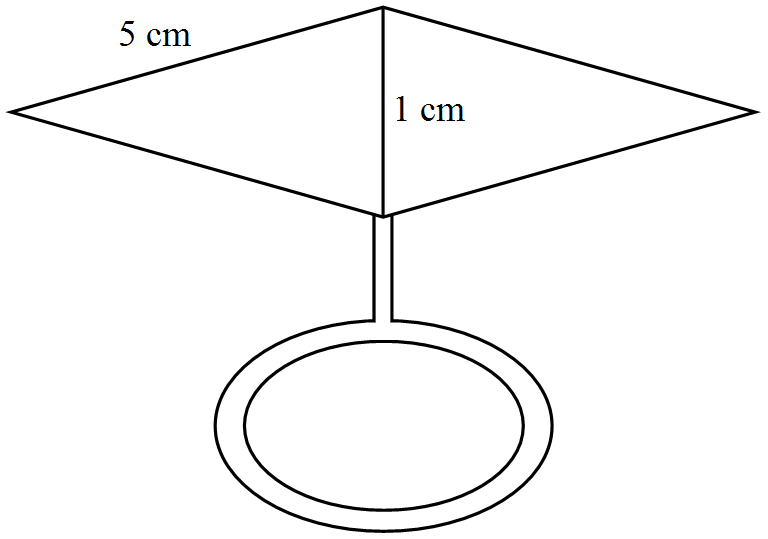
Find the area of the of the blades of the magnetic compass shown in Fig. below $\big($ Take $\sqrt{11}=3.32\big).$
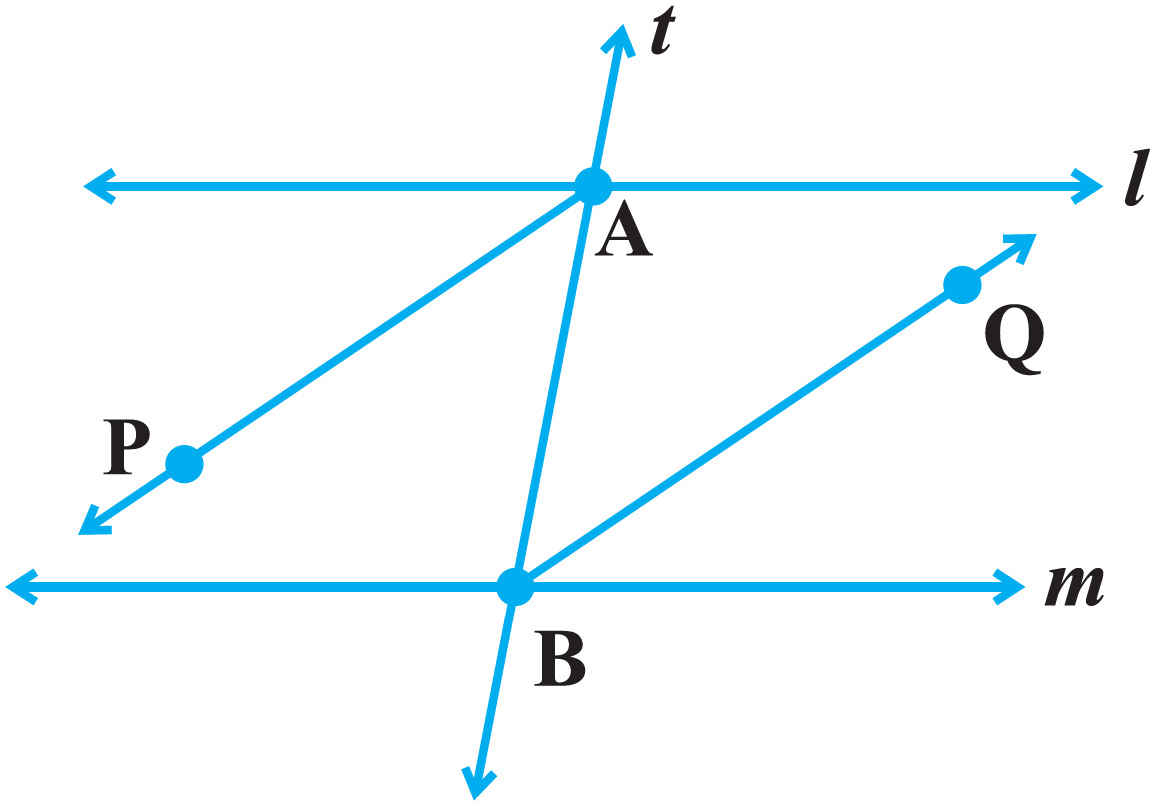
$AP$ and $BQ$ are the bisectors of the two alternate interior angles formed by the intersection of a transversal t with parallel lines l and m (Fig.). Show that $\text{AP}||\text{BQ}.$
The height of a right circular cylinder is $10.5\ m$. Three times the sum of the areas of its two circular faces is twice the area of the curved surface. Find the volume of the cylinder.
In a parallelogram ABCD, the bisector of $\angle\text{A}$ also bisects BC at X. Find AB : AD.
If the side $BC$ of $\triangle\text{ABC}$ is produced on both sides, then write the difference between the sum of the exterior angles so formed and $\angle\text{A}.$
The monthly wages of $30$ workers in a factory are given below: $83.0, 835, 890, 810, 835, 836, 869, 845, 898, 890, 820, 860, 832, 833, 855, 845, 804, 808, 812, 840, 885, 835, 836, 878, 840, 868, 890, 806, 840, 890$. Represent the data in the form of a frequency distribution with class size $10$.
The surface area of a cuboid is $758\ cm^2$. Its length and breadth are $14\ cm$ and $11\ cm$ respectively. Find its height.
What length of tarpaulin $4\ m$ wide will be required to make a conical tent of height $8\ m$ and base radius $6\ m$? Assume that the extra length of material will be required for stitching margins and wastage in cutting is approximately $20\ cm$. $($Use $\pi=3.14)$
A line segment $AB$ is of length $5\ cm$. Draw a circle of radius $4\ cm$ passing through $A$ and $B$. Can you draw a circle of radius $2\ cm$ passing through $A$ and $B$? Give reason in support of your answer.