Question
In two co-axial same circular coils, same current is flowing in the same direction. If both the coils are brought towards each other, then what will be the change in the current?

Answer

Current will decrease in both the coils (by Lenz's law).

Need a full question paper?

Generate a complete, print-ready paper with questions like this in minutes — across 16+ boards, with answer keys.
Start Generating Free

Similar questions

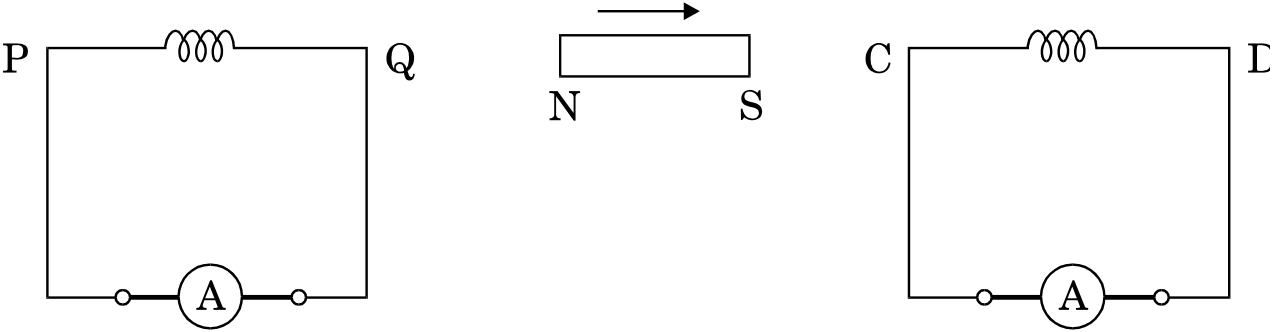
A bar magnet is moved in the direction indicated by the arrow between two coils PQ and CD. Predict the direction of the induced current in each coil.

If we walk barefoot on a nylon mat for some time and touch the metal handle of a door, we get an electric shock. Why does this happen?
Suppose that the electric field part of an electromagnetic wave in vacuum is $\text{E}=\{(3.1 \ \text{N}/\text{C}\cos[(1.8 \text{rad}/ \text{m}) \text{y}+(5.4\times10^6 \ \text{red}/\text{s}\text{t}]\hat{\text{i}}\}$.
  1. What is the direction of propagation?
  2. What is the wavelength λ ?
  3. What is the frequency ν ?
  4. What is the amplitude of the magnetic field part of the wave?
  5. Write an expression for the magnetic field part of the wave.
What will have the effect of moving the plates of a charged capacitor away from each other, on the potential difference between the plates?
Does the value of electric flux depend on the shape of the Gaussian surface?
Does the electric potential increase or decrease when moving along the lines of electric force?
Calculate the time required to heat 20kg of water from 10°C to 35°C using an immersion heater rated 1000W. Assume that 80% of the power input is used to heat the water. Specific heat capacity of water = 42000J kg-1 K-1.
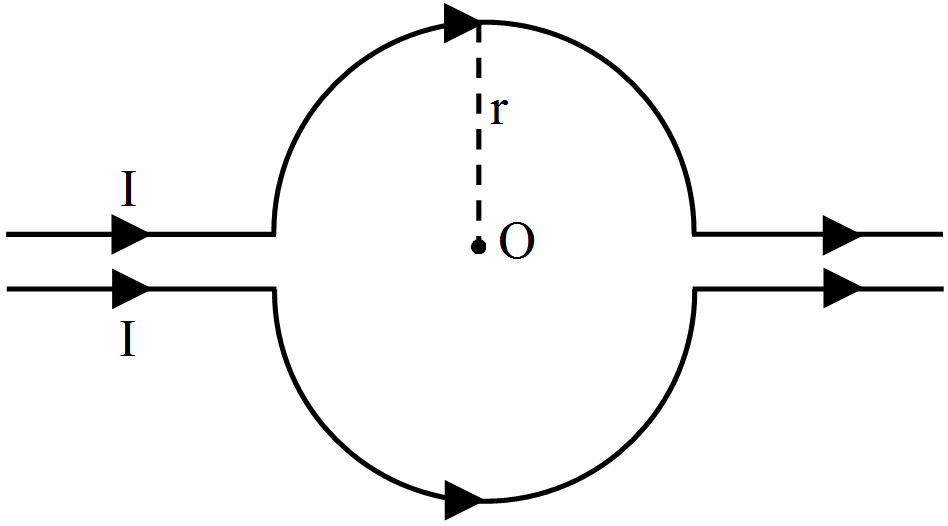
What is the value of magnetic field at point O due to current flowing in the wires?

A capillary tube of radius 0.50mm is dipped vertically in a pot of water. Find the difference between the pressure of the water in the tube 5.0cm below the surface and the atmospheric pressure. Surface tension of water = 0.075N/m.
A charge of $10 \mu C$ is placod at the centre of a square PQRS. How much workwill have to be done in bringing a point charge of $2 \mu C$ placed at its comer P to Q ?