MCQ
In uniform circular motion, the velocity vector and acceleration vector are
  • Perpendicular to each other
  • B
    Same direction
  • C
    Opposite direction
  • D
    Not related to each other

Answer

Correct option: A.
Perpendicular to each other
(a) Because velocity is always tangential and centripetal acceleration is radial.

Need a full question paper?

Generate a complete, print-ready paper with questions like this in minutes — across 16+ boards, with answer keys.
Start Generating Free

Similar questions

One likes to sit under sunshine in winter season, because
A thermally insulated container is divided into two parts by a screen. In one part the pressure and temperature are $P$ and $T$ for an ideal gas filled. In the second part it is vacuum. If now a small hole is created in the screen, then the temperature of the gas will
A boat is moving with a velocity $3 i+4 j$ with respect to ground. The water in the river is moving with a velocity $-3 i-4 j$ with respect to ground. The relative velocity of the boat with respect to water is
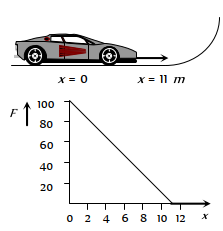
A toy car of mass $5 \mathrm{~kg}$ moves up a ramp under the influence of force $F$ plotted against displacement $x$. The maximum height attained is given by
Image
A person can not see the objects clearly placed at a distance more than $40 \mathrm{~cm}$. He is advised to use a lens of power
A thermocouple of resistance $1.6 \Omega$ is connected in series with a galvanometer of $8 \Omega$ resistance. The thermocouple develops and e.m.f. of $10 \mu V$ per degree temperature difference between two junctions. When one junction is kept at $0^{\circ} C$ and the other in a molten metal, the galvanometer reads 8 millivolt. The temperature of molten metal, when e.m.f. varies linearly with temperature difference, will be
In which case does the potential energy decrease
The ratio of the coefficient of thermal conductivity of two different materials is $5: 3$. If the thermal resistance of the rod of same thickness resistance of the rods of same thickness of these materials is same, then the ratio of the length of these rods will be
A system performs work $\Delta W$ when an amount of heat is $\Delta Q$ added to the system, the corresponding change in the internal energy is $\Delta U$. A unique function of the initial and final states (irrespective of the mode of change) is
The latent heat of vaporisation of water is $2240 \mathrm{~J} / \mathrm{gm}$. If the work done in the process of expansion of $1 \mathrm{~g}$ is $168 \mathrm{~J}$, then increase in internal energy is