MCQ 11 Mark
A solid disc rolls clockwise without slipping over a horizontal path with a constant speed $U$. Then the magnitude of the velocities of points $A, B$ and $C$ (see figure) with respect to a standing observer are respectively 
- A
$v, v$ and $v$
- ✓
$2 v, \sqrt{2} v$ and zero
- C
$2 v, 2 v$ and zero
- D
$2 v, \sqrt{2} v$ and $\sqrt{2} v$
AnswerCorrect option: B. $2 v, \sqrt{2} v$ and zero
View full question & answer→MCQ 21 Mark
A hollow sphere has radius $6.4 m$. Minimum velocity required by a motor cyclist at bottom to complete the circle will be
- A
$17.7 m / s$
- B
$10.2 m / s$
- C
$12.4 m / s$
- ✓
$16.0 m / s$
AnswerCorrect option: D. $16.0 m / s$
View full question & answer→MCQ 31 Mark
The angular velocity of a particle rotating in a circular orbit 100 times per minute is
- A
$1.66 rad / s$
- B
$10.47 rad / s$
- C
$10.47 deg / s$
- ✓
$60 deg / s$
AnswerCorrect option: D. $60 deg / s$
(d) Work done in circular motion is always zero.
View full question & answer→MCQ 41 Mark
A body of mass $100 g$ is rotating in a circular path of radius $r$ with constant velocity. The work done in one complete revolution is
- A
$100 r J$
- B
$(r / 100) J$
- C
$(100 / r) J$
- ✓
Answer(d) In complete revolution total displacement is zero so average velocity is zero
View full question & answer→MCQ 51 Mark
A body moves with constant angular velocity on a circle. Magnitude of angular acceleration
Answer(b)$\vec{v}=\vec{\omega} \times \vec{r}=\left|\begin{array}{ccc}\hat{i} & \hat{j} & \hat{k} \\3 & -4 & 1 \\5 & -6 & 6\end{array}\right|=-18 \hat{i}-13 \hat{j}+2 \hat{k}$
View full question & answer→MCQ 61 Mark
If a particle covers half the circle of radius $R$ with constant speed then
- ✓
Momentum change is $m v r$
- B
Change in $K . E$. is $1 / 2 mv$
- C
Change in $K . E$. is $m v$
- D
Change in $K . E$. is zero
AnswerCorrect option: A. Momentum change is $m v r$
(a) $\omega=\frac{v}{r}=\frac{100}{100}=1 rad / s$
View full question & answer→MCQ 71 Mark
A particle covers $50 m$ distance when projected with an initial speed. On the same surface it will cover a distance, when projected with double the initial speed
- A
$100 m$
- B
$150 m$
- ✓
$200 m$
- D
$250 m$
AnswerCorrect option: C. $200 m$
(c) $R=\frac{u^2 \sin 2 \theta}{g}=R \propto u^2$. So if the speed of projection doubled, the range will becomes four times, i.e., $4 \times 50=200 m$
View full question & answer→MCQ 81 Mark
An aeroplane flying $490 m$ above ground level at $100 m / s$, releases a block. How far on ground will it strike
- A
$0.1 km$
- ✓
$1 km$
- C
$2 km$
- D
AnswerCorrect option: B. $1 km$
(b) $S=u \times \sqrt{\frac{2 h}{g}}=100 \times \sqrt{\frac{2 \times 490}{9.8}}=1000 m =1 km$
View full question & answer→MCQ 91 Mark
The angular speed of seconds needle in a mechanical watch is
- A
$\frac{\pi}{30} rad / s$
- ✓
$2 \pi rad / s$
- C
$rad / s$
- D
$\frac{60}{\pi} rad / s$
AnswerCorrect option: B. $2 \pi rad / s$
(b) $\omega=2 \pi n=\frac{2 \pi \times 100}{60}=10.47 rad / s$
View full question & answer→MCQ 101 Mark
A wheel completes 2000 revolutions to cover the $9.5 km$. distance. then the diameter of the wheel is
- A
$1.5 m$
- B
$1.5 cm$
- ✓
$7.5 cm$
- D
$7.5 m$
AnswerCorrect option: C. $7.5 cm$
(c) Centripetal acceleration $=4 \pi n r=4 \pi \times(1) \times 0.4=1.6 \pi$
View full question & answer→MCQ 111 Mark
A particle is tied to $20 cm$ long string. It performs circular motion in vertical plane. What is the angular velocity of string when the tension in the string at the top is zero
- ✓
$5 rd / sec$
- B
$2 rad / sec$
- C
$7.5 rad / sec$
- D
$7 rad / sec$
AnswerCorrect option: A. $5 rd / sec$
View full question & answer→MCQ 121 Mark
If time of flight of a projectile is 10 seconds. Range is 500 meters. The maximum height attained by it will be
- ✓
$125 m$
- B
$50 m$
- C
$100 m$
- D
$150 m$
AnswerCorrect option: A. $125 m$
(a)$\begin{aligned}& T=\frac{2 u \sin \theta}{g}=10 sec \Rightarrow u \sin \theta=50 m / s \\& \therefore H=\frac{u^2 \sin ^2 \theta}{2 g}=\frac{(u \sin \theta)^2}{2 g}=\frac{50 \times 50}{2 \times 10}=125 m\end{aligned}$
View full question & answer→MCQ 131 Mark
A particle is moving on a circular path with constant speed, then its acceleration will be
- A
- B
External radial acceleration
- ✓
Internal radial acceleration
- D
AnswerCorrect option: C. Internal radial acceleration
(c) In uniform circular motion, acceleration causes due to change in direction and is directed radially towards centre.
View full question & answer→MCQ 141 Mark
As per given figure to complete the circular loop what should be the radius if initial height is $5 m$

- A
$4 m$
- B
$3 m$
- C
$2.5 m$
- ✓
$2 m$
Answer(d) In the given condition friction provides the required centripetal force and that is constant. i.e. $m \omega r$ =constant$\Rightarrow r \propto \frac{1}{\omega^2} \therefore r_2=r_1\left(\frac{\omega_1}{\omega_2}\right)^2=9\left(\frac{1}{3}\right)^2=1 cm$
View full question & answer→MCQ 151 Mark
A cylindrical vessel partially filled with water is rotated about its vertical central axis. It's surface will
Answer(d) As momentum is vector quantity $\therefore$ change in momentum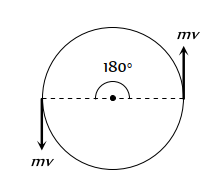
$\begin{gathered}\Delta P=2 m v \sin (\theta / 2) \\=2 m v \sin (90)=2 m v\end{gathered}$But kinetic energy remains always constant so change in kinetic energy is zero.
View full question & answer→MCQ 161 Mark
The centripetal acceleration is given by
- A
$v / r$
- ✓
$v r$
- C
$v r$
- D
$v / r$
Answer(b) Due to centrifugal force.
View full question & answer→MCQ 171 Mark
The second's hand of a watch has length $6 cm$. Speed of end point and magnitude of difference of velocities at two perpendicular positions will be
- ✓
6.28 and $0 mm / s$
- B
8.88 and $4.44 mm / s$
- C
8.88 and $6.28 mm / s$
- D
6.28 and $8.88 mm / s$
AnswerCorrect option: A. 6.28 and $0 mm / s$
(a) Work done by centripetal force in uniform circular motion is always equal to zero.
View full question & answer→MCQ 181 Mark
A circular road of radius $1000 m$ has banking angle $45^{\circ}$. The maximum safe speed of a car having mass $2000 kg$ will be, if the coefficient of friction between tyre and road is 0.5
- A
$172 m / s$
- B
$124 m / s$
- C
$99 m / s$
- ✓
$86 m / s$
AnswerCorrect option: D. $86 m / s$
(d)$v=r \omega=\frac{r \times 2 \pi}{T}=\frac{0.06 \times 2 \pi}{60}=6.28 mm / s$Magnitude of change in velocity $=\left|\overrightarrow{v_2}-\overrightarrow{v_1}\right|$$=\sqrt{v_1^2+v_2^2}=8.88 mm / s \quad\left( As v_1=v_2=6.28 mm / s \right)$
View full question & answer→MCQ 191 Mark
A block follows the path as shown in the figure from height $h$. If radius of circular path is $r$, then relation that holds good to complete full circle is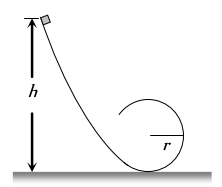
- A
$h<5 r / 2$
- B
$h>5 r / 2$
- ✓
$h=5 r / 2$
- D
$h \geq 5 r / 2$
AnswerCorrect option: C. $h=5 r / 2$
(c) $v=\sqrt{2 g l(1-\cos \theta)}=\sqrt{2 \times 9.8 \times 2\left(1-\cos 60^{\circ}\right)}=4.43 m / s$
View full question & answer→MCQ 201 Mark
A man projects a coin upwards from the gate of a uniformly moving train. The path of coin for the man will be
Answer(c) Because horizontal velocity is same for coin and the observer. So relative horizontal displacement will be zero.
View full question & answer→MCQ 211 Mark
A $500 kg$ crane takes a turn of radius $50 m$ with velocity of 36 $km / hr$. The centripetal force is
- A
$1200 N$
- ✓
$1000 N$
- C
$750 N$
- D
$250 N$
AnswerCorrect option: B. $1000 N$
(b) $F=\frac{m v^2}{r}=\frac{500 \times 100}{50}=10^3 N$
View full question & answer→MCQ 221 Mark
A scooter is going round a circular road of radius $100 m$ at a speed of $10 m / s$. The angular speed of the scooter will be
- A
$0.01 rad / s$
- ✓
$0.1 rad / s$
- C
$1 rad / s$
- D
$10 rad / s$
AnswerCorrect option: B. $0.1 rad / s$
(b) $\omega=\frac{v}{r}=\frac{10}{100}=0.1 rad / s$
View full question & answer→MCQ 231 Mark
A ball thrown by one player reaches the other in 2 sec. the maximum height attained by the ball above the point of projection will be about
- A
$10 m$
- B
$7.5 m$
- ✓
$5 m$
- D
$2.5 m$
Answer(c) $\frac{2 u \sin \theta}{g}=2 \sec \Rightarrow u \sin \theta=10$ $\therefore \quad H=\frac{u^2 \sin ^2 \theta}{2 g}=\frac{100}{2 g}=5 m$
View full question & answer→MCQ 241 Mark
A bob of mass $10 kg$ is attached to wire $0.3 m$ long. Its breaking stress is $4.8 \times 10^{ N } N / m$. The area of cross section of the wire is 10 . m. The maximum angular velocity with which it can be rotated in a horizontal circle
- A
$8 rad / sec$
- ✓
$4 rad / sec$
- C
$2 rad / sec$
- D
$1 rad / sec$
AnswerCorrect option: B. $4 rad / sec$
(b) Centripetal force $=$ breaking force$\Rightarrow m \omega^2 r=$ breaking stress $\times$ cross sectional area$\begin{aligned}& \Rightarrow m \omega^2 r=p \times A \Rightarrow \omega=\sqrt{\frac{p \times A}{m r}}=\sqrt{\frac{4.8 \times 10^7 \times 10^{-6}}{10 \times 0.3}} \\& \therefore \omega=4 rad / sec\end{aligned}$
View full question & answer→MCQ 251 Mark
A $100 kg$ car is moving with a maximum velocity of $9 m / s$ across a circular track of radius $30 m$. The maximum force of friction between the road and the car is
- ✓
$1000 N$
- B
$706 N$
- C
$270 N$
- D
$200 N$
AnswerCorrect option: A. $1000 N$
(a) $v=\sqrt{\mu \operatorname{rg}}=\sqrt{0.4 \times 30 \times 9.8}=10.84 m / s$
View full question & answer→MCQ 261 Mark
A stone is tied to one end of a string $50 cm$ long is whirled in a horizontal circle with a constant speed. If the stone makes 10 revolutions in $20 s$, what is the magnitude of acceleration of the stone
- A
$493 cm / s$
- B
$720 cm / s$
- ✓
$860 cm / s$
- D
$990 cm / s$
AnswerCorrect option: C. $860 cm / s$
(c) Maximum force of friction = centripetal force$\frac{m v^2}{r}=\frac{100 \times(9)^2}{30}=270 N$
View full question & answer→MCQ 271 Mark
What is the value of linear velocity, if $Z 3 \hat{i} 4 \hat{j} \hat{k}$ and $\overrightarrow{ r } \quad 5 \hat{ i } \quad 6 \hat{ j } \quad 6 \hat{ k }$
- ✓
$6 \hat{i} \quad 2 \hat{j} \quad 3 \hat{k}$
- B
$18 \hat{ i } \quad 13 \hat{j} \quad 2 \hat{k}$
- C
$4 \hat{i} 13 \hat{j} 6 \hat{k}$
- D
$6 \hat{ i } 2 \hat{ j } \quad 8 \hat{ k }$
AnswerCorrect option: A. $6 \hat{i} \quad 2 \hat{j} \quad 3 \hat{k}$
(a) $\quad a=4 \pi^2 n^2 r=4 \pi^2\left(\frac{1}{2}\right)^2 \times 50=493 cm / s ^2$
View full question & answer→MCQ 281 Mark
The acceleration of a train travelling with speed of $400 m / s$ as it goes round a curve of radius $160 m$, is
- ✓
$1 km / s ^2$
- B
$100 m / s ^2$
- C
$10 m / s ^2$
- D
$1 m / s ^2$
AnswerCorrect option: A. $1 km / s ^2$
(a) $\quad a=\frac{v^2}{r}=\frac{(400)^2}{160}=10^3 m / s ^2=1 km / s ^2$
View full question & answer→MCQ 291 Mark
The maximum and minimum tension in the string whirling in a circle of radius $2.5 m$ with constant velocity are in the ratio $5: 3$ then its velocity is
- A
$\sqrt{98} m / s$
- B
$7 m / s$
- C
$\sqrt{490} m / s$
- ✓
$\sqrt{4.9}$
AnswerCorrect option: D. $\sqrt{4.9}$
(d) There is no relation between centripetal and tangential acceleration. Centripetal acceleration is must for circular motion but tangential acceleration may be zero.
View full question & answer→MCQ 301 Mark
An aircraft executes a horizontal loop with a speed of $150 m / s$ with its, wings banked at an angle of 0 . The radius of the loop is $g=m s$
- ✓
$10.6 km$
- B
$9.6 km$
- C
$7.4 km$
- D
$5.8 km$
AnswerCorrect option: A. $10.6 km$
(a) The angle of banking, $\tan \theta=\frac{v^2}{r g}$$\Rightarrow \tan 12^{\circ}=\frac{(150)^2}{r \times 10} \Rightarrow r=10.6\times 10^3 m =10.6 km$
View full question & answer→MCQ 311 Mark
If the radius of curvature of the path of two particles of same masses are in the ratio $1: 2$, then in order to have constant centripetal force, their velocity, should be in the ratio of
- A
$1: 4$
- B
$4: 1$
- C
$\sqrt{2}: 1$
- ✓
$1: \sqrt{2}$
AnswerCorrect option: D. $1: \sqrt{2}$
(d) The centripetal force, $F=\frac{m v^2}{r} \Rightarrow r=\frac{m v^2}{F}$$\therefore r \propto v^2$ or $v \propto \sqrt{r} \quad$ (If $m$ and $F$ are constant),$\Rightarrow \frac{v_1}{v_2}=\sqrt{\frac{r_1}{r_2}}=\sqrt{\frac{1}{2}}$
View full question & answer→MCQ 321 Mark
A person with his hands in his pockets is skating on ice at the velocity of $10 m / s$ and describes a circle of radius $50 m$. What is his inclination with vertical
- A
$\tan ^{-1}\left(\frac{1}{10}\right)$
- B
$\tan ^{-1}\left(\frac{3}{5}\right)$
- C
$\tan ^{-1}(1)$
- ✓
$\tan ^{-1}\left(\frac{1}{5}\right)$
AnswerCorrect option: D. $\tan ^{-1}\left(\frac{1}{5}\right)$
(d) The inclination of person from vertical is given by,\tan \theta=\frac{v^2}{r g}=\frac{(10)^2}{50 \times 10}=\frac{1}{5} \therefore \theta=\tan ^{-1}(1 / 5)
View full question & answer→MCQ 331 Mark
What is the angular velocity of earth
- ✓
$\frac{2 \pi}{86400} rad / sec$
- B
$\frac{2 \pi}{3600} rad / sec$
- C
$\frac{2 \pi}{24} rad / sec$
- D
$\frac{2 \pi}{6400} rad / sec$
AnswerCorrect option: A. $\frac{2 \pi}{86400} rad / sec$
(a) Angular velocity $=\frac{2 \pi}{T}=\frac{2 \pi}{24} rad / hr =\frac{2 \pi}{86400} rad / s$
View full question & answer→MCQ 341 Mark
At what point of a projectile motion acceleration and velocity are perpendicular to each other
- A
At the point of projection
- B
- ✓
- D
Any where in between the point of projection and topmost point
View full question & answer→MCQ 351 Mark
A particle is moving in a circle with uniform speed $v$. in moving from a point to another diametrically opposite point
- A
The momentum changes by $m v$
- ✓
The momentum changes by $2 m v$
- C
The kinetic energy changes by $(1 / 2) m v$
- D
The kinetic energy changes by $m v$
AnswerCorrect option: B. The momentum changes by $2 m v$
(b) Momentum changes by $2 m v$ but kinetic energy remains same.
View full question & answer→MCQ 361 Mark
A particle moves with constant speed $v$ along a circular path of radius $r$ and completes the circle in time $T$. The acceleration of the particle is
- ✓
$2 \pi v / T$
- B
$2 \pi r / T$
- C
$2 \pi r^2 / T$
- D
$2 \pi v^2 / T$
AnswerCorrect option: A. $2 \pi v / T$
(a) Acceleration $=\omega^2 r=\frac{v^2}{r}=\omega v=\frac{2 \pi}{T} v$
View full question & answer→MCQ 371 Mark
A simple pendulum oscillates in a vertical plane. When it passes through the mean position, the tension in the string is 3 times the weight of the pendulum bob. What is the maximum displacement of the pendulum of the string with respect to the vertical
Answer(c) Tension, $T=\frac{m v^2}{r}+m g \cos \theta$For, $\theta=30^{\circ}, T_1=\frac{m v^2}{r}+m g \cos 30^{\circ}$$\theta=60^{\circ}, T_2=\frac{m v^2}{r}+m g \cos 60^{\circ} \therefore T_1>T_2$
View full question & answer→MCQ 381 Mark
Two particles of equal masses are revolving in circular paths of radii $r_1$ and $r_2$ respectively with the same speed. The ratio of their centripetal forces is
AnswerCorrect option: A. $\frac{r_2}{r_1}$
(a)$\begin{aligned}& F=\frac{m v^2}{r} \text {. If } m \text { and } v \text { are constants then } F \propto \frac{1}{r} \\& \therefore \frac{F_1}{F_2}=\left(\frac{r_2}{r_1}\right)\end{aligned}$
View full question & answer→MCQ 391 Mark
A car moving on a horizontal road may be thrown out of the road in taking a turn
- A
By the gravitational force
- ✓
Due to lack of sufficient centripetal force
- C
Due to rolling frictional force between tyre and road
- D
Due to the reaction of the ground
AnswerCorrect option: B. Due to lack of sufficient centripetal force
View full question & answer→MCQ 401 Mark
Certain neutron stars are believed to be rotating at about $1 rev / sec$. If such a star has a radius of $20 km$, the acceleration of an object on the equator of the star will be
- A
$20 \times 10^8 m / sec ^2$
- ✓
$8 \times 10^5 m / \sec ^2$
- C
$120 \times 10^5 m / sec ^2$
- D
$4 \times 10^8 m / sec ^2$
AnswerCorrect option: B. $8 \times 10^5 m / \sec ^2$
(b)$\begin{aligned}& a=\omega^2 r=4 \pi^2 n^2 r=4 \pi^2 \times 1^2 \times 20 \times 10^3 \\& \therefore a =8 \times 10^5 m / sec ^2\end{aligned}$
View full question & answer→MCQ 411 Mark
A particle $P$ is moving in a circle of radius ' $a$ ' with a uniform speed $v . C$ is the centre of the circle and $A B$ is a diameter. When passing through $B$ the angular velocity of $P$ about $A$ and $C$ are in the ratio
- A
$1: 1$
- ✓
$1: 2$
- C
$2: 1$
- D
$4: 1$
AnswerCorrect option: B. $1: 2$
View full question & answer→MCQ 421 Mark
Two racing cars of masses $m_1$ and $m_2$ are moving in circles of radii $r_1$ and $r_2$ respectively. Their speeds are such that each makes a complete circle in the same duration of time $t$. The ratio of the angular speed of the first to the second car is
- A
$m_1: m_2$
- B
$r_1: r_2$
- ✓
$1: 1$
- D
$m_1 r_1: m_2 r_2$
AnswerCorrect option: C. $1: 1$
(c) As time periods are equal therefore ratio of angular speeds will be same. $\omega=\frac{2 \pi}{T}$
View full question & answer→MCQ 431 Mark
A body of mass $m$ is moving in a circle of radius $r$ with a constant speed $v$. The force on the body is $\frac{m v^2}{r}$ and is directed towards the centre. What is the work done by this force in moving the body over half the circumference of the circle
Answer(b) Work done by centripetal force is always zero.
View full question & answer→MCQ 441 Mark
A stone of mass $m$ is tied to a string of length $l$ and rotated in a circle with a constant speed $v$. If the string is released, the stone flies
Answer(c) Stone flies in the direction of instantaneous velocity due to inertia
View full question & answer→MCQ 451 Mark
A body is moving in a circular path with a constant speed. It has
- A
- B
- ✓
An acceleration of constant magnitude
- D
An acceleration which varies with time
AnswerCorrect option: C. An acceleration of constant magnitude
(c) Centripetal acceleration $=\frac{v^2}{r}=$ constant. Direction keeps changing.
View full question & answer→MCQ 461 Mark
A cyclist taking turn bends inwards while a car passenger taking same turn is thrown outwards. The reason is
- A
Car is heavier than cycle
- B
Car has four wheels while cycle has only two
- C
Difference in the speed of the two
- ✓
Cyclist has to counteract the centrifugal force while in the case of car only the passenger is thrown by this force
AnswerCorrect option: D. Cyclist has to counteract the centrifugal force while in the case of car only the passenger is thrown by this force
View full question & answer→MCQ 471 Mark
A stone is just released from the window of a train moving along a horizontal straight track. The stone will hit the ground following
Answer(c) Due to constant velocity along horizontal and vertical downward force of gravity stone will hit the ground following parabolic path.
View full question & answer→MCQ 481 Mark
A mass of $2 kg$ is whirled in a horizontal circle by means of a string at an initial speed of 5 revolutions per minute. Keeping the radius constant the tension in the string is doubled. The new speed is nearly
- A
$14 rpm$
- ✓
$10 rpm$
- C
$2.25 rpm$
- D
$7 rpm$
AnswerCorrect option: B. $10 rpm$
View full question & answer→MCQ 491 Mark
A weightless thread can bear tension upto $3.7 kg$ wt. A stone of mass $500 gms$ is tied to it and revolved in a circular path of radius $4 m$ in a vertical plane. If $g=10 ms ^{-2}$, then the maximum angular velocity of the stone will be
- A
$4 rdins / sec$
- B
$16 radians / sec$
- ✓
$\sqrt{21}$ radians/sec
- D
$2 radians / sec$
AnswerCorrect option: C. $\sqrt{21}$ radians/sec
View full question & answer→MCQ 501 Mark
A particle moves in a plane with constant acceleration in a direction different from the initial velocity. The path of the particle will be