PART - 1 CH - 3 Motion in a Plane — Physics STD 11 Science — Question
Rajasthan BoardEnglish MediumSTD 11 SciencePhysicsPART - 1 CH - 3 Motion in a Plane5 Marks
Question
In vector combination, commutative and associative rules are followed. Explain.
✓
Answer
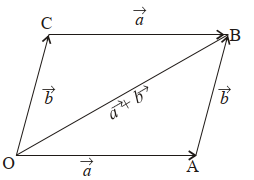
(i) Permutation rule of vector combination : If vectors $\vec{a}$ and $\vec{b}$ are two vectors then, $\vec{a}+\vec{b}=\vec{b}+\vec{a}$ Proof : Let $\vec{a}$ and $\vec{b}$ are denoted by $\overrightarrow{ OA }$ and $\overrightarrow{ OB }$ respectively. Hence, $\overrightarrow{ OA }=\vec{a}$ and $\overrightarrow{ AB }=\vec{b}$ By vector addition rule of triangle, $\begin{array}{l} \overrightarrow{OB}=\overrightarrow{OA}+\overrightarrow{AB} \\ \overrightarrow{OB}=\vec{a}+\vec{b} \ldots(1) \end{array}$
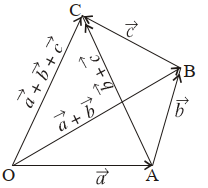
The parallelogram completes OABC whose two adjacent sides are $O A$ and $A B$ :$ \begin{array}{l} \overrightarrow{CD}=\overrightarrow{OA}=\vec{a} \\ \overrightarrow{OC}=\overrightarrow{AB}=\vec{b} \end{array}$ Again, by triangle law of vector addition $\begin{array}{l} \overrightarrow{OB}=\overrightarrow{OC}+\overrightarrow{CB}=\vec{b}+\vec{a} \\ \overrightarrow{OB}=\vec{b}+\vec{a} \ \ldots(2) \end{array}$ From equations (1) and (2) $\vec{a}+\vec{b}=\vec{b}+\vec{a}$So, this proves the rule. (ii) Associative rule in vector addition : If $\vec{a}, \vec{b}$ and $\vec{c}$ are three vectors. Then, $(\vec{a}+\vec{b})+\vec{c}=\vec{a}+(\vec{b}+\vec{c})$ Proof : Three vectors $\vec{a}, \vec{b}$ and $\vec{c}$ are represented by $\overrightarrow{ OA }, \overrightarrow{ AB }$ and $\overrightarrow{ BC }$ respectively. Hence, $\overrightarrow{ OA }=\vec{a}, \overrightarrow{ AB }=\vec{b}, \overrightarrow{ BC }=\vec{c}$ By applying triangle law of vector addition in $\triangle OAB$ and $\triangle OBC , \overrightarrow{ OB }=\overrightarrow{ OA }+\overrightarrow{ AB }$ $\begin{array}{l} \overrightarrow{OB}=\vec{a}+\vec{b} \\ \overrightarrow{OC}=\overrightarrow{OB}+\overrightarrow{BC} \end{array}$$=(\vec{a}+\vec{b})+\vec{c} \ \ldots(1)$ In $\triangle ABC$ and $\triangle OAC$, we get $\begin{aligned} \overrightarrow{AC} & =\overrightarrow{AB}+\overrightarrow{BC}=\vec{b}+\vec{c} \\ \overrightarrow{OC} & =\overrightarrow{OA}+\overrightarrow{AC} \\ & =\vec{a}+(\vec{b}+\vec{c}) \ \ldots(2) \end{aligned}$ From equations (1) and (2) $(\vec{a}+\vec{b})+\vec{c}=\vec{a}+(\vec{b}+\vec{c})$
Need a full question paper?
Generate a complete, print-ready paper with questions like this in minutes — across 16+ boards, with answer keys.