Question
In what ratio does the point $(1,3)$ divide line segment joining the points $(3,6)$ and $(-5,-6)$ ?

Answer

Get the step-by-step solution for this question inside the Vidyadip app.

Get the answer in the app

Need a full question paper?

Generate a complete, print-ready paper with questions like this in minutes — across 16+ boards, with answer keys.
Start Generating Free

Similar questions

Name the quadrilateral formed, if any, by the following points, and given reason for your answers:
A(-1, -2), B(1, 0), C(-1, 2), D(-3, 0).
Find the coordinate of the point equidistant from three given points $A(5, 3), B(5, -5)$ and $C(1, -5).$
Taking $\theta=30^{\circ}$ to verify the following Trigonometric identities :
(i) $\sin^{2}\theta+\cos^{2}\theta=1$
(ii) $1+\tan^{2}\theta=\sec^{2}\theta$
(iii) $1+\cot^{2}\theta=\csc^{2}\theta$.
Find the eighteenth term of the A.P. 1, 7, 13, 19.
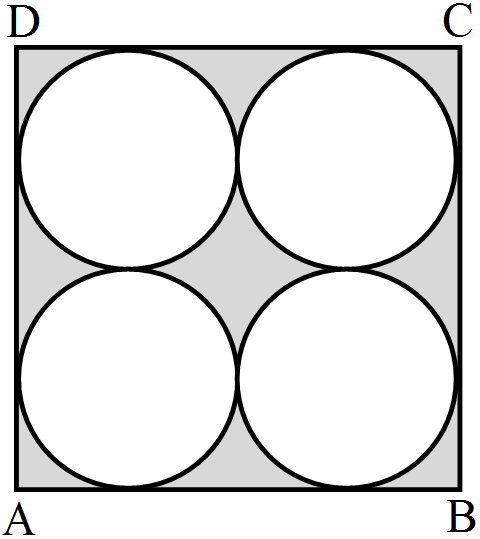
In the given figure, find the area of the shaded region, where ABCD is a square of side $14\ cm$ and all circles are of the same diameter.

Show that the following sets of points are collinear.
(2, 5), (4, 6) and (8, 8).
A card is drawn at random from a pack of well-shuffled 52 playing cards. Complete the following activity to find the probability that the card drawn is
(i) an ace(Event A)(ii) a spade (Event B).
S is the sample space.
$\therefore n(S)=52$
(i) Event A: The card drawn is an ace.
$\therefore n(A)$ = ⬜
$P(A)$ = ⬜$\quad$$\quad$...(Formula)
$\therefore P(A)=\frac{⬜}{52}$$\quad$$\quad$$\therefore P(A)=\frac{⬜}{13}$
(ii) Event B: The card drawn is a spade.
$\therefore n(B)$ = ⬜
$P(B)=\frac{n(B)}{n(S)}$
$\therefore P(B)=\frac{⬜}{4}$
Find the area of minor segment of a circle of radius 6 cm when its chord subtends an angle of 60° at its centre. $(\sqrt{3}=1.73)$
An army contingent of 616 members is to march behind an army band of 32 members in a parade. The two groups are to march in the same number of columns. What is the maximum number of columns in which they can march?
A hollow sphere of internal and external radii $2\ cm$ and $4cm$ respectively is melted into a cone of base radius $4\ cm$. Find the height and slant height of the cone.