Question
  1. In what way is diffraction from each slit related to the interference pattern in a double slit experiment?
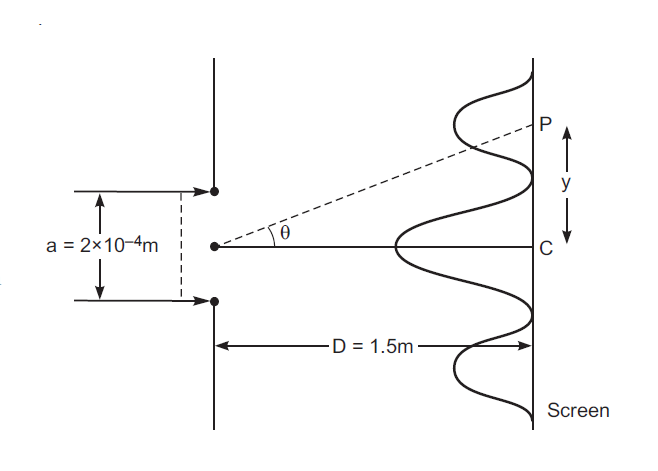
  2. Two wavelengths of sodium light $590\ nm$ and $596\ nm$ are used, in turn, to study the diffraction taking place at a single slit of aperture $2 \times 10^{–4} m$. The distance between the slit and the screen is $1.5 \ m$. Calculate the separation between the positions of the first maxima of the diffraction pattern obtained in the two cases.
Answer

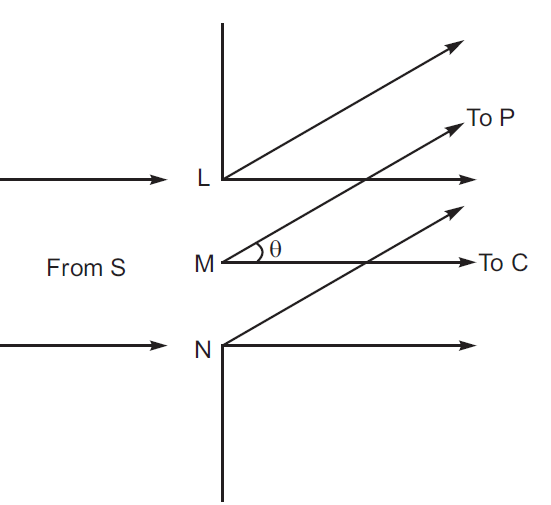
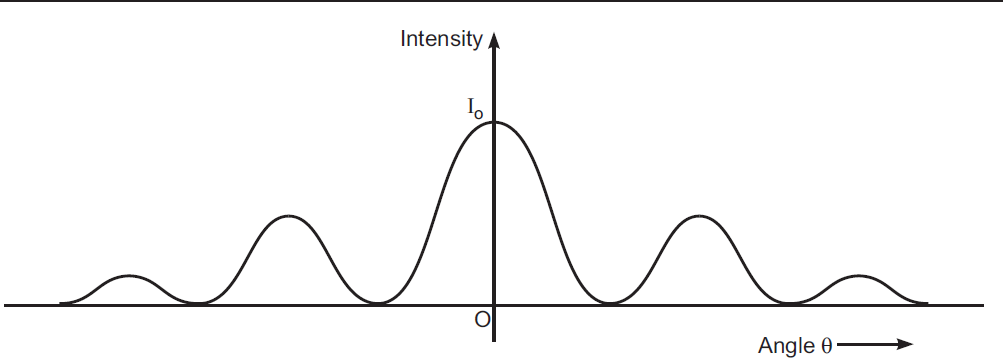
  1. When a plane wavefront of monochromatic light illuminates, the slit $LN,$ each point in the slit $LN$ becomes the source of secondary wavelets. The secondary wavelets originating from different points superpose on each, while travelling towards the point $C$ and point $P;$ at angle$\theta$. However the superposition of the secondary wavelets produces a diffraction pattern of varying intensity, as shown in fig.

  1. For maxima other than central maxima
$\theta = \bigg(\text{n} + \frac{1}{2}\bigg)\lambda$
and $\theta = \frac{\text{y}}{\text{D}}$
$\therefore\text{a}.\frac{\text{y}}{\text{D}} = \bigg(\text{n} + \frac{1}{2}\bigg)\lambda$

For light of wavelength $\lambda_{1}= 590 \ nm$
$2 \times10^{-14}\times\frac{\text{y}_{1}}{1.5} =\big(1+ \frac{1}{2}\big)\times590$
$\text{y}_{1} = \frac{3}{2}\times\frac{590\times10^{-9}\times1.5}{2\times10^{-4}}$
$= 6.64 \ mm$
For light of wavelength $\lambda_{2}=596 \ mm$
$2 \times10^{-4}\times\frac{\text{y}_{2}}{1.5} =\big(1+ \frac{1}{2}\big)\times596\text{ nm}$
$\Rightarrow\text{y}_{2} =\frac{3}{2}\times\frac{596\times10^{-9}\times1.5}{2\times10^{-4}}$
$= 6.705\ mm$
Separation between two positions of first maxima
$\Delta\text{y} = \text{y}_{2} - \text{y}_{1}$
$= 6.705 – 6.64$
$= 0.065\ mm.$

Need a full question paper?

Generate a complete, print-ready paper with questions like this in minutes — across 16+ boards, with answer keys.

Start Generating Free

Similar questions

Suppose the rod in the previous problem has a mass of $1\ kg$ distributed uniformly over its length:
  1. Find the initial angular acceleration of the rod.
  2. Find the tension in the supports to the blocks of mass $2\ kg$ and $5\ kg.$
(i) If $f=0.5 m$ for a glass lens, what is the power of the lens? (ii) The radii of curvature of the faces of a double convex lens are $10 cm$ and $15 cm$. Its focal length is $12 cm$. What is the refractive index of glass? (iii) A convex lens has $20 cm$ focal length in air. What is focal length in water? (Refractive index of air-water $=1.33$, refractive index for air-glass $=1.5$.)
State the Lenz's law regarding electromagnetic induction. This law is based on the conservation law of which quantity?
A horizontal conducting wire of length 2 m oriented in east-west direction is falling down with a speed of 5 m/s perpendicular to the horizontal component of earth's magnetic field of $0.3 \times 10^{-4} T.$ Calculate the instantaneous value of induced emf across the ends of the wire.
An electron and photon have same energy $100eV.$ Which has greater associated wavelength?
Radiation from hydrogen discharge tube falls on a cesium plate. Find the maximum possible kinetic energy of the photoelectrons. Work function of cesium is 1.9eV.
  1. State Bohr’s postulate to define stable orbits in hydrogen atom. How does de Broglie’s hypothesis explain the stability of these orbits?
  2. A hydrogen atom initially in the ground state absorbs a photon which excites it to the $n = 4$ level. Estimate the frequency of the photon.
$i.$ Draw a plot showing the variation of photoelectric current with collector potential for different frequencies but same intensity of incident radiation.
$ii.$ Use Einstein’s photoelectric equation to explain the observations from this graph.
$iii.$ What change will you observe if intensity of incident radiation is changed but the frequency remains the same?
Draw a graph showing change of alternating current with frequency in LCR series resonant circuit and obtain expression for bandwidth.
The stopping potential in a photoelectric experiment is linearly related to the inverse of the wavelength $\Big(\frac{1}{\lambda}\Big)$ of the light falling on the cathode. The potential difference applied across an $X-$ray tube is linearly related to the inverse of the cutoff wavelength $\Big(\frac{1}{\lambda}\Big)$ of the $X-$ray emitted. Show that the slopes of the lines in the two cases are equal and find its value.
A point charge of $2.0 \mu C$ is at centre of a cubic Gaussian surface 9.0 cm on edge. What is the net electric flux through the surface?