Question
An electron and photon have same energy $100eV.$ Which has greater associated wavelength?

Answer

De$-$Broglie wavelength associated with electron, $\lambda_\text{e}=\frac{\text{h}}{\sqrt{2\text{mE}_\text{e}}}\Rightarrow\ \text{E}_\text{}e=\frac{\text{h}^2}{2\text{m}\lambda^2_\text{e}}\dots(\text{i})$
Also wavelength of photon of energy $E_{ph}$ is,$\text{E}_\text{ph}=\frac{\text{hc}}{\lambda_{\text{ph}}}\Rightarrow\ \text{E}^2_{\text{ph}}=\frac{\text{h}^2\text{c}^2}{\lambda^2_\text{ph}}\dots(\text{ii})$
Given $E_e = E_{ph} = E ($say$) = 100eV$
Dividing $(ii)$ by $(i)$ and using $(iii),$
we get $\text{E}=\frac{\frac{\text{h}^2\text{c}^2}{\lambda^2_\text{ph}}}{\frac{\text{h}^2}{2\text{m}\lambda^2_\text{e}}}$ or $\text{E}=\frac{2\text{mc}^2\lambda^2_\text{e}}{\lambda^2_{\text{ph}}}$
$\therefore\ \frac{\lambda_\text{e}}{\lambda_{\text{ph}}}=\sqrt{\frac{\text{E}}{2\text{mc}^2}}$ As $\text{E}=100\text{eV } 2\text{mc}^2\cong1\text{MeV}$
$\therefore\ \text{E}<<2\text{mc}^2\Rightarrow\ \lambda_\text{e}<\lambda_\text{ph}$ That is, wavelength associated with photon is greater as compared to electron of same energy.

Need a full question paper?

Generate a complete, print-ready paper with questions like this in minutes — across 16+ boards, with answer keys.
Start Generating Free

Similar questions

The maximum tension in the string of an oscillating pendulum is double of the minimum tension. Find the angular amplitude.
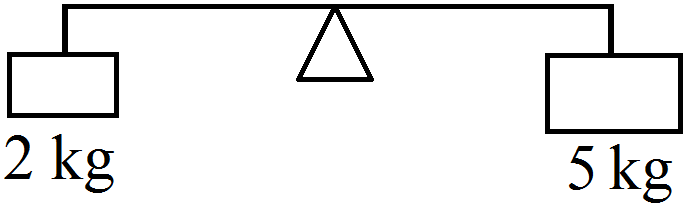
A light rod of length 1m is pivoted at its centre and two masses of 5kg and 2kg are hung from the ends as shown in figure. Find the initial angular acceleration of the rod assuming that it was horizontal in the beginning.
Three capacitors of capacitances $2 pF, 3 pF$ and $4 pF$ are connected in parallel.
  1. What is the total capacitance of the combination?
  2. Determine the charge on each capacitor if the combination is connected to a $100 V$ supply.
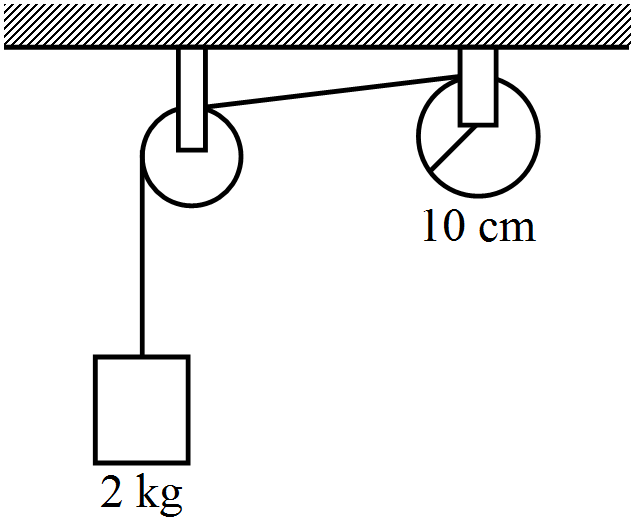
A string is wrapped on a wheel of moment of inertia $0.20\ kg-m^2$ and radius $10\ cm$ and goes through a light pulley to support a block of mass $2.0\ kg$ as shown in figure. Find the acceleration of the block.
The intensity of sound from a point source is $1.0 \times 10^{-6}W/m^2$ at a distance of $5.0m$ from the source. What will be the intensity at a distance of $25m$ from the source?
A charged metallic sphere A is suspended by a nylon thread. Another charged metallic sphere B held by an insulating
Image
handle is brought close to A such that the distance between their centres is 10 cm, as shown in Fig. 1.4(a). The resulting repulsion of A is noted (for example, by shining a beam of light and measuring the deflection of its shadow on a screen). Spheres A and B are touched by uncharged spheres C and D respectively, as shown in Fig. 1.4(b). C and D are then removed and B is brought closer to A to a distance of 5.0 cm between their centres, as shown in Fig. 1.4(c). What is the expected repulsion of A on the basis of Coulomb’s law? Spheres A and C and spheres B and D have identical sizes. Ignore the sizes of A and B in comparison to the separation between their centres.
Suppose, one wishes to construct a 1.0 farad capacitor using circular discs. If the separation between the discs be kept at 1.0mm, what would be the radius of the discs?
In a common emitter mode of a transistor, the d.c. current gain is 20, the emitter current is 7mA. Calculate (i) base current and (ii) collector current.
A hydrogen atom in state n = 6 makes two successive transitions and reaches the ground state. In the first transition a photon of 1.13eV is emitted. (a) Find the energy of the photon emitted in the second transition (b) What is the value of n in the intermediate state?
The spectrum of a star in the visible and the ultraviolet region was observed and the wavelength of some of the lines that could be identified were found to be:
$824\mathring{\text{A}},970\mathring{\text{A}},1120\mathring{\text{A}},2504\mathring{\text{A}},5173\mathring{\text{A}},6100\mathring{\text{A}}$
Which of these lines cannot belong to hydrogen atom spectrum? $($Given Rydberg constant $\text{R}=1.03\times10^7\text{m}^{-1}$ and $\frac{1}{\text{R}}=970\mathring{\text{A}})$ Support your answer with suitable calculations.