MCQ
In which case does the potential energy decrease?
  • A
    On compressing the spring.
  • B
    On stretching a spring.
  • C
    On moving a body against gravitational pull.
  • On the raising of an air bubble in water.

Answer

Correct option: D.
On the raising of an air bubble in water.
$P.E.$ decreases when an air bubble rises in water. Because work is done by upthrust.

Need a full question paper?

Generate a complete, print-ready paper with questions like this in minutes — across 16+ boards, with answer keys.

Start Generating Free

Similar questions

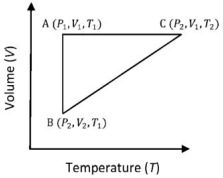
A reversible cyclic process for an ideal gas is shown below. Here, $P , V$, and $T$ are pressure, volume and temperature, respectively. The thermodynamic parameters $q, w, H$ and $U$ are heat, work, enthalpy and internal energy, respectively.

The correct option ($s$) is (are)

$(A)$ $q_{A C}=\Delta U_{B C}$ and $W_{A B}=P_2\left(V_2-V_1\right)$ $(B)$ $W _{ BC }= P _2\left( V _2- V _1\right)$ and $q _{ BC }= H _{ AC }$ $(C)$ $\Delta H _{ CA }<\Delta U _{ CA }$ and $q _{ AC }=\Delta U _{ BC }$ $(D)$ $q_{B C}=\Delta H_{A C}$ and $\Delta H_{C A}>\Delta U_{C A}$
The adiabatic elasticity of hydrogen gas $(\gamma = 1.4)$ at $NTP$ is
If the acceleration due to gravity at earth is $'g\ '$ and mass of earth is $80$ times that of moon and radius of earth is $4$ times that of moon, the value of $'g\ '$ at the surface of moon will be:
A block of wood floats in water with $\frac{4}{5}$ th of its volume submerged, but it just floats in another liquid. The density of liquid is (in $kg / m ^3$ )
A motor car blowing a horn of frequency $124\,vib/sec$ moves with a velocity $72\, km/hr$ towards a tall wall. The frequency of the reflected sound heard by the driver will be .... $vib/sec$ (velocity of sound in air is $330\, m/s$)
A small toy starts moving from the position of rest under a constant acceleration. If it travels a distance of $10 \,m$ in $t \;s ,$ the distance travelled by the toy in the next $t s$ will be .........$m$
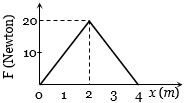
The graph between the resistive force $ F$ acting on a body and the distance covered by the body is shown in the figure. The mass of the body is $25\, kg$ and initial velocity is $2\, m/s$. When the distance covered by the body is $4m$, its kinetic energy would be .............. $\mathrm{J}$
A particle starts from origin at $t = 0$ with a velocity $5.0\hat{\text{i}}\text{ ms}^{-1}$ and moves in $XY-$plane under action of force which produces a constant acceleration of $(3.0\hat{\text{i}}+2.0\hat{\text{j}})\text{ ms}^{-2}.$ What is the $y-$coordinate of the particle at the instant when its $x-$coordinate is $84m?$
$A$ boy hits $a$ baseball with $a$ bat and imparts an impulse $J$ to the ball. The boy hits the ball again with the same force, except that the ball and the bat are in contact for twice the amount of time as in the first hit. The new impulse equals:
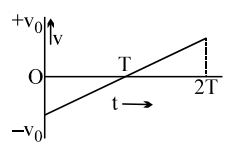
The figure shows the velocity $(v)$ of a particle plotted against time $(t)$