MCQ
In which case there is maximum extension in the wire, if same force is applied on each wire
  • A
    $L = 500\, cm, d = 0.05\, mm$
  • B
    $L = 200 \,cm, d = 0.02 \,mm$
  • C
    $L = 300 \,cm, d = 0.03 \,mm$
  • $L = 400\, cm, d = 0.01\, mm$

Answer

Correct option: D.
$L = 400\, cm, d = 0.01\, mm$
d
(d) $l \propto \frac{L}{{{r^2}}}$                   $(Y$ and $F$ are constant$)$

Maximum extension takes place in that wire for which the ratio of $\frac{L}{{{r^2}}}$ will be maximum.

Need a full question paper?

Generate a complete, print-ready paper with questions like this in minutes — across 16+ boards, with answer keys.
Start Generating Free

Similar questions

A body is performing simple harmonic with an amplitude of $10 \,cm$. The velocity of the body was tripled by air Jet when it is at $5 \,cm$ from its mean position. The new amplitude of vibration is $\sqrt{ x } \,cm$. The value of $x$ is________
If 150J of heat is added to a system and the work done by the system is 110J, then change in internal energy will be:
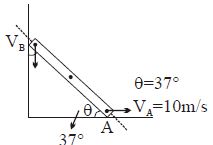
Find $V_B = ?$
A rod elongates by l when a body of mass M is suspended from it. The work done is:
A force $F$ is needed to break a copper wire having radius $R.$ The force needed to break a copper wire of radius $2R$ will be
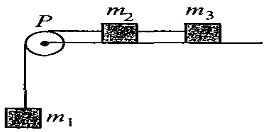
A system consists of three masses $m_1 , m_2$ and $m_3$ connected by a string passing over a pulley $P.$ The mass $m_1$ hangs freely and $m_2$ and $m_3$ are on a rough horizontal table (the coefficient of friction $= \mu ).$ The pulley is frictionless and of negligible mass. The downward acceleration of mass $m_1$ is $(Assume\, m = m_2 = m_3 = m)$ 
When forces F1, F2, F3 are acting on a particle of mass m such that F2 and F2 are mutually perpendicular, then the particle remain stationary. If the force F1 is now removed, then the acceleration of the particle is:
Young's moduli of the material of wires $A$ and $B$ are in the ratio of $1: 4$, while its area of cross sections are in the ratio of $1: 3$. If the same amount of load is applied to both the wires, the amount of elongation produced in the wires $A$ and $B$ will be in the ratio of

[Assume length of wires $A$ and $B$ are same]

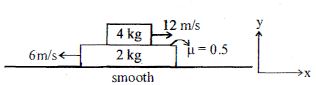
The blocks are given velocity in the direction shown in figure. Co-efficient of friction between two blocks shown in figure is $μ = 0.5$. Take $g = 10\  m/s^2$

(considering $4\ kg$ block doesn't fall on ground)

Consider the following statements

$(i)$  Time when relative motion between them is stopped is $1.4\  second$.

$(ii)$  Time when relative motion between them is stopped in $1.2\  second$

$(iii)$  The common velocity of the two blocks is $8\  m/s$, towards right.

$(iv)$  The displacement of the $4\, kg$ block when relative motion stopped is$10.8\  m$.

Which of the fstatements is/are correct
The ratio of frequencies of two pendulums oscillating are 2 : 3, then their lengths are in ratio: