MCQ
In which of the following decays the element does not change?
  • A
    $\alpha-\text{decay}$
  • B
    $\beta^+-\text{decay}$
  • C
    $\beta^--\text{decay}$
  • $\gamma-\text{decay}$

Answer

Correct option: D.
$\gamma-\text{decay}$

In alpha particle decay, the unstable nucleus emits an alpha particle reducing its proton number $Z$ by $4$ and neutron number $N$ by $2$ such that the element gets changed.
$\text{ }^{\text{A}}_{\text{Z}}\text{X}\rightarrow\text{ }^{\text{A}-4}_{\text{Z}-2}\text{Y}+\text{ }^4_2\text{He}$
During $\beta^--\text{decay},$ a neutron is converted to a proton​, an electron and an antineutrino, i.e. an active nucleus gets converted to one of its isobars and hence the element gets changed.
$\text{ }^{\text{A}}_{\text{Z}}\text{X}\rightarrow\text{ }^{\text{A}}_{\text{Z}+1}\text{Y}+\text{e}+\bar{\text{v}}$
During $\beta^+-\text{decay},$ a proton in the nucleus is converted to a neutron​, a positron and a neutrino in order to maintain the stability of the nucleus, i.e. an active nucleus gets converted to one of its isobars and hence the element gets changed.
$\text{ }^{\text{A}}_{\text{Z}}\text{X}\rightarrow\text{ }^{\text{A}}_{\text{Z}-1}\text{Y}+\beta^++\text{v}$
When a nucleus is in higher excited state or has excess of energy, it comes to the ground state in order to become stable and release energy in the form of electromagnetic radiation called gamma ray. Hence, the element in gamma decay doesn't change.

Need a full question paper?

Generate a complete, print-ready paper with questions like this in minutes — across 16+ boards, with answer keys.
Start Generating Free

Similar questions

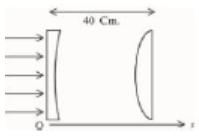
As shown in the figure, a combination of a thin plano concave lens and a thin plano convex lens is used to image an object placed at infinity. The radius of curvature of both the lenses is $30\,cm$ and refraction index of the material for both the lenses is $1.75$. Both the lenses are placed at distance of $40\,cm$ from each other. Due to the combination, the image of the object is formed at distance $x =..........cm$, from concave lens.
An object has image thrice of its original size when kept at 8 cm and 16 cm from a convex lens. Focal length of the lens is
The phenomenon of radioactivity is
The SI unit of surface charge density is:
The impedance of a series $\text{L - C - R}$ circuit in an $AC$ circuit is.
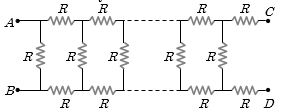
In the figure, the value of resistors to be connected between $C$ and $D$ so that the resistance of the entire circuit between $A$ and $B$ does not change with the number of elementary sets used is
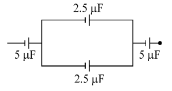
Equivalence in the following circuit is:
Image
In an amplitude modulated wave for audio frequency of 500 cycle/second, the appropriate carrier frequency will be
Which of the following pairs has quantities of the same dimensions?
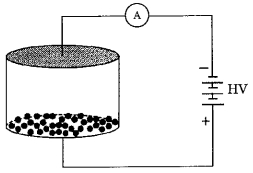
Consider an evacuated cylindrical chamber of height $h$ having rigid conducting plates at the ends and an insulating curved surface as shown in the figure. A number of spherical balls made of a light weight and soft material and coated with a conducting material are placed on the bottom plate. The balls have a radius $r \ll h$. Now a high voltage source ($HV$) is connected across the conducting plates such that the bottom plate is at $+V_0$ and the top plate at $-V_0$. Due to their conducting surface, the balls will get charged, will become equipotential with the plate and are repelled by it. The balls will eventually collide with the top plate, where the coefficient of restitution can be taken to be zero due to the soft nature of the material of the balls. The electric field in the chamber can be considered to be that of a parallel plate capacitor. Assume that there are no collisions between the balls and the interaction between them is negligible. (Ignore gravity)

(image)

($1$) Which one of the following statements is correct?

($A$) The balls will stick to the top plate and remain there

($B$) The balls will bounce back to the bottom plate carrying the same charge they went up with

($C$) The balls will bounce back to the bottom plate carrying the opposite charge they went up with

($D$) The balls will execute simple harmonic motion between the two plates

($2$) The average current in the steady state registered by the ammeter in the circuit will be

($A$) zero

($B$) proportional to the potential $V_0$

($C$) proportional to $V_0^{1 / 2}$

($D$) proportional to $V_0^2$

Give the answer quetion ($1$) and ($2$)