Question
In which of the following transitions will the wavelength be minimum?

Answer

  1. n = 2 to n = 1
Explanation:
For the transition in the hydrogen-like atom, the wavelength of the emitted radiation is calculated by,
$\frac{1}{\lambda}=\text{RZ}^2\Big(\frac{1}{\text{n}_1}-\frac{1}{\text{n}_2}\Big)$
Here, R is the Rydberg constant.
For the transition from n = 5 to n = 4, the wavelength is given by,
$\frac{1}{\lambda}=\text{RZ}^2\Big(\frac{1}{4^2}-\frac{1}{5^2}\Big)$
$\lambda=\frac{400}{9\text{RZ}^2}$
For the transition from n = 4 to n = 3, the wavelength is given by,
$\frac{1}{\lambda}=\text{RZ}^2\Big(\frac{1}{3^2}-\frac{1}{4^2}\Big)$
$\lambda=\frac{144}{7\text{RZ}^2}$
For the transition from n = 3 to n = 2, the wavelength is given by,
$\frac{1}{\lambda}=\text{RZ}^2\Big(\frac{1}{2^2}-\frac{1}{3^2}\Big)$
$\lambda=\frac{36}{5\text{RZ}^2}$
For the transition form n = 2 to n = 1, the wavelength is given by,
$\frac{1}{\lambda}=\text{RZ}^2\Big(\frac{1}{1^2}-\frac{1}{2^2}\Big)$
$\lambda=\frac{2}{\text{RZ}^2}$
From the above calculations, it can be observed that the wavelength of the radiation emitted for the transition from n = 2 to n = 1 will be minimum.

Need a full question paper?

Generate a complete, print-ready paper with questions like this in minutes — across 16+ boards, with answer keys.
Start Generating Free

Similar questions

X-rays are :
The equivalent resistance of resistors connected in series is always (a) Equal to the mean of component resistors(b) Less than the lowest of component resistors(c) In between the lowest and the highest of component resistors(d) Equal to sum of component resistors


An optically active compound (a) Rotates the plane polarised light(b) Changing the direction of polarised light (c) Do not allow plane polarised light to pass through(d) None of the above


A proton of mass m and charge +e is moving in a circular orbit in a magnetic field with energy 1 MeV. What should be the energy of α -  particle (mass = 4m and charge = + 2e), so that it can revolve in the path of same radius(a) 1 MeV(b) 4 MeV(c) 2 MeV(d) 0.5 MeV
       
A biconvex lens of focal length f is cut into two identical plano convex lenses. The focal length of each part will be
For a colour of light the wavelength for air is $6000 \mathring A$ and in water the wavelength is $4500 \mathring A .$ Then the speed of light in water will be
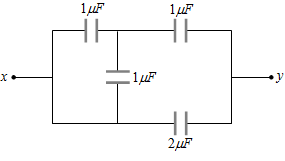
Four capacitors are connected as shown in the figure. Their capacities are indicated in the figure. The effective capacitance between points $x$  and $y$  is $($in $μF)$
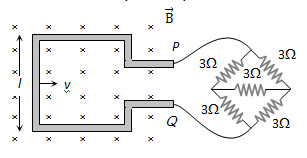
A square metallic wire loop of side $0.1 m$ and resistance of $1 \Omega$ is moved with a constant velocity in a magnetic field of $2 \ \mathrm{wb} / \mathrm{m}^2$ as shown in figure. The magnetic field is perpendicular to the plane of the loop, loop is connected to a network of resistances. What should be the velocity of loop so as to have a steady current of $1 \ mA$ in loop
The temperature coefficient of resistance for a wire is 0.00125/℃. At 300K its resistance is 1 ohm. The temperature at which the resistance becomes 2 ohm is(a) 1154 K(b) 1100 K(c) 1400 K(d) 1127 K
       
A solid sphere falls with a terminal velocity of 20m/s in air. If it is allowed to fall in vacuum,
  1. Terminal velocity will be 20m/s
  2. Terminal velocity will be less than 20m/s
  3. Terminal velocity will be more than 20m/s
  4. There will be no terminal velocity.