MCQ
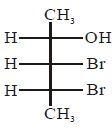
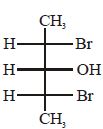
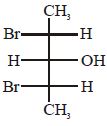
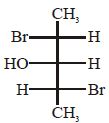
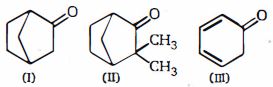
In which structure central carbon ($C-3$) not chiral centre ?
  • A

  • B

  • C


Answer

Correct option: D.

d

Need a full question paper?

Generate a complete, print-ready paper with questions like this in minutes — across 16+ boards, with answer keys.

Start Generating Free

Similar questions

The incorrect statements regarding geometrical isomerism are :
(A) Propene shows geometrical isomerism.
(B) Trans isomer has identical atoms/groups on the opposite sides of the double bond.
(C) Cis-but-2-ene has higher dipole moment than trans-but-2-ene.
(D) 2-methylbut-2-ene shows two geometrical isomers.
(E) Trans-isomer has lower melting point that cis isomer.
Choose the CORRECT answer from the options given below :
Which of the following is a buffer solution ?
Which of following does not react with $NaHSO_3$ (sodium bisulphite)?
Thermochemical reactions $C({\rm{graphite}}) + \frac{1}{2}{O_2}(g) \to CO(g);\,\Delta H = - 110.5\,kJ$ $CO(g) + \frac{1}{2}{O_2}(g) \to C{O_2}(g);\,\Delta H = - 283.2\,kJ$ From the above reaction, the heat of reaction for $C({\rm{graphite}}) + {O_2}(g) \to C{O_2}(g)$ will be ........$kJ$
$AlF_3$ is soluble in $HF$ only in presence of $KF.$ It is due to the formation of
Among the given ketones, the one which does not enolize is
Product $(B)$ is
Which of the following statement($s$) is(are) true ?

$(1)$ Oxidation of glucose with bromine water gives glutamic acid

$(2)$ The two six-membered cyclic hemiacetal forms of $D-(+)$-glucose ard called anomers

$(3)$ Hydrolysis of sucrose gives dextrorotatory glucose and laevorotatory fructose

$(4)$ Monosaccharides cannot be hydrolysed to give polyhydroxy aldehydes and ketones

What would be the effect of increasing solvent polarity on the rate of each of the  following reactions ? ($Nu =$ neutral nucleophile)

$\begin{align}
    (A)\,Nu+R-L\to \overset{\oplus }{\mathop{Nu}}\,-R+{{L}^{-}} \\ 
  (B)\,R-{{L}^{\oplus }}\to {{R}^{\oplus }}+:L \\ 
\end{align}$

Chlorobenzene when condensed with chloral in the presence of conc. $H_2SO_4$ yields