MCQ
In $Xe{F_2}$ hybridisation of $Xe$ is
  • A
    $s{p^2}$
  • $s{p^3}d$
  • C
    $s{p^3}$
  • D
    $s{p^3}{d^2}$

Answer

Correct option: B.
$s{p^3}d$
b
$Xe$ has $3$ lone pairs and it forms $2 Xe - F$ bonds.

Hybridisation of a atom with $3$ lone pairs and $2$ bond pairs is $sp ^3 d ^2$.

So, the hybridisation of $Xe$ is $sp ^3 d$.

Need a full question paper?

Generate a complete, print-ready paper with questions like this in minutes — across 16+ boards, with answer keys.

Start Generating Free

Similar questions

On adding water to $BiC{l_3}$ solution in $HCl$, the compound produced is
The relative reactivity of $1\,^oH, 2\,^oH$ and $3\,^oH$ in bromination reaction has been found to be $1 : 82 : 1600$ respectively. In the reaction

$\begin{array}{*{20}{c}}
  {C{H_3}\,\,\,\,\,\,\,\,\,\,\,\,\,\,\,\,\,\,\,\,\,\,\,\,\,\,\,\,\,\,\,\,\,\,\,\,\,\,\,\,\,\,\,} \\ 
  {|\,\,\,\,\,\,\,\,\,\,\,\,\,\,\,\,\,\,\,\,\,\,\,\,\,\,\,\,\,\,\,\,\,\,\,\,\,\,\,\,\,\,\,\,\,\,\,\,\,} \\ 
  {C{H_3} - CH - C{H_3}(excess) + B{r_2}\xrightarrow{{hv}}} 
\end{array}$ $\mathop {\begin{array}{*{20}{c}}
  {\,\,\,\,\,C{H_3}} \\ 
  | \\ 
  {C{H_3} - C - C{H_3}} \\ 
  | \\ 
  {\,\,Br} 
\end{array}}\limits_{(A)} $   +   $\mathop {\begin{array}{*{20}{c}}
  {C{H_3}\,\,\,\,\,\,\,\,\,\,} \\ 
  {\,\,|\,\,\,\,\,\,\,\,\,\,\,\,\,\,\,\,\,\,\,} \\ 
  {C{H_3} - CH - C{H_2} - Br} 
\end{array}}\limits_{(B)} $ 

the percentage yields of the products $(A)$ and $(B)$ are expected to be
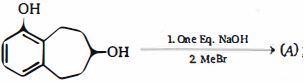
An example of near ideal solution is
During electrolysis of fused aluminium chloride $0.9\,gm$ of aluminium was deposited on the cathode. The volume of chlorine liberated at the anode will be .............. $\mathrm{litres}$
Which compound on heating produces coloured metal oxide finally?
Product $(A)$ is
The total number of possible isomers of the compound $[C{u^{} }{(N{H_3})_4}][P{t^{}} C{l_4}]$ are :
Bleaching action of $S{O_2}$ is due to
Half lives of first order and a zero order reaction are same. Assume that initial concentration of reactant is same for both reactions, then the ratio of initial rates of first order reaction to that of zero order reaction is
For the feasibility of a redox reaction in a cell, the e.m.f. should be